
We read your photo as:
What happened in the story of Joseph when his brothers returned to Egypt? What gifts did Joseph send his father?
ScanSolve AI Answer
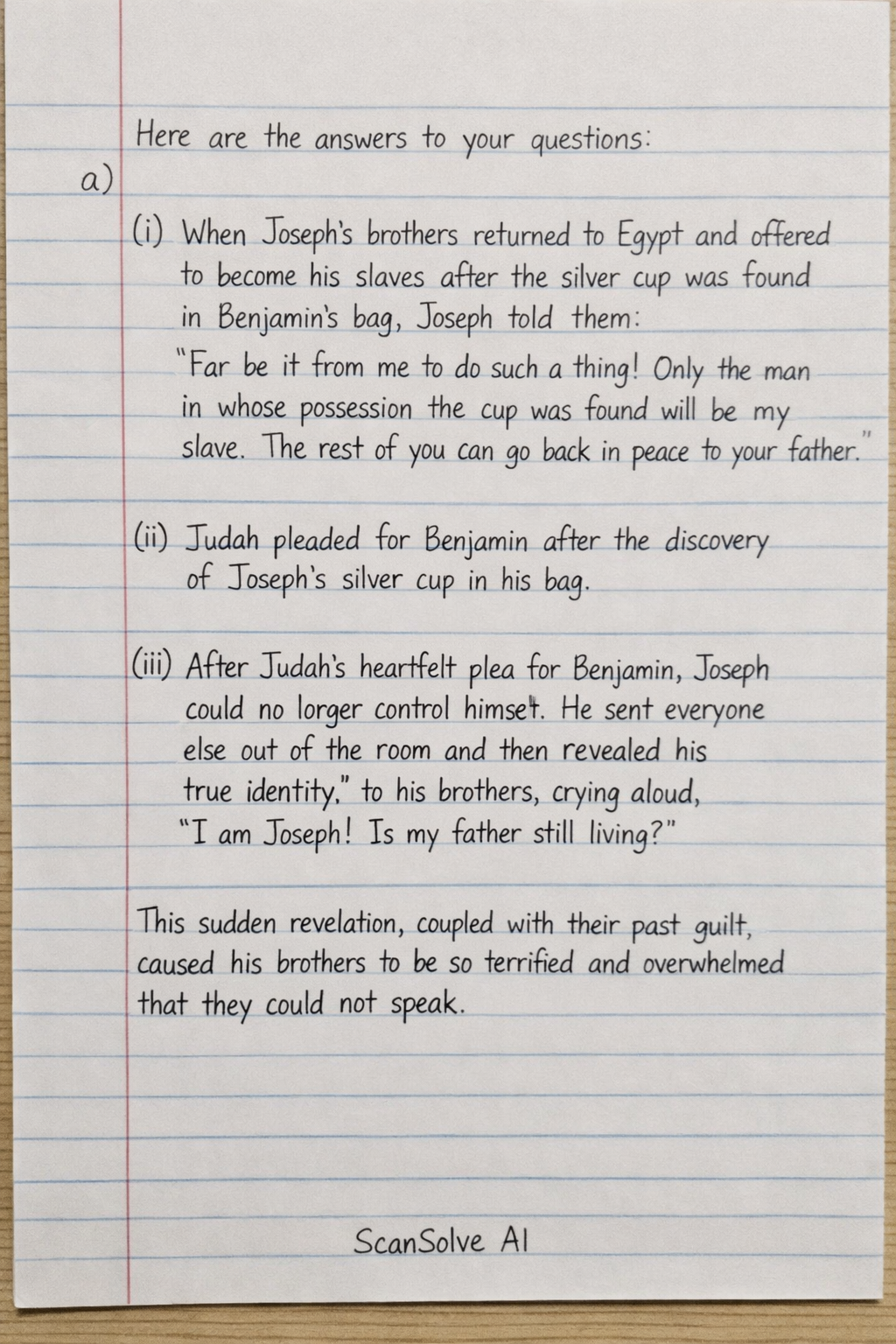
Here are the answers to your questions:
a)
(i) When Joseph's brothers returned to Egypt and offered to become his slaves after the silver cup was found in Benjamin's bag, Joseph told them: "Far be it from me to do such a thing! Only the man in whose possession the cup was found will be my slave. The rest of you can go back in peace to your father."
(ii) Judah pleaded for Benjamin after the discovery of Joseph's silver cup in his bag.
(iii) After Judah's heartfelt plea for Benjamin, Joseph could no longer control himself. He sent everyone else out of the room and then revealed his true identity to his brothers, crying aloud, "I am Joseph! Is my father still living?" This sudden revelation, coupled with their past guilt, caused his brothers to be so terrified and overwhelmed that they could not speak.
b)
(i) Joseph sent ten donkeys loaded with the best of Egyptian goods and ten female donkeys loaded with grain, bread, and provisions for his father's journey.
(ii) God told Jacob not to be afraid to go to Egypt by speaking to him in a vision at Beersheba. God assured him, saying, "I am God, the God of your father. Do not be afraid to go down to Egypt, for I will make you into a great nation there. I will go down to Egypt with you, and I will surely bring you up again, and Joseph's hand will close your eyes."
c)
(i) When the Lord made the Egyptian king stubborn after the Israelites left Egypt, the outcome was that Pharaoh changed his mind and pursued the Israelites with his entire army, including chariots and horsemen, intending to bring them back.
(ii) The Lord shielded the Israelites from the Egyptian army in two ways:
- He placed a pillar of cloud between the camp of Israel and the camp of Egypt, which brought darkness to the Egyptians but light to the Israelites, preventing the Egyptians from approaching all night.
- He parted the Red Sea, allowing the Israelites to cross on dry ground, and then caused the waters to return, drowning the entire Egyptian army as they pursued the Israelites into the sea.
(iii) Moses referred to the food the Lord had given the Israelites to eat as manna and quail.
d)
(i) Some people went out on the seventh day to gather food but found none. The command of Moses which such people disrespected was to rest on the Sabbath and not go out to gather manna on that day, having already gathered a double portion on the sixth day.
(ii) From God's Commandment not to accuse anyone falsely ("You shall not bear false witness against your neighbor"), I have learned the importance of truthfulness and integrity in all interactions. It teaches us to uphold justice, protect the reputation of others, and avoid slander, perjury, or any form of deception that could harm an innocent person.
Still stuck on this one?
Ask a follow-up, and the answer starts from this question.
More History Questions
Handwritten Step-by-Step Solution
Get this as a handwritten image on WhatsApp — like a tutor wrote it for you.
Try on WhatsApp