
We read your photo as:
Hendrik Greef was a Cape farmer who died in 1745, after which a list of all his possessions was drawn up. Next to each item is the value of that item in rixdaler. Study the table and answer questions a) to j) below for 1 mark each:
ScanSolve AI Answer
Answers
8 partsStep-by-step solution
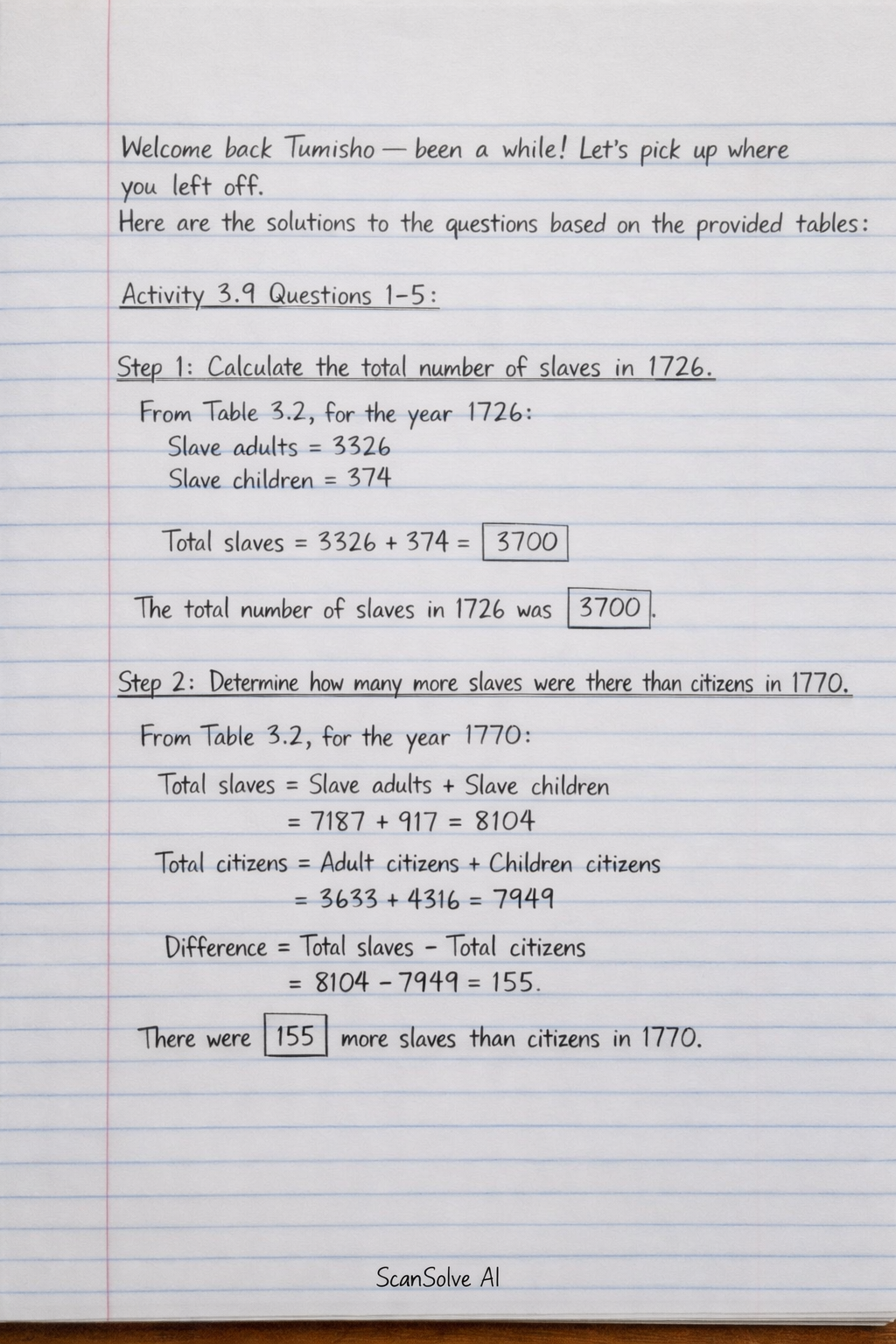
5 stepsHere are the solutions to the questions based on the provided tables:
Activity 3.9 Questions 1-5:
Calculate the total number of slaves in 1726.
From Table 3.2, for the year 1726:
Slave adults = 3326
Slave children = 374
Total slaves =
The total number of slaves in 1726 was .Determine how many more slaves were there than citizens in 1770.
From Table 3.2, for the year 1770:
Total slaves = Slave adults + Slave children =
Total citizens = Adult citizens + Children citizens =
Difference = Total slaves - Total citizens =
There were more slaves than citizens in 1770.Calculate how many more citizen children than slave children were there in 1825.
From Table 3.2, for the year 1825:
Citizen children = 27352
Slave children = 11822
Difference = Citizen children - Slave children =
There were more citizen children than slave children in 1825.Find the increase in adult slaves from 1726 to 1825.
From Table 3.2:
Adult slaves in 1825 = 21008
Adult slaves in 1726 = 3326
Increase = Adult slaves in 1825 - Adult slaves in 1726 =
The increase in adult slaves from 1726 to 1825 was .Explain why there was such an increase in slaves over 100 years.
The significant increase in slave numbers over this period was primarily due to the expansion of the colonial economy, particularly in agriculture and other labor-intensive industries. This created a high demand for forced labor, leading to increased importation and reproduction of enslaved people to meet economic needs.
Activity 3.9 Questions a-j (Hendrik Greef's possessions):
First, let's list the individual values of items in rixdaler:
- 1 bundle of rags = 5
- 1 halter =
- 1 ox-wagon =
- 1 shovel = 2
- 1 cattle =
- All slaves (male, female, boy) = 1800
a) What was the least valuable item on the list?
Comparing the individual values (2, 2.5, 4, 5, 75, 1800), the least valuable item was the .b) What was the most valuable item on the list?
The most valuable item on the list was any .c) How many of the slaves were born at the Cape?
The slaves born at the Cape are: "slave boy, Carel of the Cape", "male slave, Willem of the Cape", and "slave woman, Trijn of the Cape".
There were slaves born at the Cape.d) Work out how many slaves came from Madagascar?
The slave from Madagascar is: "male slave, Titus of Madagascar".
There was slave from Madagascar.e) How many slaves came from Bengal?
The slave from Bengal is: "male slave, Fortuin of Bengal".
There was slave from Bengal.f) Estimate how many cattle were worth the same price as one slave.
Price of one slave = 1800 rixdaler
Price of one cattle = 4 rixdaler
Number of cattle =
Approximately cattle were worth the same price as one slave.g) Calculate how many ox-wagons you would need to exchange for a slave.
Price of one slave = 1800 rixdaler
Price of one ox-wagon = 75 rixdaler
Number of ox-wagons =
You would need ox-wagons to exchange for a slave.h) What do you notice about the price of male and female slaves?
All male slaves and the slave woman (Trijn of the Cape) are listed at 1800 rixdaler. This indicates that the price of male and female slaves was in this inventory.i) Why do you think some slaves were named after months of the year?
Slaves were often named by their owners, sometimes after the month of their arrival, purchase, or birth. This practice was a way to identify and categorize them as property, often stripping them of their original identities.j) What can you conclude about how wealthy this farmer was when he died?
Hendrik Greef was a very wealthy farmer. His possessions included multiple slaves, each valued at 1800 rixdaler, along with numerous cattle and ox-wagons. Slaves were extremely valuable assets, indicating significant economic power and status.
Try one yourself
A new problem that tests the same skill.
Still stuck on this one?
Ask a follow-up, and the answer starts from this question.
More History Questions
Handwritten Step-by-Step Solution
Get this as a handwritten image on WhatsApp — like a tutor wrote it for you.
Try on WhatsApp