
We read your photo as:
Identify 7 literary forms used to write the Bible and outline the major divisions of the Old Testament with an example for each.
ScanSolve AI Answer
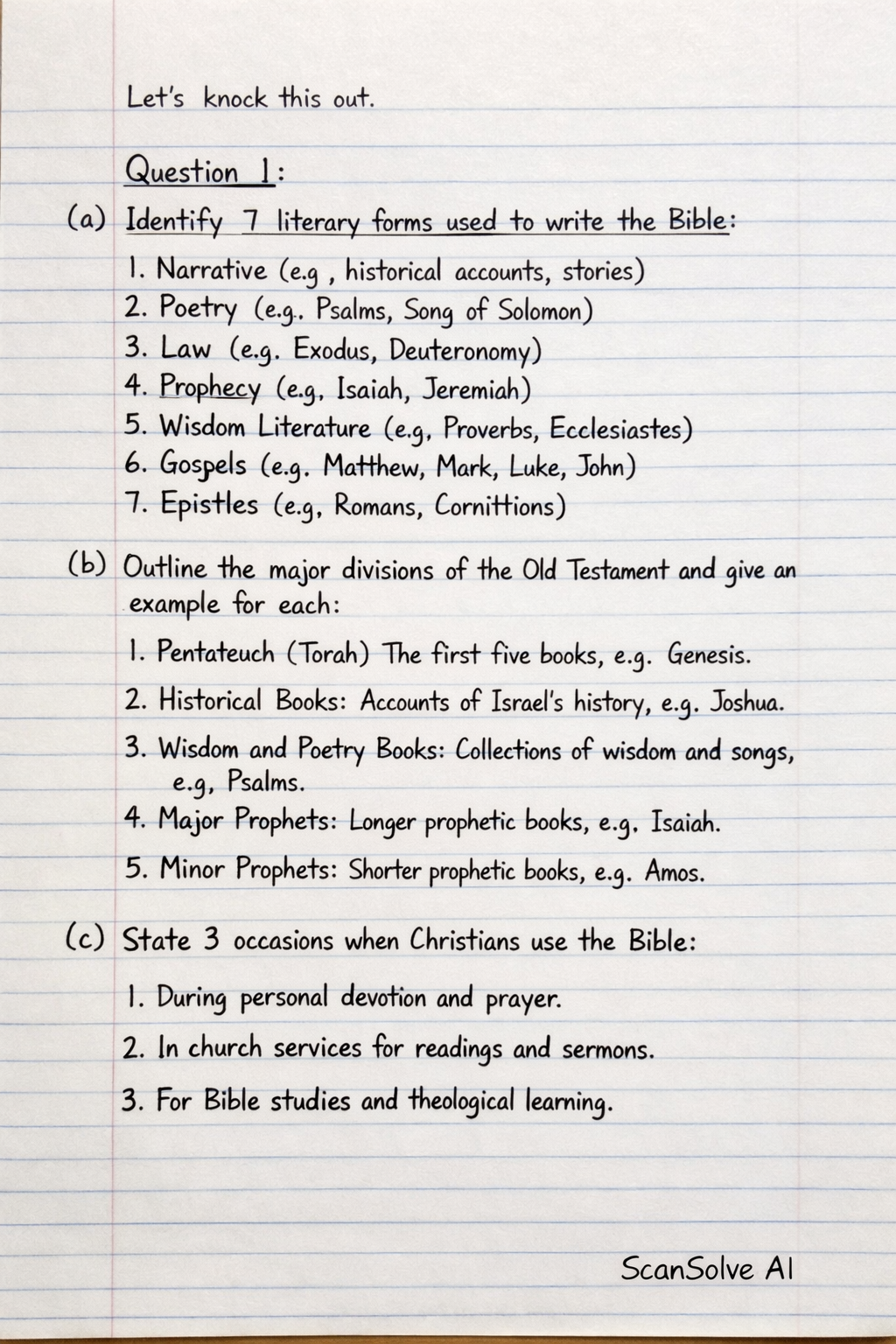
Let's knock this out.
Question 1:
a) Identify 7 literary forms used to write the Bible.
- Narrative (e.g., historical accounts, stories)
- Poetry (e.g., Psalms, Song of Solomon)
- Law (e.g., Exodus, Deuteronomy)
- Prophecy (e.g., Isaiah, Jeremiah)
- Wisdom Literature (e.g., Proverbs, Ecclesiastes)
- Gospels (e.g., Matthew, Mark, Luke, John)
- Epistles (e.g., Romans, Corinthians)
b) Outline the major divisions of the Old Testament and give an example for each.
- Pentateuch (Torah): The first five books, e.g., Genesis.
- Historical Books: Accounts of Israel's history, e.g., Joshua.
- Wisdom and Poetry Books: Collections of wisdom and songs, e.g., Psalms.
- Major Prophets: Longer prophetic books, e.g., Isaiah.
- Minor Prophets: Shorter prophetic books, e.g., Amos.
c) State 3 occasions when Christians use the Bible.
- During personal devotion and prayer.
- In church services for readings and sermons.
- For Bible studies and theological learning.
Question 2:
a) Give 4 differences between the Jewish and traditional practices of circumcision.
- Timing: Jewish circumcision is typically on the eighth day after birth, while traditional practices (e.g., African) often occur later, during adolescence.
- Religious Significance: Jewish circumcision is a covenant sign with God, while traditional practices are often a rite of passage into adulthood.
- Performer: Jewish circumcision is performed by a mohel, a trained religious practitioner, whereas traditional circumcision is often performed by community elders or traditional surgeons.
- Symbolism: Jewish circumcision symbolizes belonging to the Jewish people and covenant, while traditional practices often symbolize bravery, endurance, and readiness for marriage.
b) Identify 7 actions which show that Abraham had faith in God.
- He left his homeland (Ur of the Chaldeans and Haran) as God commanded.
- He believed God's promise of numerous descendants despite his old age and Sarah's barrenness.
- He offered Isaac as a sacrifice when God commanded him.
- He built altars to worship God wherever he settled.
- He trusted God's provision for a ram as a substitute for Isaac.
- He interceded for Sodom and Gomorrah, believing in God's justice and mercy.
- He bought a burial plot in Canaan, showing belief in God's promise of the land.
c) What teachings do Christians learn from Abraham's acts of faith?
Christians learn the importance of obedience to God's call, even when it requires leaving familiar comforts. Abraham's life teaches unwavering trust in God's promises, even when circumstances seem impossible. His willingness to sacrifice Isaac demonstrates the ultimate lesson of total surrender and faithfulness to God's will.
Question 3:
a) Give 7 reasons why Israelites demanded for a king.
- They wanted to be like other nations that had kings.
- Samuel's sons, who were judges, were corrupt and unjust.
- They desired a visible leader to guide them in battle.
- They sought a king to unite the tribes against common enemies.
- They believed a king would provide security and stability.
- They wanted a king to administer justice more effectively.
- They had lost faith in God's direct rule through judges.
b) Give reasons why Samuel was against kingship in Israel.
Samuel was against kingship because he viewed it as a rejection of God as their true King. He warned that a human king would oppress the people, take their sons for military service, confiscate their land and resources, and ultimately lead them away from God. He foresaw that a king would impose heavy taxes and forced labor, diminishing their freedom.
c) What lessons do Christians learn from Saul's failure?
Christians learn that obedience to God is paramount and more important than religious rituals or sacrifices. Saul's failure teaches that pride and disobedience lead to downfall and rejection by God. It also highlights the danger of seeking human approval over divine approval and the consequences of not fully carrying out God's commands.
Question 4:
a) State 7 characteristics of Old Testament prophets.
- They were called by God and spoke His word directly.
- They were courageous in delivering unpopular messages.
- They acted as God's messengers and spokespersons.
- They were the moral conscience of the nation, condemning sin.
- They often suffered persecution for their messages.
- They interceded for the people before God.
- They sometimes foretold future events related to God's plan.
b) Outline the social injustices condemned by prophet Amos in the northern kingdom.
Amos condemned the oppression of the poor and vulnerable by the wealthy elite. He spoke out against corruption in the legal system, where justice was denied to the needy. He denounced the exploitation of workers and the selling of the poor into slavery for debts. Amos also condemned the extravagant lifestyles of the rich while others suffered, and the practice of false worship that lacked genuine righteousness.
c) Identify 5 acts of hypocrisy in worship in the church today.
- Attending church regularly but living a life contrary to Christian teachings outside of it.
- Giving offerings for show or recognition rather than from a sincere heart.
- Participating in rituals and outward expressions of worship without genuine repentance or faith.
- Judging others' sins while ignoring one's own moral failings.
- Preaching love and forgiveness but harboring bitterness and resentment towards others.
Question 5:
a) State the 5 visions of Amos.
- The vision of locusts devouring the crops.
- The vision of fire consuming the land.
- The vision of a plumb line, symbolizing God's standard of justice.
- The vision of a basket of ripe fruit, signifying the end of Israel.
- The vision of the Lord standing by the altar, indicating inescapable judgment.
b) Describe the Mt. Carmel contest.
The Mt. Carmel contest was a dramatic confrontation between the prophet Elijah and the 450 prophets of Baal, along with 400 prophets of Asherah, during the reign of King Ahab. Elijah challenged them to prove whose God was real by calling down fire from heaven to consume a sacrifice. The prophets of Baal cried out to their god all day, but no fire came. Elijah then repaired the altar of the Lord, drenched his sacrifice with water three times, and prayed. Immediately, fire from the Lord fell and consumed the burnt offering, the wood, the stones, the dust, and even licked up the water in the trench. This demonstrated the supremacy of Yahweh over Baal, leading the people to acknowledge the Lord as God and to kill the prophets of Baal.
c) State the features of the Canaanite religion.
- Polytheistic: Worship of multiple gods and goddesses, such as Baal (god of storm and fertility) and Asherah (mother goddess).
- Fertility Cults: Emphasis on rituals and practices to ensure agricultural fertility and human reproduction.
- Sacred Prostitution: Temple prostitution was common as part of fertility rites.
- Child Sacrifice: In some instances, children were sacrificed to gods like Molech.
- Nature Worship: Deities were often associated with natural phenomena and elements.
Question 6:
a) State six roles of spirits towards the living.
- Guardians: Protecting individuals and communities from harm.
- Punishers: Inflicting misfortune or illness for wrongdoing.
- Blessers: Granting prosperity, good health, and fertility.
- Communicators: Conveying messages or warnings through dreams or diviners.
- Healers: Assisting in the recovery from sickness or disease.
- Bringers of Misfortune: Causing calamities or bad luck when angered.
b) Identify 8 ways through which ancestors were venerated in T.A.S.
- Libations: Pouring drinks (e.g., water, beer) on the ground as offerings.
- Prayers: Addressing ancestors directly for guidance or blessings.
- Offerings: Presenting food, goods, or sacrifices at shrines or graves.
- Naming children: Giving children the names of revered ancestors.
- Consulting diviners: Seeking ancestral wisdom through spiritual intermediaries.
- Maintaining shrines: Keeping sacred places dedicated to ancestors.
- Respecting elders: Showing deference to living elders as closer to the ancestral realm.
- Observing taboos: Adhering to rules and customs believed to be set by ancestors.
c) Give six occasions when sacrifices were offered in T.A.S.
- Births: To welcome a new child and seek ancestral blessings.
- Marriages: To bless the union and ensure fertility.
- Deaths and Funerals: To appease the spirit of the deceased and facilitate their journey to the ancestral realm.
- Harvests: To thank ancestors and deities for bountiful crops.
- Initiation Rites: To mark transitions into adulthood and seek ancestral guidance.
- Sickness or Calamity: To appease angered spirits or seek healing.
Still stuck on this one?
Ask a follow-up, and the answer starts from this question.
More History Questions
Handwritten Step-by-Step Solution
Get this as a handwritten image on WhatsApp — like a tutor wrote it for you.
Try on WhatsApp