

This history question requires analysis of historical events, causes, and consequences. The detailed answer below provides context, evidence, and a well-structured explanation.
ScanSolve AI Answer
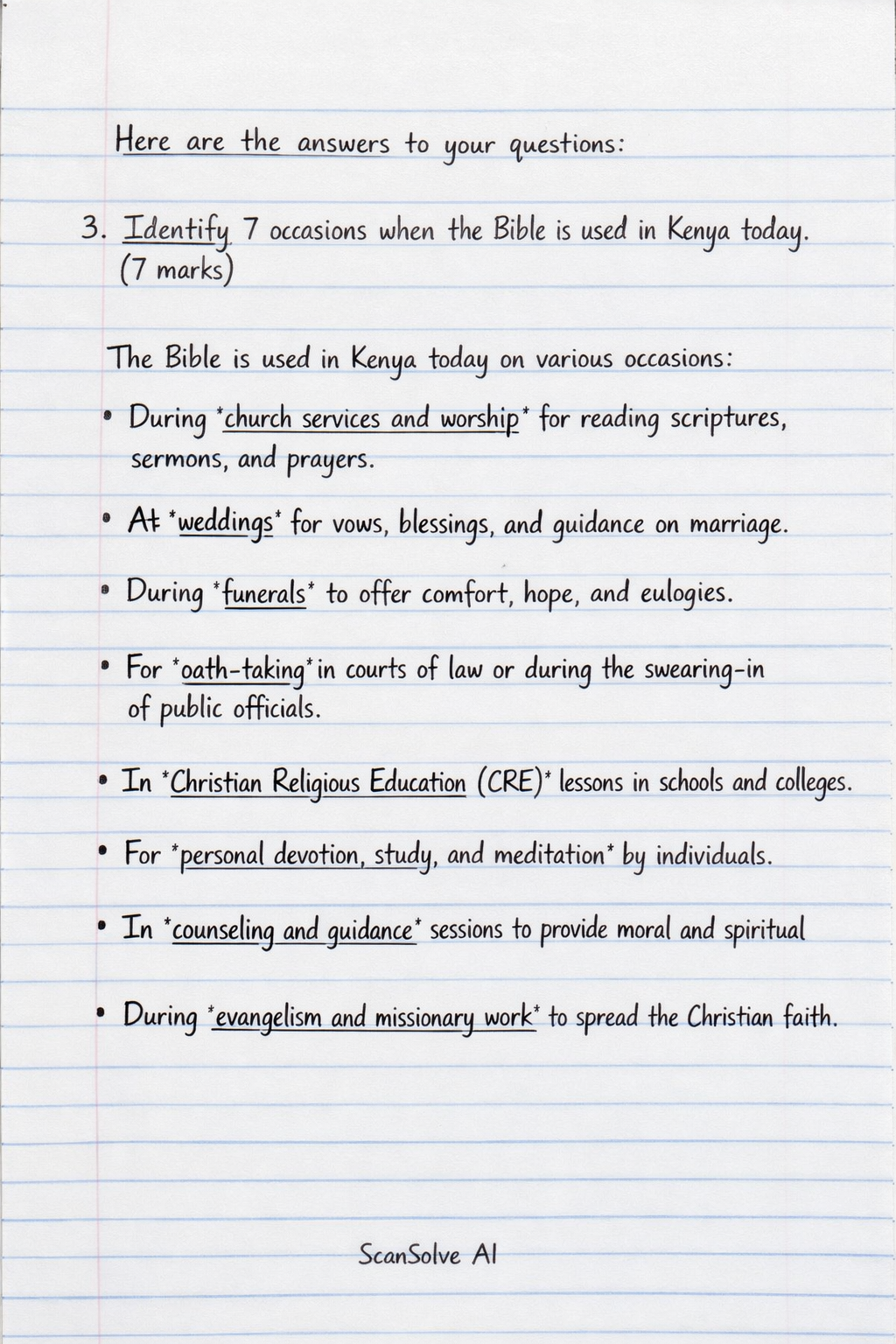
Here are the answers to your questions: 3. Identify 7 occasions when the Bible is used in Kenya today. (7 marks) The Bible is used in Kenya today on various occasions: During church services and worship* for reading scriptures, sermons, and prayers. At weddings* for vows, blessings, and guidance on marriage. During funerals* to offer comfort, hope, and eulogies. For oath-taking* in courts of law or during the swearing-in of public officials. In Christian Religious Education (CRE)* lessons in schools and colleges. For personal devotion, study, and meditation* by individuals. In counseling and guidance* sessions to provide moral and spiritual direction. During evangelism and missionary work* to spread the Christian faith. 4. Describe the covenant between God and Abraham that is recorded in Genesis 15-21. (7 marks) The covenant between God and Abraham involved several key promises and requirements: God promised Abraham numerous descendants*, comparing them to the stars in the sky and dust of the earth. God promised Abraham and his descendants the land of Canaan* as an everlasting possession. God promised to make Abraham a great nation* and bless him. God declared that through Abraham, all the families of the earth would be blessed*. Abraham was required to walk faithfully before God* and be blameless. The covenant was initially sealed with a sacrifice ritual* (Genesis 15) where God passed through divided animals. Circumcision* was later instituted as a physical sign of the covenant for Abraham and his male descendants (Genesis 17). God reaffirmed the covenant after Abraham's willingness to sacrifice Isaac, promising even greater blessings (Genesis 22). 5. State the significance of circumcision of Abraham and his descendants. (6 marks) The circumcision of Abraham and his descendants held significant meaning: It served as the physical sign of the covenant* between God and Abraham. It marked Abraham's descendants as God's chosen people*, distinguishing them from other nations. It symbolized belonging to God's family* and the community of faith. It was an act of obedience* to God's direct command. It served as a constant reminder of God's promises* to Abraham and his lineage. It represented a commitment to a holy and dedicated life* before God. 6. What lesson do Christians learn from the incident Abraham was willing to sacrifice his only son Isaac? (7 marks) From Abraham's willingness to sacrifice Isaac, Christians learn several profound lessons: Absolute obedience to God*: Abraham's readiness to obey even the most difficult command demonstrates the importance of submitting to God's will. Unwavering faith and trust in God*: Abraham believed that God was able to provide a lamb or even raise Isaac from the dead, showing complete reliance on God's power and faithfulness. God's provision*: The incident highlights that God always provides a way out and meets needs, as He provided a ram as a substitute sacrifice. The cost of discipleship*: Following God may require great personal sacrifice and letting go of what is most precious. God's love and mercy*: God does not desire human sacrifice but tests faith, ultimately showing His mercy by stopping Abraham. Foreshadowing of Christ's sacrifice*: The event is seen as a powerful foreshadowing of God the Father's ultimate sacrifice of His only Son, Jesus, for humanity's salvation. The nature of true worship*: True worship involves giving God our best and holding nothing back from Him. That's 2 down. 3 left today — send the next one.