
We read your photo as:
Identify seven characteristics of false prophets and explain seven categories of true prophets in the Old Testament.
ScanSolve AI Answer
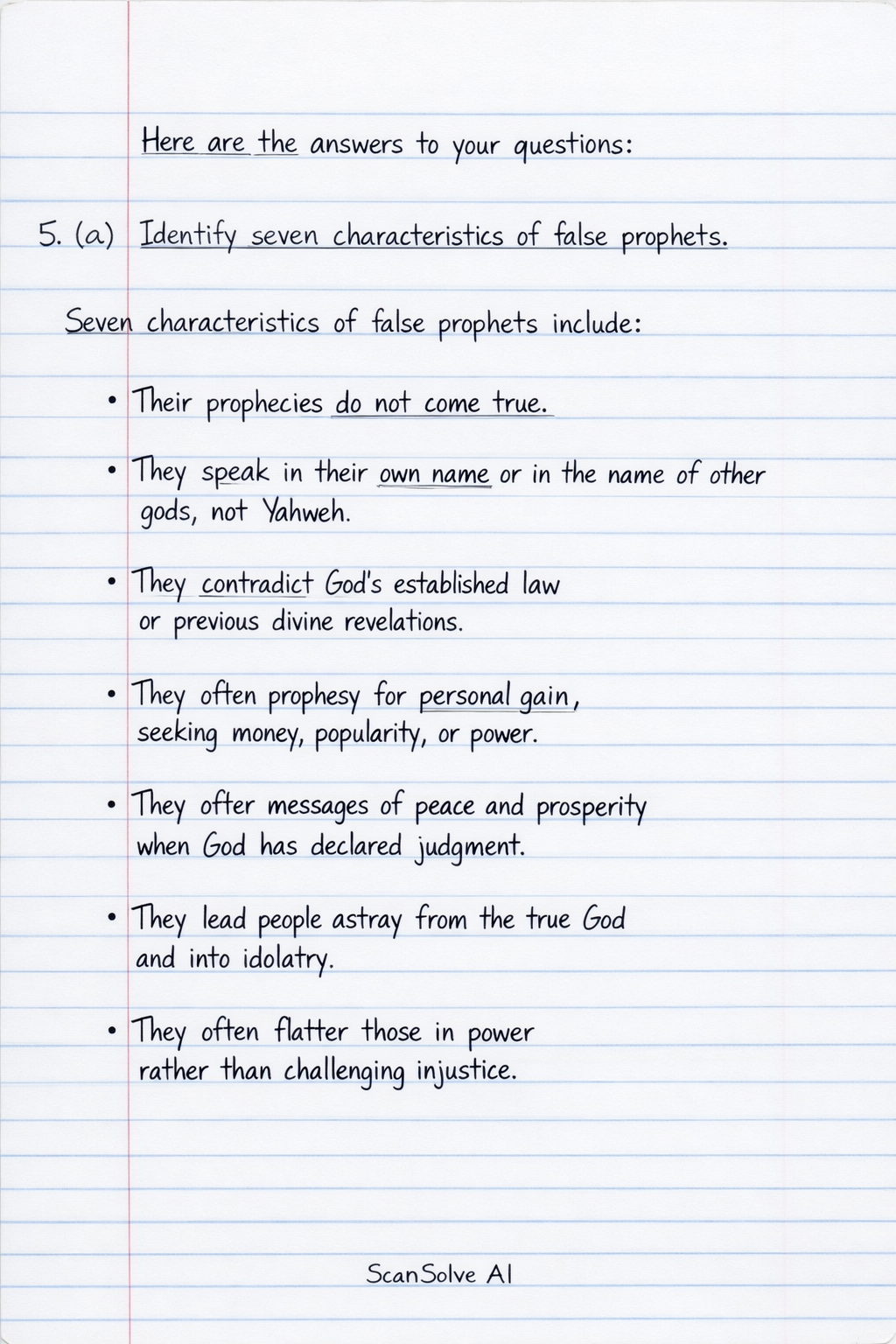
Here are the answers to your questions:
5. (a) Identify seven characteristics of false prophets.
Seven characteristics of false prophets include:
- Their prophecies do not come true.
- They speak in their own name or in the name of other gods, not Yahweh.
- They contradict God's established law or previous divine revelations.
- They often prophesy for personal gain, seeking money, popularity, or power.
- They offer messages of peace and prosperity when God has declared judgment.
- They lead people astray from the true God and into idolatry.
- They often flatter those in power rather than challenging injustice.
5. (b) Explain seven categories of true prophets in the Old Testament.
Seven categories of true prophets in the Old Testament are:
- Foundational Prophets: Like Moses, who received the Law and established the covenant.
- Prophets as Judges: Figures like Samuel, who combined prophetic and judicial leadership.
- Court Prophets: Prophets who advised kings and served in royal courts, such as Nathan and Gad.
- Non-Writing Prophets: Prophets whose ministries are recorded in historical books but who did not write their own prophetic books, like Elijah and Elisha.
- Major Prophets: Prophets whose books are extensive and contain long prophecies, such as Isaiah, Jeremiah, and Ezekiel.
- Minor Prophets: Prophets whose books are shorter, including Hosea, Amos, Micah, and others.
- Post-Exilic Prophets: Prophets who ministered after the Babylonian exile, focusing on rebuilding and spiritual renewal, like Haggai, Zechariah, and Malachi.
5. (c) Outline six differences between traditional African prophets and the Old Testament prophets.
Six differences between traditional African prophets and Old Testament prophets:
- Source of Authority: African prophets often derive authority from ancestral spirits or local deities, while Old Testament prophets derive authority solely from Yahweh, the one true God.
- Focus of Message: African prophets often focus on community well-being, fertility, protection from witchcraft, and local issues, whereas Old Testament prophets primarily focus on covenant faithfulness, justice, righteousness, and monotheism for the entire nation.
- Method of Revelation: African prophecy can involve divination, trance, or spirit possession, while Old Testament prophecy involves direct divine revelation, visions, dreams, or direct speech from God.
- Call and Succession: The role of an African prophet can sometimes be hereditary or passed down, but Old Testament prophets received a direct, divine call from God, which was not hereditary.
- Scope of Audience: African prophets' messages are often specific to a clan, tribe, or local community, while Old Testament prophets' messages were typically for the entire nation of Israel/Judah, and sometimes for foreign nations as well.
- Challenge to Authority: Old Testament prophets frequently challenged kings and religious leaders, calling for national repentance, whereas African prophets often worked within existing social structures to maintain harmony.
6. (a) Describe the call of prophet Amos.
Amos was a simple shepherd and a dresser of sycamore figs from Tekoa, a village in the Southern Kingdom of Judah. He was not a professional prophet or part of any prophetic guild. God directly called him from his humble agricultural work to deliver a message of judgment to the Northern Kingdom of Israel, specifically condemning their social injustice, religious hypocrisy, and moral decay. Despite his lack of formal prophetic training and his reluctance, Amos obeyed God's command and went to Bethel, a royal sanctuary in Israel, to prophesy.
6. (b) Explain any four visions given to Amos by God.
Four visions given to Amos by God:
- Vision of Locusts (Amos 7:1-3): Amos saw a vision of locusts devouring the crops, symbolizing impending destruction for Israel. Amos interceded, and God relented from this judgment.
- Vision of Fire (Amos 7:4-6): Amos saw a vision of fire consuming the land, representing another form of severe judgment. Again, Amos interceded, and God relented.
- Vision of a Plumb Line (Amos 7:7-9): God showed Amos a plumb line, signifying that Israel would be measured against God's standard of righteousness and found to be crooked, leading to inevitable and unalterable judgment.
- Vision of a Basket of Summer Fruit (Amos 8:1-3): Amos saw a basket of ripe summer fruit, which God explained meant that Israel was ripe for judgment, and their end was near.
6. (c) State five evils that prophet Amos would condemn in Kenya today.
Five evils that prophet Amos would condemn in Kenya today:
- Social injustice and oppression of the poor: The wealthy and powerful exploiting the vulnerable and denying them their rights.
- Corruption and bribery: Officials and leaders taking bribes, perverting justice, and enriching themselves at the expense of the public.
- Religious hypocrisy: People engaging in elaborate religious rituals and outward displays of piety while neglecting justice, mercy, and righteousness in their daily lives.
- Materialism and excessive luxury: The rich indulging in extravagant lifestyles and accumulating vast wealth while widespread poverty and suffering persist.
- Denial of justice: The powerful manipulating legal systems to their advantage, ensuring that the poor and marginalized do not receive fair treatment.
Still stuck on this one?
Ask a follow-up, and the answer starts from this question.
More History Questions
Handwritten Step-by-Step Solution
Get this as a handwritten image on WhatsApp — like a tutor wrote it for you.
Try on WhatsApp