
In 1789 various society, economic and political factors in France lead to revolution which changed ancient practices and customs of Franch governmental structures evaluate the validity of this statement by discussing the causes and the events of the Franch revolution
ScanSolve AI Answer
Answer
The statement that various societal, economic, and political factors in 1789 France led to a revolution which fundamentally changed ancient practices and customs of French governmental structures is highly valid.
The revolution was precipitated by deep-seated societal inequalities under the Ancien Régime, where the privileged First and Second Estates (clergy and nobility) were exempt from many taxes, while the Third Estate (commoners) bore the brunt. This created immense resentment and a demand for social justice. Economic hardship was rampant, with France burdened by massive national debt from costly wars and exacerbated by poor harvests that led to soaring food prices and widespread poverty. The political system of absolute monarchy under King Louis XVI was seen as unresponsive and inefficient, failing to address the growing crises. These factors, combined with the spread of Enlightenment ideals promoting liberty, equality, and popular sovereignty, created an explosive environment.
The events of the revolution directly dismantled these ancient practices. The storming of the Bastille in July 1789 symbolized the collapse of royal authority. The abolition of feudalism in August 1789 eradicated centuries of aristocratic privilege and serfdom, fundamentally altering social and economic structures. The Declaration of the Rights of Man and of the Citizen established principles of equality before the law, individual freedoms, and popular sovereignty, directly challenging the divine right of kings and the hierarchical nature of the old government. Ultimately, the monarchy was overthrown, leading to the establishment of a republic and the execution of the king, a radical transformation of France's governmental structure from an absolute monarchy to a state founded on the will of the people. These changes unequivocally demonstrate the validity of the statement.
Still stuck on this one?
Ask a follow-up, and the answer starts from this question.
More History Questions
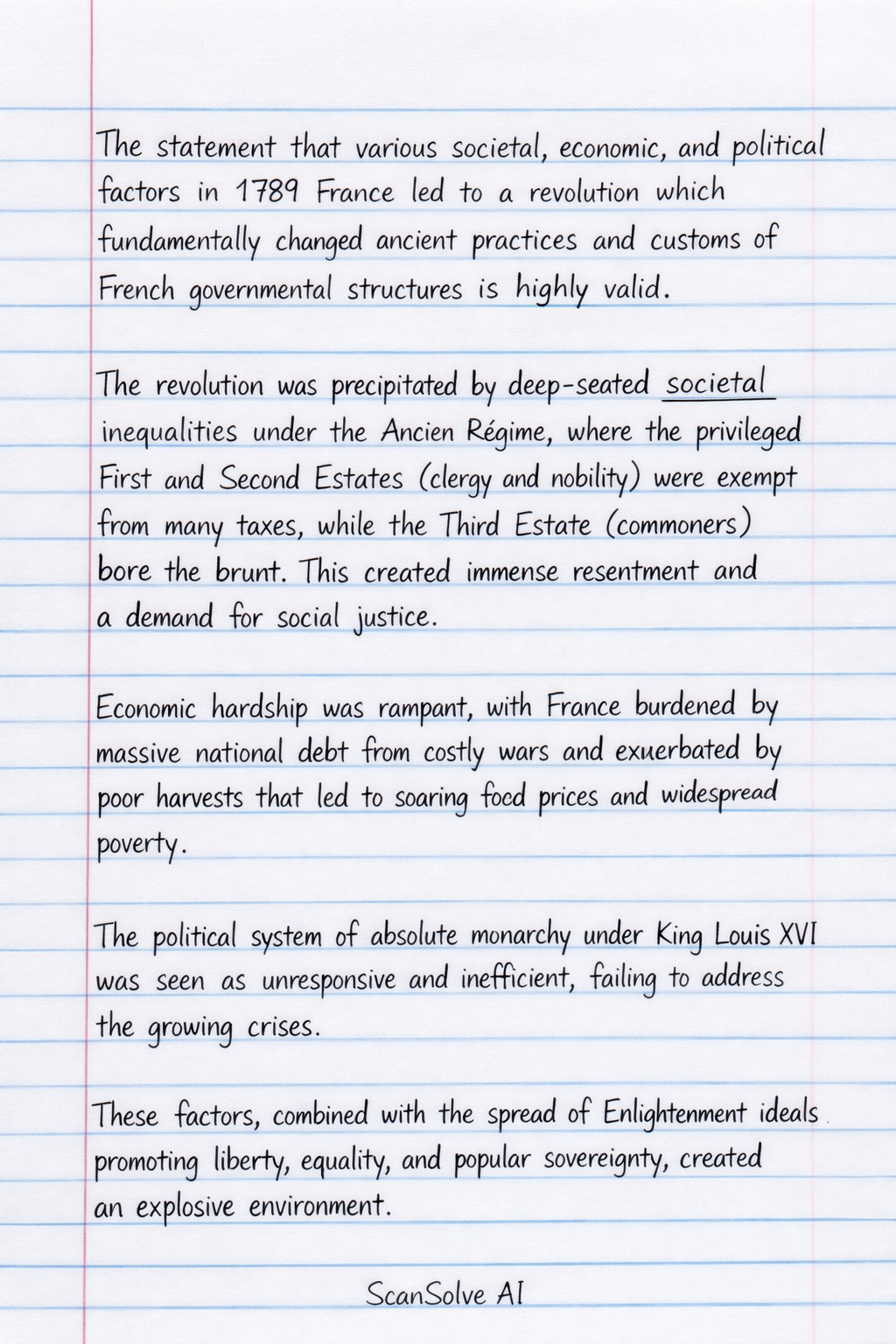
Handwritten Step-by-Step Solution
Get this as a handwritten image on WhatsApp — like a tutor wrote it for you.
Try on WhatsApp