
We read your photo as:
How do J.K. Nyerere's arguments for Education for Self-Reliance (ESR) align with current Tanzanian government policies on education and self-reliance?
History
ScanSolve AI Answer
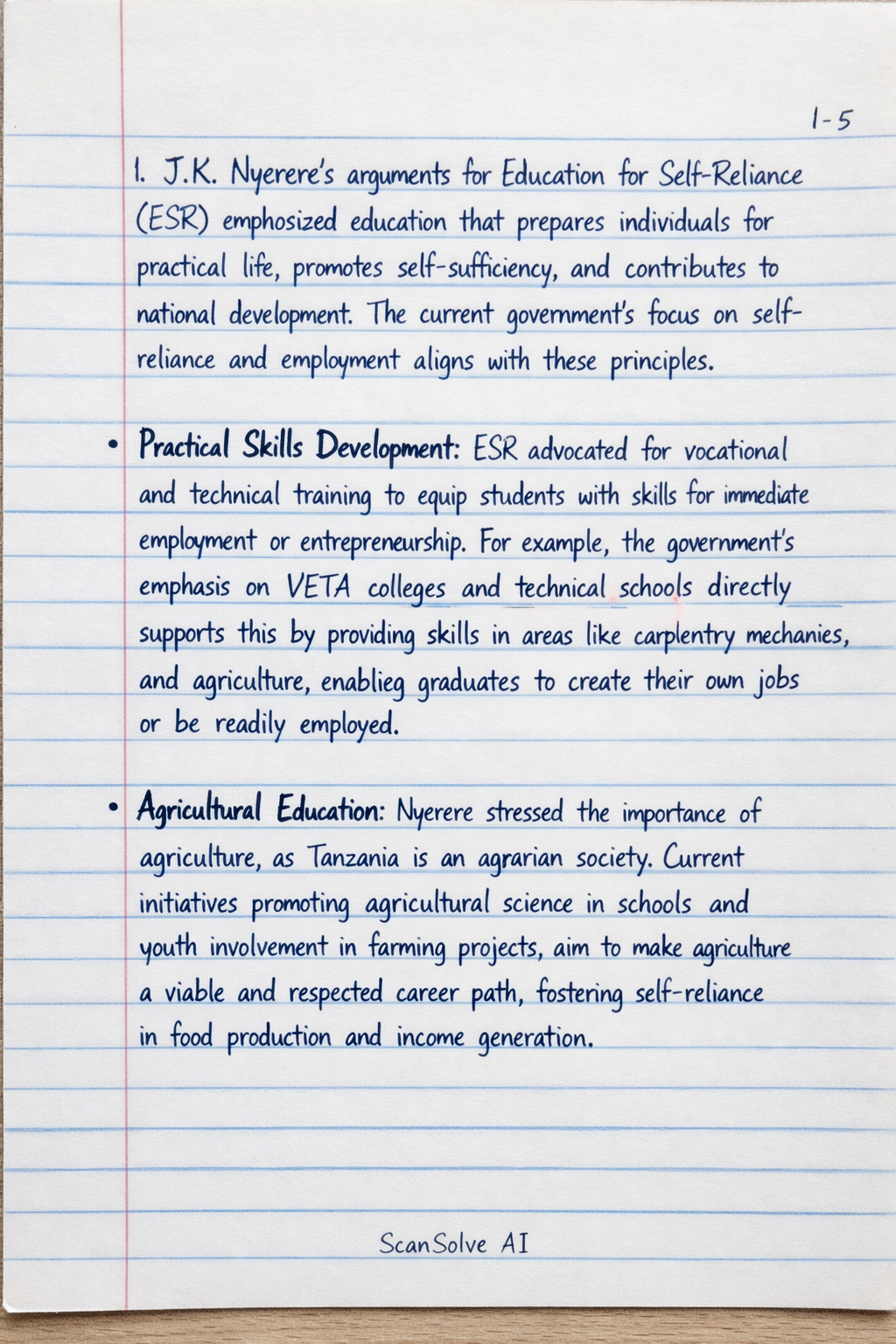
- J.K. Nyerere's arguments for Education for Self-Reliance (ESR) emphasized education that prepares individuals for practical life, promotes self-sufficiency, and contributes to national development. The current government's focus on self-reliance and employment aligns with these principles.
- Practical Skills Development: ESR advocated for vocational and technical training to equip students with skills for immediate employment or entrepreneurship. For example, the government's emphasis on VETA colleges and technical schools directly supports this by providing skills in areas like carpentry, mechanics, and agriculture, enabling graduates to create their own jobs or be readily employed.
- Agricultural Education: Nyerere stressed the importance of agriculture, as Tanzania is an agrarian society. Current initiatives promoting agricultural science in schools and youth involvement in farming projects aim to make agriculture a viable and respected career path, fostering self-reliance in food production and income generation.
- Community Service and Responsibility: ESR encouraged students to contribute to their communities. Modern programs that integrate community projects or internships into curricula help students understand societal needs and develop a sense of responsibility, preparing them for active roles in local development.
- Critical Thinking and Problem Solving: Nyerere wanted education to foster independent thought. Current reforms that encourage project-based learning and research assignments empower students to identify and solve local problems, promoting innovation and self-reliance rather than rote memorization.
- Resourcefulness and Innovation: ESR aimed to teach students to make the most of available resources. Government support for small and medium enterprises (SMEs) and entrepreneurship hubs encourages graduates to innovate and create businesses using local materials and opportunities, reducing dependence on external employment.
- Cultural Relevance: Nyerere believed education should be rooted in Tanzanian culture and values. Efforts to incorporate local content and indigenous knowledge into the curriculum help students appreciate their heritage and develop solutions relevant to their specific context, fostering a unique form of self-reliance.
- To address unethical public servants and social evils, the government of the United Republic of Tanzania can employ several strategies:
- Strengthening Anti-Corruption Institutions: Enhance the capacity and independence of bodies like the Prevention and Combating of Corruption Bureau (PCCB) to investigate, prosecute, and deter corruption effectively. This includes providing adequate funding, training, and legal powers.
- Promoting Transparency and Accountability: Implement and enforce policies that ensure openness in government operations, such as public disclosure of assets for public servants, transparent procurement processes, and accessible information on public spending. This reduces opportunities for illicit activities.
- Enforcing Strict Ethical Codes: Develop and rigorously enforce codes of conduct and ethics for all public servants, with clear penalties for violations. Regular training on ethical behavior and integrity should be mandatory.
- Public Awareness and Education Campaigns: Launch nationwide campaigns to educate citizens about the dangers of corruption and social evils, their rights, and how to report misconduct. This empowers the public to demand accountability and reject unethical practices.
- Whistleblower Protection: Establish robust legal frameworks and mechanisms to protect whistleblowers who report corruption or unethical behavior. This encourages individuals to come forward without fear of retaliation, providing crucial information for investigations.
- Judicial Reform and Rule of Law: Strengthen the judiciary to ensure fair, impartial, and timely justice for all cases, including those involving corruption and social evils. An efficient and trustworthy justice system is crucial for deterring misconduct and upholding the rule of law.
- Privatization, often a component of Structural Adjustment Programs (SAPs) emphasized by the IMF and World Bank, involves transferring assets from public to private ownership. The intentions behind this transfer typically include:
- Increasing Efficiency and Productivity: Private companies are often perceived as more efficient and productive than state-owned enterprises (SOEs) due to market competition, profit motives, and less bureaucratic interference. The intention is to improve the performance of these assets.
- Generating Revenue for the Government: Selling state assets can provide a significant one-time injection of funds into government coffers, which can be used to reduce national debt, fund public services, or invest in infrastructure.
- Reducing Government Expenditure and Subsidies: SOEs often require government subsidies to operate, draining public funds. Privatization aims to eliminate these financial burdens, allowing the government to reallocate resources to other priority areas.
- Attracting Foreign Direct Investment (FDI): Privatization can signal a more market-friendly environment, attracting foreign investors who bring capital, technology, and management expertise, thereby stimulating economic growth and job creation.
- Promoting Competition and Innovation: Introducing private ownership can break state monopolies, fostering competition in various sectors. This competition is expected to lead to better quality goods and services, lower prices, and greater innovation.
- Improving Corporate Governance: Private companies are often subject to stricter corporate governance standards and market discipline, which can lead to better management practices, transparency, and accountability compared to politically influenced SOEs.
- As an expert in conflict resolution, to address the Israel-Palestine conflict, I would employ the following five strategies:
- Facilitated Dialogue and Mediation: Establish a neutral, high-level mediation team to facilitate direct, structured dialogue between Israeli and Palestinian representatives. The focus would be on creating a safe space for both sides to articulate their narratives, grievances, and aspirations, moving beyond public rhetoric to find common ground.
- Confidence-Building Measures (CBMs): Implement immediate, tangible CBMs to de-escalate tensions and build trust. This could include prisoner exchanges, easing movement restrictions, joint economic projects, and shared resource management initiatives (e.g., water), demonstrating a commitment to improving daily life for both populations.
- Multi-Track Diplomacy: Engage not only official government representatives but also civil society organizations, religious leaders, academics, and youth groups from both sides. This "multi-track" approach ensures a broader range of perspectives are heard and helps build a constituency for peace from the ground up.
- Addressing Root Causes and Core Issues: Systematically address the fundamental issues driving the conflict, including borders, settlements, Jerusalem's status, refugee rights, and security concerns for both Israelis and Palestinians. This requires a framework for negotiations that acknowledges and seeks equitable solutions for each of these complex issues.
- International Guarantees and Support: Secure robust international guarantees for any agreed-upon peace settlement, including security assurances for both states and financial support for reconstruction and development. This international backing provides legitimacy, resources, and enforcement mechanisms crucial for the long-term sustainability of peace.
- If my brother is addicted to alcohol and wants to quit, I would recommend the following six things:
- Seek Professional Help: Encourage him to consult a doctor or an addiction specialist immediately. They can provide a proper diagnosis, recommend medical interventions for withdrawal symptoms, and suggest appropriate therapy or rehabilitation programs.
- Build a Strong Support System: Advise him to confide in trusted family members or friends who can offer emotional support, encouragement, and accountability. Joining a support group like Alcoholics Anonymous (AA) can also provide a community of individuals facing similar challenges.
- Identify Triggers and Develop Coping Strategies: Help him recognize situations, emotions, or people that trigger his urge to drink. Once identified, work together to develop healthy coping mechanisms, such as exercise, hobbies, meditation, or calling a support person, instead of resorting to alcohol.
- Set Clear, Achievable Goals: Encourage him to set realistic short-term and long-term goals for sobriety, such as reducing intake gradually (if advised by a professional) or aiming for specific periods of abstinence. Celebrating small victories can reinforce positive behavior.
- Adopt a Healthy Lifestyle: Recommend incorporating regular physical activity, a balanced diet, and sufficient sleep into his routine. A healthy body can better cope with the stress of recovery and improve overall well-being, reducing the desire for alcohol.
- Remove Alcohol from His Environment: Advise him to remove all alcohol from his home and avoid places or social situations where drinking is prevalent, especially during the initial stages of recovery. This minimizes temptation and creates a safer environment for sobriety.
- The statement by the wholesaler at Tandale market, "Since the government introduced the National Property and Business Formalization Program (NPBFP), it contributed nothing to the promotion of entrepreneurship and self-reliance," is largely false.
The National Property and Business Formalization Program (NPBFP), often associated with the Mkukuta (National Strategy for Growth and Reduction of Poverty) framework, aimed to formalize informal businesses and property ownership in Tanzania. Its contributions to entrepreneurship and self-reliance are significant:
- Access to Credit: Formalizing businesses allows entrepreneurs to obtain legal recognition and registration, which is a prerequisite for accessing formal financial services like bank loans. This credit is crucial for business expansion, investment, and working capital, directly promoting entrepreneurship.
- Property as Collateral: Formalizing property ownership (e.g., land titles) enables individuals to use their assets as collateral for loans. This unlocks significant capital for investment in businesses or other self-reliant ventures that would otherwise be inaccessible.
- Increased Security of Tenure: Formal property rights provide legal protection against arbitrary eviction or confiscation. This security encourages individuals to invest in their land or businesses, knowing their assets are protected, fostering long-term self-reliance.
- Reduced Transaction Costs: Formalization simplifies business operations by reducing the need for informal payments or navigating complex, unofficial systems. This lowers transaction costs and makes it easier for small businesses to operate legally and efficiently, boosting profitability and sustainability.
- Integration into the Formal Economy: Bringing informal businesses into the formal sector allows them to participate in larger markets, access government contracts, and benefit from legal protections. This integration expands opportunities for growth and reduces vulnerability, enhancing self-reliance.
- Improved Government Revenue and Services: While primarily benefiting individuals, formalization also broadens the tax base, allowing the government to collect more revenue. This revenue can then be reinvested in public services and infrastructure that further support entrepreneurship and economic development.
- For the late John P. Magufuli's statement that "The Tanzania election of 2025 will be free and fair" to be justified, several necessary conditions must be met:
- Independent Electoral Commission: The National Electoral Commission (NEC) must operate with complete independence, free from political interference, ensuring impartiality in voter registration, candidate nomination, election administration, and results tabulation.
- Transparent Voter Registration: There must be a transparent, inclusive, and verifiable voter registration process that allows all eligible citizens to register without undue obstacles or discrimination, and ensures the accuracy of the voter roll.
- Equal Access to Media and Campaigning: All political parties and candidates must have equal and fair access to state and private media for campaigning, and freedom to hold rallies and disseminate their messages without harassment or intimidation.
- Security and Freedom from Intimidation: Voters, candidates, and election observers must be able to participate in the electoral process without fear of violence, intimidation, or coercion. Security forces must act professionally and neutrally.
- Impartial Judiciary and Dispute Resolution: An independent and impartial judiciary must be in place to effectively and timely resolve electoral disputes, complaints, and petitions, ensuring that justice is served and electoral laws are upheld.
- Presence of Domestic and International Observers: The government must allow and facilitate the presence of accredited domestic and international election observers to monitor all stages of the electoral process, providing transparency and accountability.
Was this helpful?
Still stuck on this one?
Ask a follow-up, and the answer starts from this question.
Got a different question?Ask your own question
More History Questions
QHow do current Tanzanian education policies reflect J.K. Nyerere's Education for Self-Reliance…QWhat lessons can Sierra Leone learn from the education reforms in other African countries.QDiscuss the key causes that led to the collapse of Tanzania's Ujamaa policy, focusing on economic…QDiscuss four major educational changes that have taken place in Kenya since independence.QCompare the Kenyan education system with international systems in Kenya.
Handwritten Step-by-Step Solution
Get this as a handwritten image on WhatsApp — like a tutor wrote it for you.
Try on WhatsApp