
We read your photo as:
Show how Jesus fulfilled Old Testament prophecies about the coming of the Messiah.
ScanSolve AI Answer
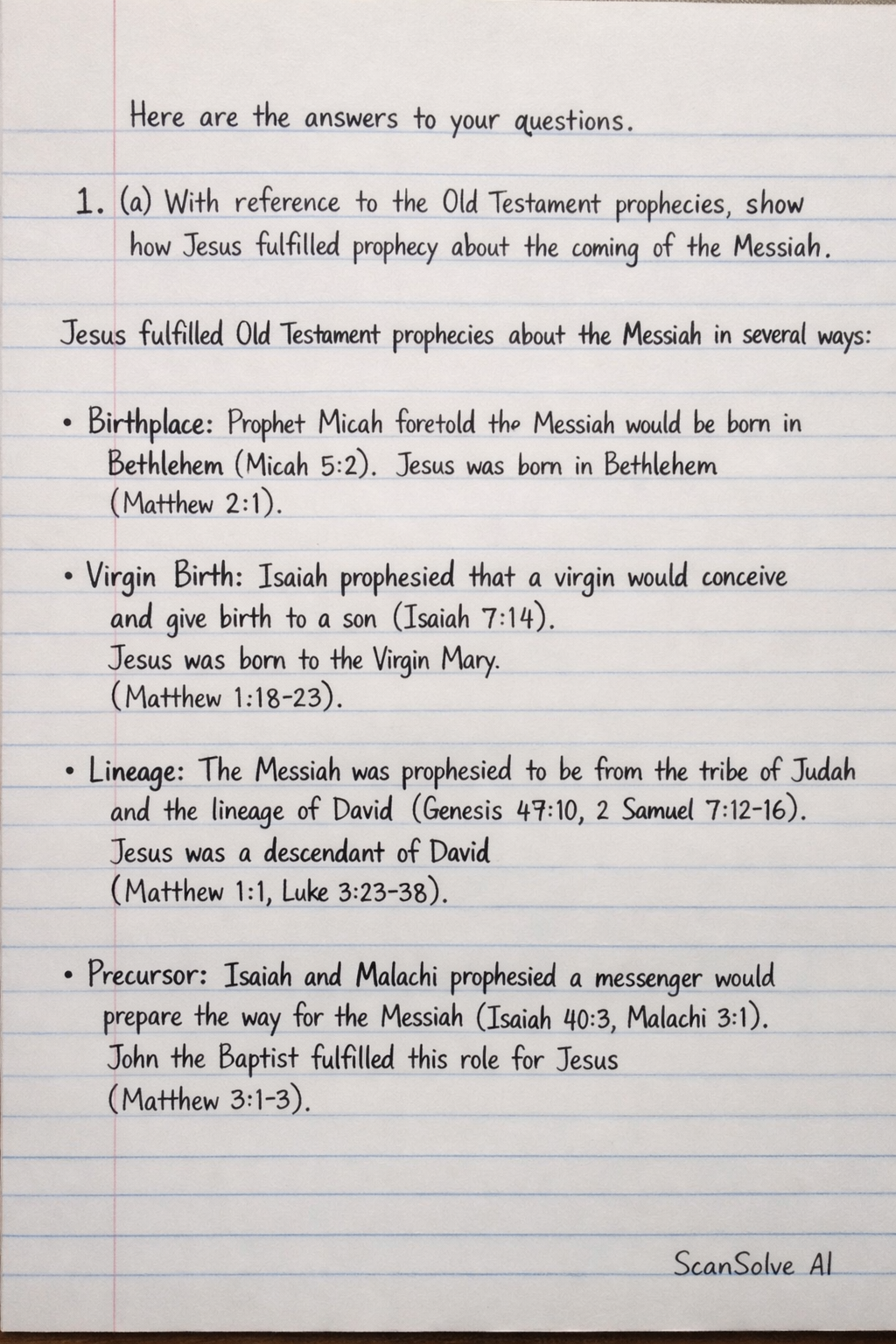
Here are the answers to your questions.
1. (a) With reference to the Old Testament prophecies, show how Jesus fulfilled prophecy about the coming of the Messiah.
Jesus fulfilled Old Testament prophecies about the Messiah in several ways:
- Birthplace: Prophet Micah foretold the Messiah would be born in Bethlehem (Micah 5:2). Jesus was born in Bethlehem (Matthew 2:1).
- Virgin Birth: Isaiah prophesied that a virgin would conceive and give birth to a son (Isaiah 7:14). Jesus was born to the Virgin Mary (Matthew 1:18-23).
- Lineage: The Messiah was prophesied to be from the tribe of Judah and the lineage of David (Genesis 49:10, 2 Samuel 7:12-16). Jesus was a descendant of David (Matthew 1:1, Luke 3:23-38).
- Precursor: Isaiah and Malachi prophesied a messenger would prepare the way for the Messiah (Isaiah 40:3, Malachi 3:1). John the Baptist fulfilled this role for Jesus (Matthew 3:1-3).
- Miracles: Isaiah prophesied that the Messiah would open the eyes of the blind, unstop the ears of the deaf, and make the lame leap (Isaiah 35:5-6). Jesus performed numerous miracles of healing (Matthew 11:4-5).
- Betrayal: Zechariah prophesied the Messiah would be betrayed for 30 pieces of silver (Zechariah 11:12-13). Judas Iscariot betrayed Jesus for 30 pieces of silver (Matthew 26:15).
- Suffering and Death: Isaiah 53 details the suffering servant who would be wounded for transgressions and bear the sins of many. Jesus' crucifixion and death fulfilled this prophecy.
1. (b) Outline seven important ideas that came out of the Benedictus (Luke 1:68-79).
The Benedictus, Zechariah's prophecy, outlines these important ideas:
- God has visited and redeemed His people.
- God has raised up a horn of salvation (the Messiah) in the house of David.
- God has fulfilled His ancient promises made to Abraham and the prophets.
- God will deliver His people from their enemies.
- People will serve God without fear, in holiness and righteousness.
- John (the child) will be called a prophet of the Most High and will prepare the way for the Lord.
- John will give knowledge of salvation to God's people through the forgiveness of their sins.
- The rising sun (the Messiah) will come from heaven to shine on those living in darkness.
- The Messiah will guide people's feet into the path of peace.
1. (c) Give five reasons why the birth of a child is celebrated in modern society.
Five reasons why the birth of a child is celebrated in modern society are:
- It brings immense joy and happiness to the parents, family, and friends.
- It signifies the continuation of the family lineage and legacy.
- A child represents new hope and a fresh start for the family.
- It strengthens family bonds and relationships.
- It is seen as a blessing from God or a gift of life, often with religious significance.
- It adds a new member to the community and society.
2. (a) Give the account of Jesus healing the paralyzed man in Luke 5:17-26.
One day, while Jesus was teaching, with Pharisees and teachers of the law present from every village of Galilee and Judea and Jerusalem, the power of the Lord was with him to heal the sick. Some men came carrying a paralyzed man on a mat and tried to take him into the house to lay him before Jesus. When they could not find a way to do this because of the crowd, they went up on the roof and lowered him on his mat through the tiles into the middle of the crowd, right in front of Jesus. When Jesus saw their faith, he said, "Friend, your sins are forgiven." The Pharisees and the teachers of the law began thinking, "Who is this fellow who speaks blasphemy? Who can forgive sins but God alone?" Jesus knew what they were thinking and asked, "Which is easier: to say, 'Your sins are forgiven,' or to say, 'Get up and walk'? But I want you to know that the Son of Man has authority on earth to forgive sins." So he said to the paralyzed man, "I tell you, get up, take your mat and go home." Immediately he stood up in front of them, took what he had been lying on, and went home praising God. Everyone was amazed and gave praise to God. They were filled with awe and said, "We have seen remarkable things today."
2. (b) State seven reasons why Jesus was always in conflict with the Jewish religious leaders in Galilee.
Jesus was often in conflict with the Jewish religious leaders for these reasons:
- Sabbath Observance: Jesus performed healings and allowed his disciples to pick grain on the Sabbath, which the leaders considered breaking the law.
- Forgiveness of Sins: Jesus claimed the authority to forgive sins, which the leaders saw as blasphemy, as only God could forgive sins.
- Association with Sinners: Jesus associated with tax collectors and sinners, which the religious leaders found scandalous and inappropriate for a holy man.
- Interpretation of the Law: Jesus often challenged their rigid, legalistic interpretations of the Mosaic Law, emphasizing the spirit of the law over its letter.
- Claims of Divinity: Jesus' claims about his own identity and relationship with God (e.g., "Son of Man," "Son of God") were seen as blasphemous and a challenge to their authority.
- Hypocrisy: Jesus openly criticized their hypocrisy, outward show of piety, and focus on external rituals rather than inner righteousness.
- Healing on the Sabbath: His repeated acts of healing on the Sabbath were seen as a direct defiance of their traditions and rules.
- Authority: Jesus taught with an authority that surpassed theirs, drawing large crowds and undermining their influence.
2. (c) Identify the qualities of an evangelist in Kenya today.
An evangelist in Kenya today should possess these qualities:
- Strong Faith: A deep personal relationship with God and unwavering belief in the Gospel message.
- Biblical Knowledge: A thorough understanding of the Bible to teach and defend the faith accurately.
- Communication Skills: Ability to articulate the Gospel clearly, persuasively, and in a culturally relevant manner.
- Compassion: Genuine love and concern for people, especially the lost and marginalized.
- Humility: A humble spirit, recognizing that their work is God's work, not their own.
- Integrity: Living a life that is consistent with the message they preach, demonstrating honesty and moral uprightness.
- Perseverance: Resilience to face challenges, opposition, and discouragement in their ministry.
- Cultural Sensitivity: Ability to understand and respect diverse cultural contexts in Kenya to effectively share the Gospel.
- Prayerfulness: A commitment to prayer, recognizing dependence on God for guidance and power.
3. (a) Outline the message delivered by Jesus during the Last Supper.
During the Last Supper, Jesus delivered several key messages:
- Institution of the Eucharist/Communion: He broke bread and shared wine, instituting the sacrament as a remembrance of his body and blood, sacrificed for the forgiveness of sins and the new covenant.
- His Impending Betrayal and Death: He announced that one of his disciples would betray him and spoke of his imminent suffering and death.
- Love and Service: He washed his disciples' feet, demonstrating humility and commanding them to love and serve one another as he had loved them.
- The New Commandment: He gave them a new commandment: "Love one another. As I have loved you, so you must love one another."
- The Promise of the Holy Spirit: He promised to send the Holy Spirit, the Advocate, to be with them, teach them, and remind them of everything he had said.
- Peace: He offered them his peace, a peace that the world cannot give.
- Abiding in Him: He taught them the importance of remaining connected to him, like branches to a vine, to bear fruit.
- Future Kingdom: He spoke of drinking the wine anew with them in his Father's kingdom.
3. (b) Give six reasons why Judas Iscariot betrayed Jesus.
Six reasons why Judas Iscariot betrayed Jesus include:
- Greed: He was motivated by money, accepting 30 pieces of silver to hand over Jesus. He was also known to steal from the common purse.
- Disillusionment: He may have been disappointed that Jesus was not establishing an earthly political kingdom as he might have expected from the Messiah.
- Political Motives: He might have hoped that by forcing Jesus' hand, Jesus would be compelled to reveal his full power and overthrow the Roman oppressors.
- Satanic Influence: The Bible states that Satan entered Judas, influencing his actions.
- Lack of True Faith: Despite being a disciple, he may not have fully understood or believed in Jesus' spiritual mission.
- Resentment: He might have harbored resentment towards Jesus for various reasons, such as Jesus' rebuke over the anointing oil.
3. (c) State six ways in which Christians are persecuted today.
Six ways in which Christians are persecuted today include:
- Physical Violence and Murder: Christians are killed, beaten, or tortured for their faith in various parts of the world.
- Imprisonment and Detention: Christians are arrested and imprisoned on false charges or for practicing their faith.
- Discrimination: They face discrimination in employment, education, housing, and access to public services.
- Forced Conversion: Christians are coerced or forced to convert to other religions.
- Destruction of Property: Churches, homes, and businesses belonging to Christians are vandalized or destroyed.
- Social Ostracism: They are socially isolated, shunned by their communities, or denied basic rights.
- Blasphemy Laws: Christians are accused of blasphemy for expressing their faith, leading to severe penalties.
- Restrictions on Worship: Governments or extremist groups impose restrictions on public worship, evangelism, or owning Bibles.
4. (a) Identify seven gifts of the Holy Spirit from the teachings of St. Paul.
From the teachings of St. Paul (primarily 1 Corinthians 12 and Romans 12), seven gifts of the Holy Spirit include:
- Wisdom: The ability to apply spiritual truth to life situations.
- Knowledge: The ability to understand and explain spiritual truths.
- Faith: An extraordinary measure of trust in God, enabling miraculous acts.
- Healing: The ability to be an instrument through whom God restores health.
- Miracles: The ability to perform supernatural acts of power.
- Prophecy: The ability to speak a message from God, often for encouragement, edification, or conviction.
- Discernment of Spirits: The ability to distinguish between true and false spiritual influences.
- Tongues: The ability to speak in languages unknown to the speaker, for prayer or praise.
- Interpretation of Tongues: The ability to interpret messages spoken in tongues.
- Service/Ministry: Practical help and assistance to others.
- Teaching: The ability to explain and apply God's word effectively.
- Exhortation/Encouragement: The ability to motivate and comfort others.
- Giving: The ability to contribute resources generously and cheerfully.
- Leadership/Administration: The ability to organize and guide others.
- Mercy: The ability to show compassion and practical help to those suffering.
4. (b) Give five criteria for discerning gifts of the Holy Spirit.
Five criteria for discerning gifts of the Holy Spirit are:
- Glorifies Christ: A true gift of the Spirit will always point to and glorify Jesus Christ, not the individual exercising the gift.
- Edifies the Church: The gift should build up, strengthen, and benefit the entire body of believers, not cause division or confusion.
- Aligns with Scripture: The exercise of the gift must be consistent with the teachings and principles found in the Bible.
- Promotes Order and Peace: Gifts should be exercised in an orderly and peaceful manner, contributing to harmony within the church.
- Bears Good Fruit: The use of the gift should produce positive spiritual fruit, such as love, joy, peace, patience, kindness, goodness, faithfulness, gentleness, and self-control.
- Motivated by Love: The underlying motivation for exercising the gift should be genuine love for God and others.
4. (c) Explain the works of the Holy Spirit among Christians today.
The Holy Spirit performs several vital works among Christians today:
- Conviction and Regeneration: The Spirit convicts people of sin, righteousness, and judgment, leading them to repentance and new birth (regeneration).
- Indwelling and Sealing: The Spirit indwells every believer, making them a temple of God, and seals them as a guarantee of their salvation and future inheritance.
- Empowerment for Service: The Spirit empowers Christians with spiritual gifts for ministry and service within the church and the world.
- Guidance and Teaching: The Spirit guides believers into all truth, helps them understand Scripture, and reminds them of Jesus' teachings.
- Sanctification: The Spirit works to transform believers into the likeness of Christ, producing spiritual fruit (love, joy, peace, etc.) and helping them overcome sin.
- Intercession: The Spirit intercedes for believers with groans that words cannot express, helping them in their prayers.
- Assurance: The Spirit bears witness with our spirit that we are children of God, providing assurance of salvation.
5. (a) Outline Christians teaching on celibacy.
Christian teaching on celibacy generally holds that it is a *voluntary commitment to abstain from marriage and sexual relations
Still stuck on this one?
Ask a follow-up, and the answer starts from this question.
More History Questions
Handwritten Step-by-Step Solution
Get this as a handwritten image on WhatsApp — like a tutor wrote it for you.
Try on WhatsApp