
We read your photo as:
What are key aspects of Liberia, French colonial policy, Ghanaian nationalism, law, citizenship, political parties, and timekeeping?
ScanSolve AI Answer
SECTION A
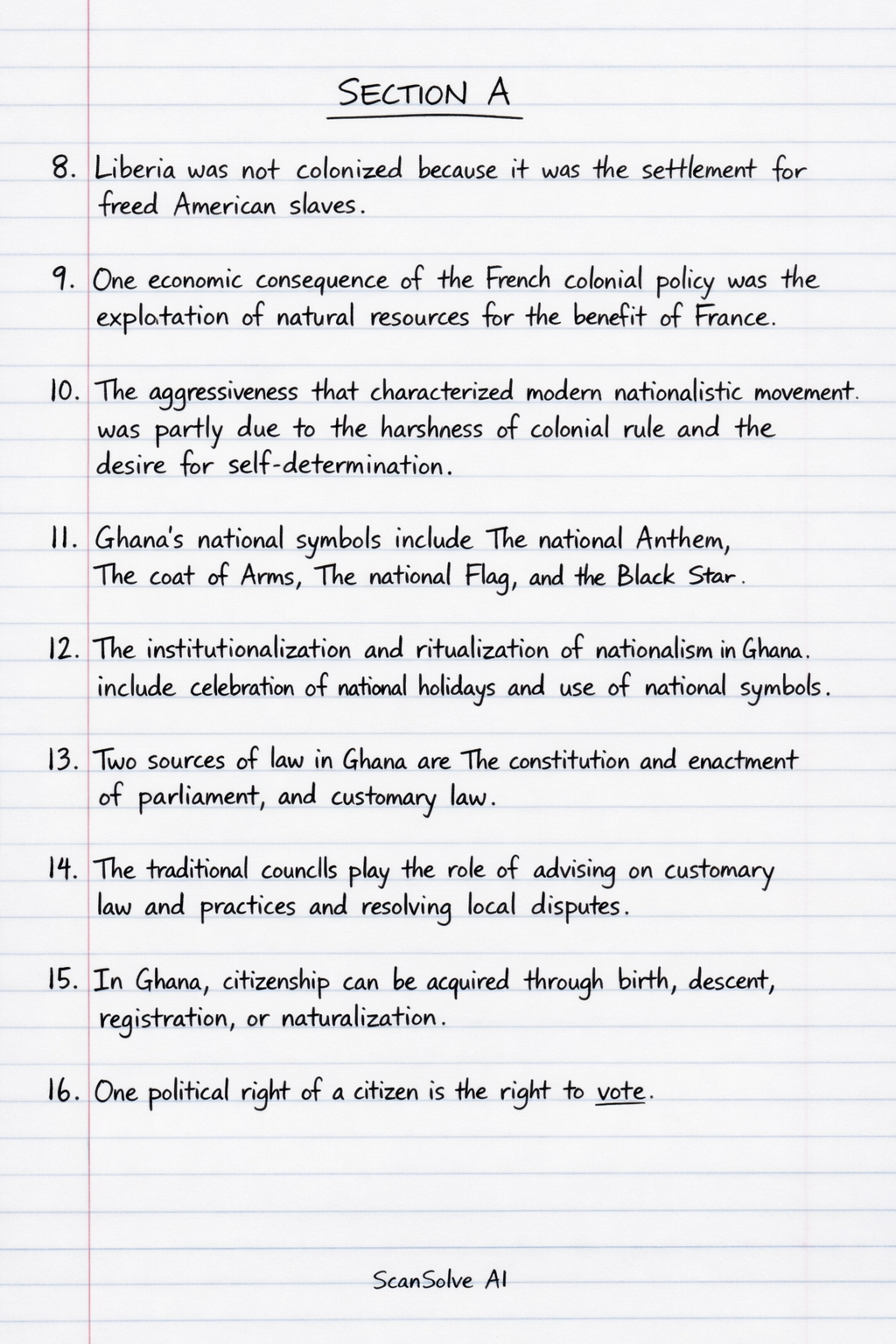
- Liberia was not colonized because it was the settlement for freed American slaves.
- One economic consequence of the French colonial policy was the exploitation of natural resources for the benefit of France.
- The aggressiveness that characterized modern nationalistic movement was partly due to the harshness of colonial rule and the desire for self-determination.
- Ghana's national symbols include The national Anthem, The coat of Arms, The national Flag, and the Black Star.
- The institutionalization and ritualization of nationalism in Ghana include celebration of national holidays and use of national symbols.
- Two sources of law in Ghana are The constitution and enactment of parliament, and customary law.
- The traditional councils play the role of advising on customary law and practices and resolving local disputes.
- In Ghana, citizenship can be acquired through birth, descent, registration, or naturalization.
- One political right of a citizen is the right to vote.
- One limitation to citizenship is restrictions on dual citizenship in certain circumstances.
- Among the roles of political parties are Educate electorates, Train future leaders, and formulating public policy.
- Traditionally, societies relied on the celestial bodies and natural phenomena to tell time.
- One of the roles of the World Bank and the International Monetary Fund is to provide financial assistance and advice to developing countries.
SECTION B
-
One objective of the course African Studies is to promote a deeper understanding of African history, cultures, and societies. This helps students appreciate the continent's rich heritage, diverse perspectives, and contributions to global civilization, challenging stereotypes and fostering informed engagement with African issues.
-
Culture is cumulative means that it builds upon itself over time, with each generation adding to, modifying, and transmitting the knowledge, beliefs, values, and practices inherited from previous generations. It is not static but evolves and grows.
-
Two legal requirements for customary marriage in Ghana are:
- Consent of the families of both the bride and groom.
- Payment of bride price (or 'dowry') by the groom's family to the bride's family.
-
The principle underlying divorce in Ghana is the irretrievable breakdown of the marriage. This means that the marriage has broken down to the extent that the parties cannot reasonably be expected to live together as husband and wife.
-
One implication of the theory of indirect rule is that it strengthened the power of traditional rulers who cooperated with the colonial administration, often at the expense of their people or other traditional authorities.
-
Nationalism is a political ideology and movement characterized by a strong identification of a group of individuals with a nation. It typically involves a belief in the nation's right to self-determination, sovereignty, and the promotion of its interests.
-
Two causes of proto-nationalism in Ghana were:
- Shared grievances against colonial rule, such as economic exploitation and political disenfranchisement.
- Emergence of educated elites who were exposed to Western ideas of self-determination and began to articulate a common identity and desire for independence.
-
Ghana institutionalizes nationalism through national holidays (e.g., Independence Day), national symbols (flag, anthem, coat of arms), and civic education in schools. It ritualizes it through public ceremonies, parades, and memorials that commemorate national heroes and historical events, fostering a sense of shared identity and pride.
-
Three implications of "African Time" are:
- Lack of punctuality: Events and meetings often start later than scheduled.
- Relaxed approach to deadlines: Less emphasis on strict adherence to timeframes.
- Prioritizing social interactions: Valuing relationships and community engagement over rigid timing.
-
The types of citizenship allowed under the laws of Ghana are:
- Citizenship by Birth: A person born in Ghana on or after 6th March 1957, or a person born outside Ghana whose parent is a citizen of Ghana.
- Citizenship by Descent: A person whose parent or grandparent was born in Ghana.
- Citizenship by Registration: For persons who marry a Ghanaian citizen or are of African descent.
- Citizenship by Naturalization: For foreign nationals who have resided in Ghana for a specified period and meet other legal requirements.
-
The International Monetary Fund (IMF) is crucial for maintaining global financial stability by providing financial assistance to countries facing balance of payments problems and promoting international monetary cooperation. The World Bank is vital for reducing poverty and supporting development in developing countries through loans, grants, and technical assistance for projects like infrastructure, education, and health. Together, they work to foster economic growth and stability worldwide, addressing both short-term financial crises and long-term development challenges.
Still stuck on this one?
Ask a follow-up, and the answer starts from this question.
More History Questions
Handwritten Step-by-Step Solution
Get this as a handwritten image on WhatsApp — like a tutor wrote it for you.
Try on WhatsApp