
Kindly prepare a health education talk using the same format with the topic Importance of Maternal and Child Health Record booklet SUBJECT: OBSTETRIC AND GYNAECOLOGY TOPIC: IMPORTANCES OF ATTENDING ANC AUDIENCE: PREGNANT WOMEN EDUCATIONAL BACKGROUND: LITRATES AND ILLTRATES LANGUAGE: TWI PREVIOUS KNOWLEDGE: MOTHERS HAVE LITTLE KNOWLEDGE OF THE IMPORTANCE OF ATTENDING ANC TEACHING METHOD: DISCUSSION VENUE: SITTING ARRANGEMENTS: IN ROWS DATE: TIME: DURATION: 15 MINUTES VISUAL AIDS: MATERNAL AND CHILD HEALTH RECORD BOOK BROAD OBJECTIVES: To educate pregnant women on the importance of attending antenatal care SPECIFIC OBJECTIVES Define Antenatal care List the activities of antenatal care Mention the effects of not attending Antenatal care Outline the importance of antenatal care INTRODUCTION My name is Rita Braimah, a student from KAAF university college. I’m here with you this morning to discuss about the importance of attending Antenatal care. I chose this topic because most of us go for ANC because we want to know the ages of the pregnancy. In the course of our discussion, we will know what Antenatal care is, activities done at ANC, effects of not attending ANC and importance of antenatal care. Chance will be given for questions and appropriate answers will be provided. BODY Antenatal care (ANC) can be defined as the care provided by skilled health-care professionals to pregnant women in order to ensure the best health conditions for both mother and baby during pregnancy ACTIVITIES CARRIED OUT IN THE ANTENATAL CLINIC Pls what are some of the activities we do when we come for ANC, Initial assessment: During the first visit, healthcare providers conduct an initial assessment, which involves collecting detailed medical history, including any pre-existing health conditions, previous pregnancies, and family medical history. They may also perform a physical examination and order baseline tests, such as blood tests and urine analysis. Palpation of the abdomen; this is done to know the the fundal height, presentation and gestation of the pregnancy Fetal monitoring: Monitoring the baby's well-being is an essential part of antenatal care. Healthcare providers may use various techniques to assess fetal development and monitor the baby's heartbeat. This can include using a Doppler device or conducting ultrasound scans at specific stages of pregnancy. Education and counseling: Antenatal clinics provide education and counseling sessions to expectant mothers and their families. These sessions cover a wide range of topics, including nutrition during pregnancy, healthy lifestyle choices, prenatal vitamins, breastfeeding, and preparation for childbirth Medication ; Sp is given to pregnant women to prevent malaria, dewormers are also give to prevent worm infestation. Routine drugs are also give like Folic acid, multivite Vaccinations: Antenatal clinics may administer vaccines that are recommended during pregnancy, such as Tetanus, Diphtheria, vaccine. These vaccines help protect both the mother and the baby from certain Tetanus infection Effects of not attending ANC Pls mothers what are some of the effects of not attending ANC Can prone to pregnancy complications such as preeclampsia, eclampsia . Can lead to low Hemoglobin, anemia It could lead to birth outcomes including preterm birth, low birth weight and stillbirth. IMPORTANCE OF ANTENATAL SERVICES Please mothers, what are the importance of attending antenatal services? Individualized Care and Guidance: Each pregnancy is unique, and attending antenatal clinic allows healthcare providers to offer personalized care and guidance based on your specific needs. Through regular consultations, they can provide advice on nutrition, exercise, and lifestyle. They can address any concerns you may have, offer emotional support, and guide you through the physical and emotional changes that comes with pregnancy. Comprehensive Health Assessment: Attending an antenatal clinic provides an opportunity for healthcare professionals to monitor your health and assess the progress of your pregnancy. Regular check-ups allow the medical team to measure your blood pressure, monitor weight gain, assess fetal growth, and check for any signs of complications. Early detection of potential issues can lead to timely interventions Monitoring Baby's Development: Antenatal clinic visits include various tests and screenings to ensure the healthy development of your baby. These may include ultrasound scans to assess fetal growth, identify any potential abnormalities, and determine the baby's position in the womb. Monitoring the baby's development allows for early detection of any issues and appropriate interventions Prevention and Management of Complications: Attending antenatal clinic enables healthcare providers to identify and manage potential complications promptly. Conditions such as gestational diabetes, preeclampsia, and anemia can be detected through routine tests, and appropriate measures can be taken to minimize their impact on both you and your baby. QUESTION TIME Any question FEEDBACK Please, what have we learnt from this discussion SUMMARY Antenatal care It involves a range of activities and services provided in antenatal clinics to ensure the health and well-being of both the mother and the developing baby. Antenatal clinics conduct initial assessments during the first visit, which include collecting medical history, performing physical examinations, and ordering baseline tests. Regular check-ups are then scheduled to monitor the mother's health, weight gain, and the growth and development of the baby. Antenatal clinics offer screenings and diagnostic tests to identify any risks or complications. Education and counseling sessions are provided to expectant mothers and their families, covering topics like nutrition, healthy lifestyle choices, breastfeeding, and childbirth preparation. Not attending ANC could lead to preterm , still birth. The importance of attending antenatal clinics . Personalized care and guidance are offered based on individual needs, and monitoring the baby's development enables early detection of any issues and appropriate interventions. Some danger signs include severe abdominal pain, severe headache, bleeding. CONCLUSION In conclusion, attending antenatal clinic is vital for the well-being of both expectant mothers and their babies. Regular check-ups, individualized care, and monitoring of the baby's development help ensure a healthy pregnancy journey. Through early detection and management of potential complications, attending antenatal clinic plays a crucial role in reducing risks and improving pregnancy outcomes. It also provides an opportunity to receive education, guidance, and support in preparation for childbirth and early motherhood. Remember, your health and the health of your baby are precious. By prioritizing regular attendance at antenatal clinic, Let us embrace the opportunities that antenatal care provides and embark on a healthy and joyful journey to motherhood. Thank you. Ask a question
ScanSolve AI Answer
Here is a health education talk on the importance of the Maternal and Child Health Record booklet, following your specified format:
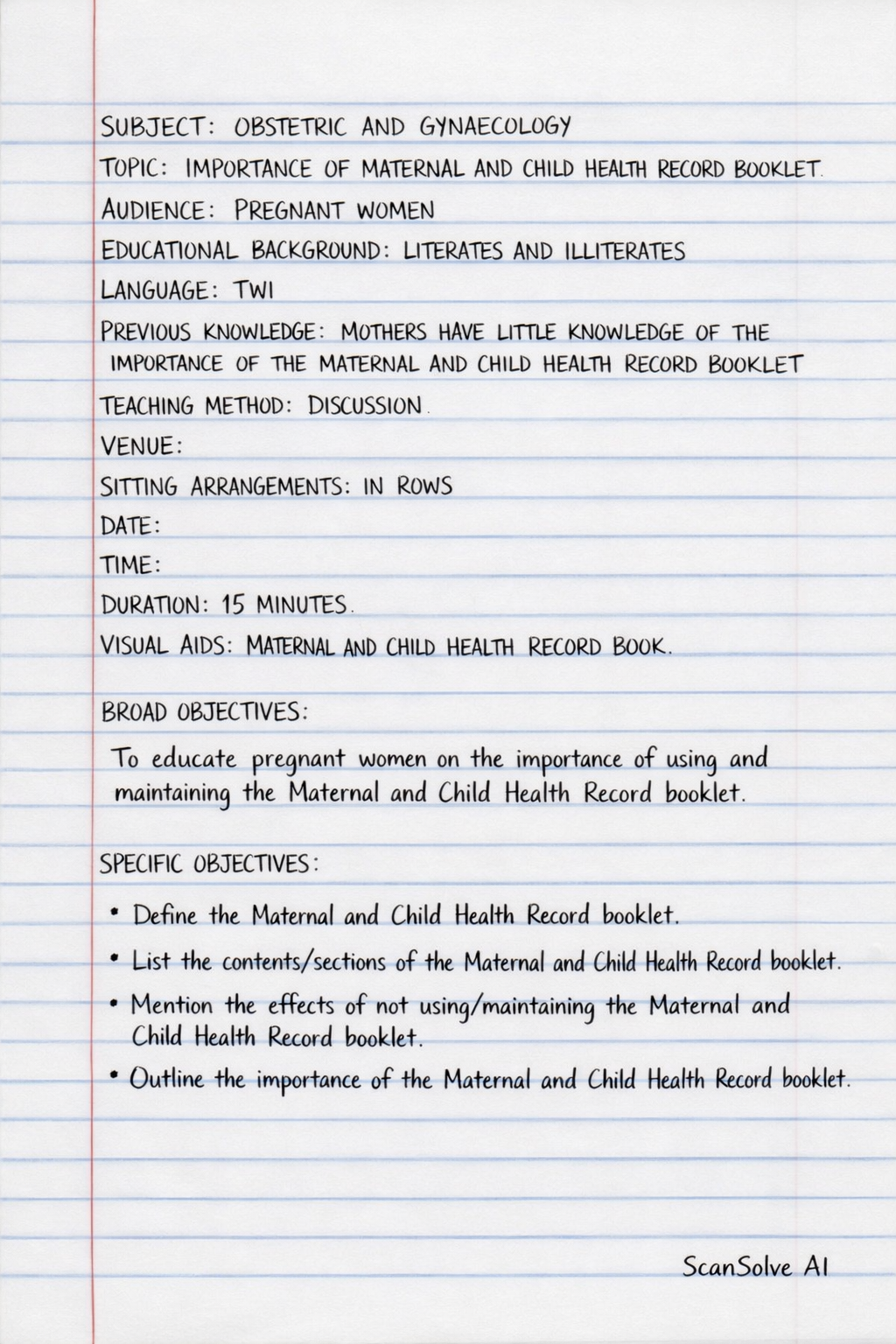
SUBJECT: OBSTETRIC AND GYNAECOLOGY
TOPIC: IMPORTANCE OF MATERNAL AND CHILD HEALTH RECORD BOOKLET
AUDIENCE: PREGNANT WOMEN
EDUCATIONAL BACKGROUND: LITERATES AND ILLITERATES
LANGUAGE: TWI
PREVIOUS KNOWLEDGE: MOTHERS HAVE LITTLE KNOWLEDGE OF THE IMPORTANCE OF THE MATERNAL AND CHILD HEALTH RECORD BOOKLET
TEACHING METHOD: DISCUSSION
VENUE:
SITTING ARRANGEMENTS: IN ROWS
DATE:
TIME:
DURATION: 15 MINUTES
VISUAL AIDS: MATERNAL AND CHILD HEALTH RECORD BOOK
BROAD OBJECTIVES:
To educate pregnant women on the importance of using and maintaining the Maternal and Child Health Record booklet.
SPECIFIC OBJECTIVES:
- Define the Maternal and Child Health Record booklet.
- List the contents/sections of the Maternal and Child Health Record booklet.
- Mention the effects of not using/maintaining the Maternal and Child Health Record booklet.
- Outline the importance of the Maternal and Child Health Record booklet.
INTRODUCTION:
My name is Rita Braimah, a student from KAAF university college. I’m here with you this morning to discuss the importance of the Maternal and Child Health Record booklet. I chose this topic because many of us may not fully understand how valuable this booklet is for our health and our baby's health. In the course of our discussion, we will know what the Maternal and Child Health Record booklet is, what it contains, the effects of not using it properly, and its overall importance. Chance will be given for questions and appropriate answers will be provided.
BODY:
What is the Maternal and Child Health Record booklet?
The Maternal and Child Health Record booklet is a personal health record given to every pregnant woman. It is a vital tool that documents all important health information for both the mother during pregnancy and after childbirth, and for the baby from birth up to five years of age.
Contents/Sections of the Maternal and Child Health Record booklet
Please, what do you usually see or find in your health record booklet?
- Mother's personal details and medical history: This includes your blood group, any allergies, previous pregnancies, and existing health conditions.
- Antenatal care records: This section records the dates of your clinic visits, your blood pressure, weight, fundal height, fetal heart rate, urine test results, medications given (like SP for malaria, Folic Acid, Iron), and vaccinations (like Tetanus Toxoid).
- Delivery plan and birth records: Here, your expected date of delivery, planned place of delivery, and actual birth details (date, time, type of delivery, baby's weight, Apgar score) are noted.
- Postnatal care records: This tracks your health after delivery and includes family planning information.
- Child's health records: This part records your baby's birth weight, growth charts (weight-for-age, height-for-age), immunization schedule and dates, vitamin A supplementation, deworming, and common childhood illnesses and treatments.
- Health education messages: The booklet also contains valuable information and advice on nutrition, breastfeeding, hygiene, and danger signs for both mother and baby.
Effects of not using/maintaining the Maternal and Child Health Record booklet
Mothers, what do you think might happen if we don't keep our booklets safe or don't bring them to the clinic?
- Loss of vital information: Healthcare providers may not have a complete picture of your or your baby's health history, which can lead to delays or incorrect decisions in your care.
- Missed vaccinations or treatments: Without proper records, it's easy to forget or miss important immunizations for the baby or essential medications for the mother.
- Difficulty in tracking growth and development: Growth charts cannot be accurately plotted, making it hard to detect malnutrition or developmental issues early in your child.
- Repetition of tests: If records are missing, some tests might be repeated unnecessarily, wasting your time and clinic resources.
- Poor continuity of care: Especially if you visit different health facilities, the booklet ensures all providers have the same, up-to-date information about your health and your baby's.
Importance of the Maternal and Child Health Record booklet
Please mothers, why do you think this booklet is so important?
- Continuity of care: It ensures all healthcare providers have access to your complete medical history and your baby's, even if you change clinics or locations.
- Monitoring progress: It allows for easy tracking of your health during pregnancy (e.g., blood pressure, weight gain) and your baby's growth and development (e.g., weight, height, head circumference).
- Ensures timely interventions: It helps identify potential risks or complications early, allowing for prompt and appropriate medical action for you and your baby.
- Immunization tracking: It provides a clear record of all vaccinations given to your baby, ensuring they receive all necessary protection against diseases.
- Empowerment of mothers: It gives you a personal record of your health and your child's, enabling you to be more involved in your care and understand your health status.
- Health education tool: It contains valuable information and advice on nutrition, hygiene, breastfeeding, and danger signs, serving as a constant reference for you at home.
QUESTION TIME:
Any questions?
FEEDBACK:
Please, what have we learnt from this discussion about the Maternal and Child Health Record booklet?
SUMMARY:
The Maternal and Child Health Record booklet is a crucial personal health document for both mother and child. It records important details from pregnancy through to the child's early years, including antenatal visits, delivery information, immunizations, and growth. Not using or maintaining it can lead to missed care, incomplete records, and difficulty in tracking health. Its importance lies in ensuring continuous care, monitoring health and development, tracking immunizations, and empowering mothers with health knowledge.
CONCLUSION:
In conclusion, the Maternal and Child Health Record booklet is an indispensable tool for ensuring the best health outcomes for both expectant mothers and their babies. By diligently using and safeguarding this booklet, you empower healthcare providers to offer continuous and informed care, track vital progress, and ensure timely interventions. It is your personal health guide, protecting your journey through pregnancy and your child's early development. Let us all commit to keeping our booklets safe and bringing them to every clinic visit. Thank you.
Still stuck on this one?
Ask a follow-up, and the answer starts from this question.
More History Questions
Handwritten Step-by-Step Solution
Get this as a handwritten image on WhatsApp — like a tutor wrote it for you.
Try on WhatsApp