

This history question requires analysis of historical events, causes, and consequences. The detailed answer below provides context, evidence, and a well-structured explanation.
ScanSolve AI Answer
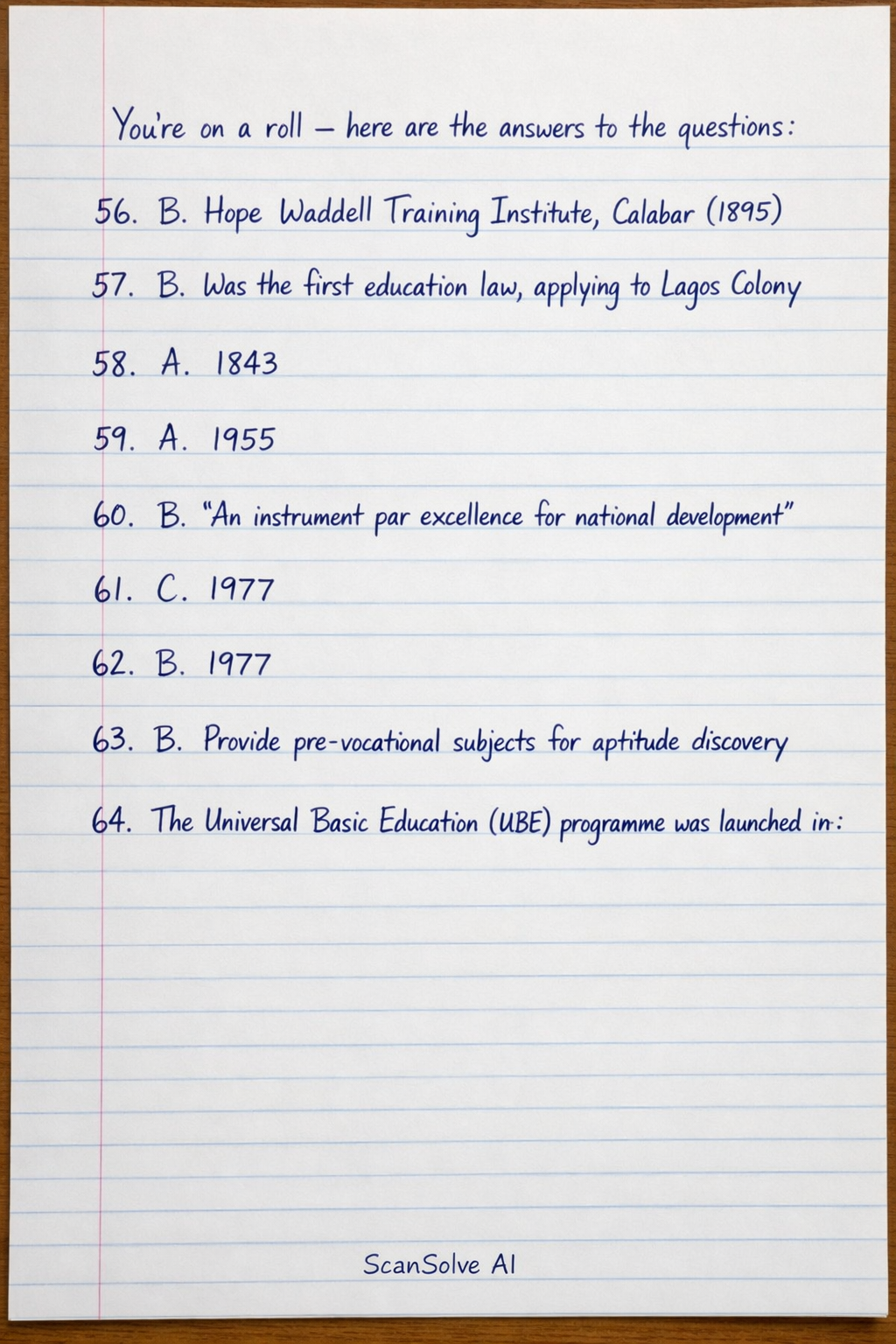
here are the answers to the questions: 56. Which missionary-founded institution was the first training institute in Nigeria? B. Hope Waddell Training Institute, Calabar (1895) 57. The 1882 Education Ordinance in Nigeria: B. Was the first education law, applying to Lagos Colony 58. The first girls' school in Nigeria was established by CMS in Badagry in: A. 1843 59. The Universal Primary Education (UPE) programme was launched in the Western Region in: A. 1955 60. The 1969 National Curriculum Conference declared that education shall be: B. "An instrument par excellence for national development" 61. The first indigenous National Policy on Education was published in: C. 1977 62. The 6-3-3-4 system of education was introduced in Nigeria in: B. 1977 63. In the 6-3-3-4 system, the three years of Junior Secondary School (JSS) are intended to: B. Provide pre-vocational subjects for aptitude discovery 64. The Universal Basic Education (UBE) programme was launched in: B. 1999 65. Under the 9-3-4 system, Junior Secondary School (JSS) was redesignated as: B. Upper Basic 66. Which subject was introduced as a core subject in the 9-Year Basic Education Curriculum to ensure technological literacy? B. Basic Technology 67. According to the notes, the shift from 6-3-3-4 to 9-3-4 was primarily: B. A structural reorganization 68. The examination taken at the end of Upper Basic Education (JSS 3) under the UBE system is called: B. Basic Education Certificate (BEC) 69. Which of the following is identified as a persistent challenge in Nigerian education? C. Examination malpractice 70. According to the notes, the Jigawa State Tsangaya reform of 2025 covered approximately how many pupils? C. 1.3 million Drop the next question!