
We read your photo as:
Show how Moses demonstrated his obedience to the God of Israel and the importance of the decalogue to Christians today.
ScanSolve AI Answer
Here are the answers to your questions.
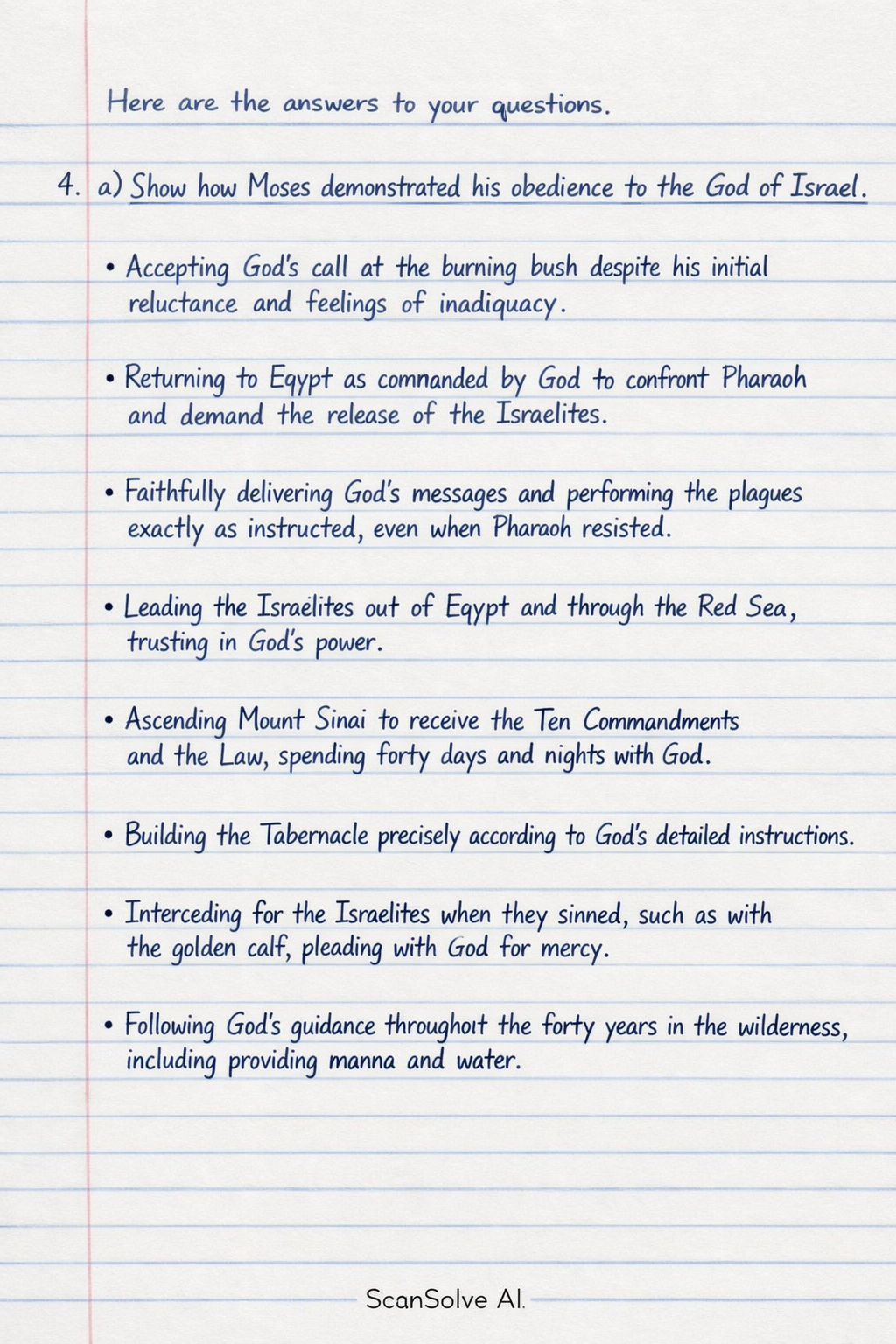
4. a) Show how Moses demonstrated his obedience to the God of Israel.
Moses demonstrated his obedience to God by:
- Accepting God's call at the burning bush despite his initial reluctance and feelings of inadequacy.
- Returning to Egypt as commanded by God to confront Pharaoh and demand the release of the Israelites.
- Faithfully delivering God's messages and performing the plagues exactly as instructed, even when Pharaoh resisted.
- Leading the Israelites out of Egypt and through the Red Sea, trusting in God's power.
- Ascending Mount Sinai to receive the Ten Commandments and the Law, spending forty days and nights with God.
- Building the Tabernacle precisely according to God's detailed instructions.
- Interceding for the Israelites when they sinned, such as with the golden calf, pleading with God for mercy.
- Following God's guidance throughout the forty years in the wilderness, including providing manna and water.
4. b) What is the importance of the decalogue to Christians today?
The Decalogue (Ten Commandments) is important to Christians today because:
- It provides fundamental moral and ethical guidelines for living a righteous life, reflecting God's character.
- It serves as a standard for self-examination, revealing human sinfulness and the need for God's grace.
- It teaches Christians about God's expectations for their relationship with Him and with fellow human beings.
- It forms the basis for many civil laws and societal values, promoting order and justice.
- It is fulfilled and interpreted through the teachings of Jesus Christ, particularly the commands to love God and neighbor.
- It helps Christians understand the holiness and justice of God.
4. c) What can Christians learn about God on the call of Moses in the wilderness?
From the call of Moses in the wilderness, Christians can learn that God is:
- A personal God who knows individuals by name and is concerned with the suffering of His people.
- A holy God who demands reverence and respect, as shown by Moses removing his sandals.
- A compassionate God who hears the cries of the oppressed and acts to deliver them.
- A powerful God who can use ordinary individuals to accomplish extraordinary tasks.
- A faithful God who remembers His covenant promises to His people.
- A God who equips those He calls, providing assurance and signs to overcome fear and doubt.
5. a) Explain five ways on how Moses was prepared by God to be the future leader of the Israelites.
- Egyptian education: Moses was educated in Pharaoh's palace, gaining knowledge in administration, military strategy, and diplomacy, which were crucial for leading a nation.
- Leadership experience: His position in Pharaoh's household likely exposed him to leadership principles and the complexities of governance.
- Understanding of Egyptian culture: Living in Egypt gave him insight into the culture and power structures he would later confront.
- Humility and patience in Midian: His forty years as a shepherd in Midian taught him humility, patience, and dependence on God, stripping him of his Egyptian pride.
- Direct encounter with God: The burning bush experience gave him a personal revelation of God, divine authority, and a clear mission.
- Family background: Being an Israelite by birth connected him to his people and their heritage, fostering empathy for their plight.
5. b) Identify six similarities between the Jewish Passover and Christian Easter.
- Both involve sacrifice: A lamb for Passover, Jesus (the Lamb of God) for Easter.
- Both commemorate liberation/deliverance: From slavery in Egypt for Passover, from sin and death for Easter.
- Both involve blood: The blood of the lamb on doorposts for Passover, the blood of Jesus shed on the cross for Easter.
- Both are associated with a meal: The Passover Seder, and the Last Supper (which was a Passover meal) leading to the Christian Eucharist.
- Both signify new beginnings: Freedom and a new nation for Israel, new life and salvation for Christians.
- Both are remembrance events: Remembering God's mighty acts of salvation.
5. c) State four reasons why Christians should live by laws of God.
- To demonstrate their love and obedience to God, as commanded by Jesus.
- To live a life that pleases God and reflects His holy character.
- To experience God's blessings and protection in their lives.
- To promote justice, peace, and order in society and within the Christian community.
- To serve as a witness to non-believers about the transforming power of God.
- To avoid sin and its destructive consequences.
6. a) State seven ways in which the Israelites worshipped God in the wilderness during the Exodus.
- Offering sacrifices (burnt offerings, peace offerings, sin offerings) at the Tabernacle.
- Observing festivals such as Passover, Unleavened Bread, Weeks, and Tabernacles.
- Presenting various offerings like grain offerings, drink offerings, and firstfruits.
- Worshipping at the Tabernacle, which was the central place of God's presence.
- Praying and crying out to God in times of need or distress.
- Obeying God's laws and commandments as a form of worship.
- Singing praises and songs of deliverance and thanksgiving.
- Consulting God through Moses and the High Priest (e.g., using the Urim and Thummim).
6. b) Outline the new understanding Moses gave the Israelites about the nature of God from the Exodus.
Moses gave the Israelites a new understanding of God as:
- A deliverer and redeemer who actively intervenes to save His people from oppression.
- A covenant-keeping God who remembers His promises to Abraham, Isaac, and Jacob.
- A holy and righteous God who demands purity and obedience from His people.
- A powerful and sovereign God who controls nature and defeats mighty empires (e.g., Pharaoh).
- A present God who dwells among His people in the Tabernacle and guides them with a pillar of cloud and fire.
- A jealous God who demands exclusive worship and tolerates no other gods.
- A law-giver who provides clear instructions for righteous living.
6. c) Give six reasons why Christians should not covet their neighbours property.
- Coveting is a direct violation of the Tenth Commandment, "You shall not covet."
- It leads to discontentment and dissatisfaction with what God has provided.
- It can lead to other sins such as stealing, lying, or even murder to acquire what is coveted.
- It demonstrates a lack of trust in God's provision and sovereignty.
- It fosters selfishness and greed, which are contrary to Christian values of generosity and love.
- It harms relationships with neighbors, creating envy and resentment.
- It distracts from focusing on spiritual blessings and eternal treasures.
7. a) Describe the covenant making between God and the Israelites at Mt. Sinai (Exodus 24:1-8).
The covenant making at Mt. Sinai involved several steps:
- God's invitation: God called Moses, Aaron, Nadab, Abihu, and seventy elders to come up the mountain to worship Him.
- Moses' mediation: Moses first went up alone to receive God's laws and words.
- Presentation of the Law: Moses returned to the people, read all of God's words and laws to them.
- People's affirmation: The people responded unanimously, "All the words the Lord has spoken we will do."
- Writing the words: Moses wrote down all the words of the Lord.
- Altar and sacrifices: Moses built an altar at the foot of the mountain with twelve pillars, representing the twelve tribes of Israel. Young men offered burnt offerings and peace offerings of oxen to the Lord.
- Blood ritual: Moses took half the blood and put it in basins, and the other half he sprinkled on the altar. He then took the book of the covenant and read it aloud to the people, who again affirmed, "All that the Lord has spoken we will do, and we will be obedient."
- Sealing the covenant: Moses then took the blood from the basins and sprinkled it on the people, saying, "Behold the blood of the covenant that the Lord has made with you in accordance with all these words." This act symbolized the binding agreement and purification.
7. b) Explain seven Israelites new understanding of God from the Exodus to the renewal of the covenant.
From the Exodus to the renewal of the covenant, the Israelites gained a new understanding of God as:
- Yahweh, the self-existent God: They learned His personal name and that He is the "I AM WHO I AM," a God who is always present and active.
- A powerful deliverer: They understood Him as the God who miraculously freed them from slavery in Egypt and parted the Red Sea.
- A covenant-making God: They realized He is a God who makes binding agreements with His people and keeps His promises.
- A holy and righteous law-giver: They understood that He is a God who provides moral and ceremonial laws for their well-being and to guide their worship.
- A provider and sustainer: They experienced Him as the God who provided manna, quail, and water in the wilderness.
- A jealous God: They learned He demands exclusive worship and will not tolerate idolatry.
- A forgiving and merciful God: Despite their repeated disobedience (e.g., golden calf), He was willing to renew His covenant and continue to lead them.
- A God of judgment: They witnessed His judgment against Pharaoh and against their own rebellion.
8. a) Describe the call of Moses.
The call of Moses occurred while he was tending the flock of his father-in-law Jethro in Midian.
- Burning bush: Moses led the flock to Horeb, the mountain of God, where he saw a bush burning with fire, yet it was not consumed.
- God's voice: God called to him from the bush, "Moses! Moses!" and instructed him to remove his sandals because he was standing on holy ground.
- God's self-revelation: God identified Himself as the God of Abraham, Isaac, and Jacob, and revealed His awareness of the Israelites' suffering in Egypt.
- God's mission: God commanded Moses to go to Pharaoh and bring the Israelites out of Egypt.
- Moses' reluctance: Moses expressed several objections, questioning his own ability ("Who am I?"), God's name, the Israelites' belief, and his speaking ability.
- God's assurance and signs: God assured Moses of His presence ("I will be with you"), revealed His name as "I AM WHO I AM," and gave him miraculous signs (staff turning into a snake, hand becoming leprous, water turning to blood) to convince both the Israelites and Pharaoh.
- Aaron's assistance: God appointed Moses' brother Aaron to be his spokesman due to Moses' perceived speech impediment.
8. b) Explain the conditions given to the Israelites during the renewal of the Sinai covenant.
During the renewal of the Sinai covenant, the conditions given to the Israelites emphasized:
- Exclusive worship of Yahweh: They were to worship only the Lord God
Still stuck on this one?
Ask a follow-up, and the answer starts from this question.
More History Questions
Handwritten Step-by-Step Solution
Get this as a handwritten image on WhatsApp — like a tutor wrote it for you.
Try on WhatsApp