
We read your photo as:
Define National Philosophy and explain the origin of African Socialism, Harambee, and Nyayo philosophy.
ScanSolve AI Answer
Here are the solutions for the questions in the new image:
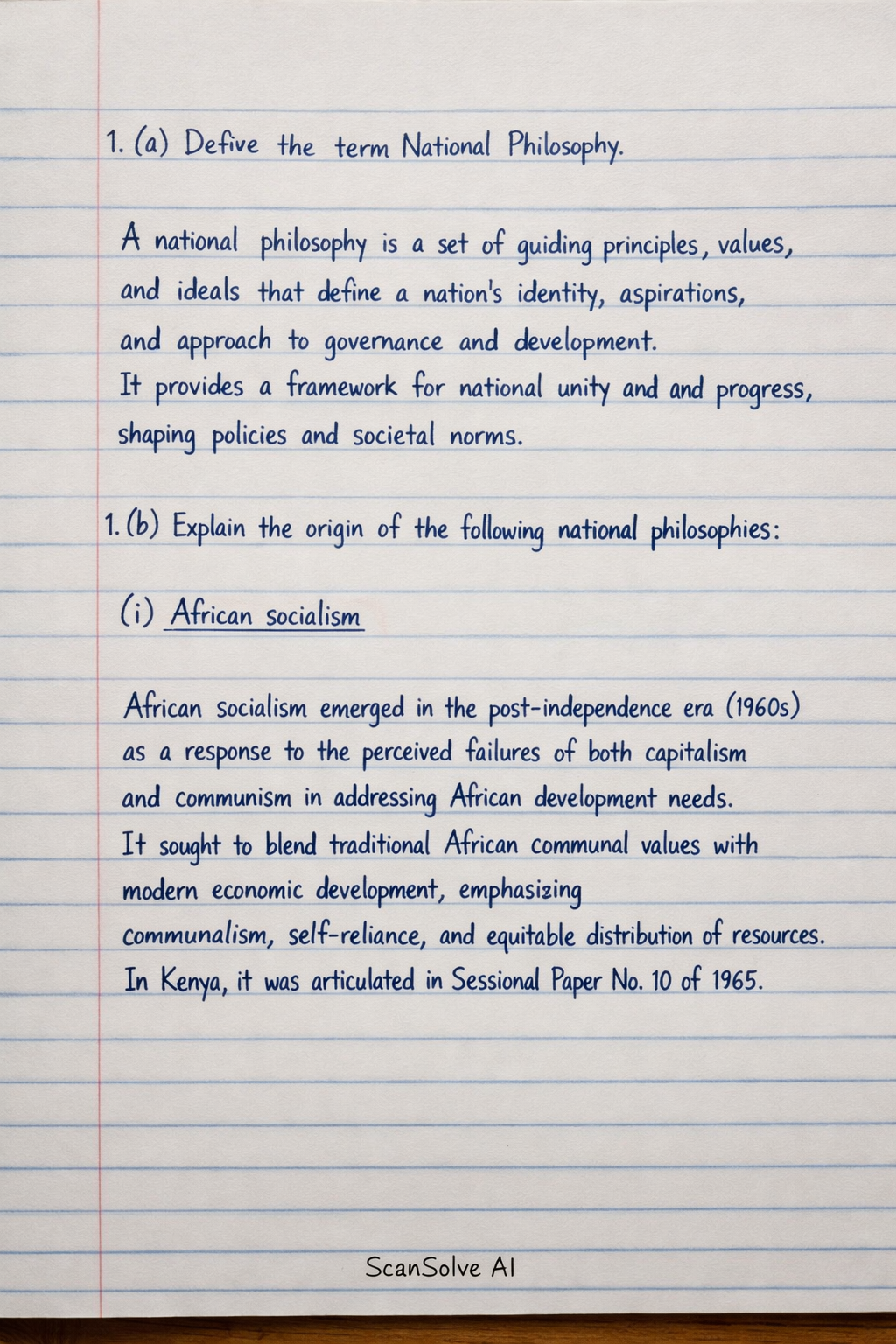
1. (a) Define the term National Philosophy.
A national philosophy is a set of guiding principles, values, and ideals that define a nation's identity, aspirations, and approach to governance and development. It provides a framework for national unity and progress, shaping policies and societal norms.
1. (b) Explain the origin of the following national philosophies:
(i) African socialism
African socialism emerged in the post-independence era (1960s) as a response to the perceived failures of both capitalism and communism in addressing African development needs. It sought to blend traditional African communal values with modern economic development, emphasizing communalism, self-reliance, and equitable distribution of resources. In Kenya, it was articulated in Sessional Paper No. 10 of 1965.
(ii) Harambee philosophy
Harambee is a Kenyan philosophy rooted in the Swahili word meaning "pulling together." It was popularized by Kenya's first President, Jomo Kenyatta, shortly after independence in 1963. It encouraged community self-help and collective effort for national development, particularly in building schools, hospitals, and other infrastructure projects.
(iii) Nyayo philosophy
Nyayo philosophy was introduced by Kenya's second President, Daniel arap Moi, when he took office in 1978. The word "Nyayo" means "footsteps" in Swahili, signifying that Moi would follow in the footsteps of his predecessor, Jomo Kenyatta. Its core tenets were Peace, Love, and Unity, aiming to foster national cohesion and development.
2. (a) Discuss the contributions of Harambee to national development.
- Infrastructure Development: Harambee projects led to the construction of numerous schools, health centers, cattle dips, and roads, especially in rural areas, improving access to essential services.
- Community Empowerment: It fostered a sense of ownership and collective responsibility among communities, empowering them to initiate and manage their own development projects.
- National Unity: The spirit of "pulling together" promoted national cohesion and solidarity, transcending ethnic and regional differences for common goals.
- Resource Mobilization: It mobilized local resources, both human and financial, for development initiatives, complementing government efforts.
2. (b) Give the shortcomings of Harambee philosophy to National development.
- Corruption and Mismanagement: Funds collected through Harambee were sometimes misused or embezzled, leading to incomplete projects or poor quality work.
- Inequality: Wealthier individuals and regions could raise more funds, leading to uneven development and widening disparities between communities.
- Burden on Citizens: It placed a heavy financial burden on ordinary citizens, who were often pressured to contribute, sometimes beyond their means.
- Political Manipulation: Harambee rallies were often used by politicians to gain popularity and consolidate power, rather than purely for community development.
3. Identify the characteristics of African socialism that promote national development in Kenya.
- Political Democracy: Emphasized democratic governance, ensuring citizen participation in decision-making.
- African Nationalism: Promoted national unity and identity, rejecting tribalism and regionalism.
- Mutual Social Responsibility: Encouraged collective responsibility for the welfare of all citizens, especially the vulnerable.
- Various Forms of Ownership: Advocated for a mixed economy with state, cooperative, and private ownership, aiming for equitable distribution of wealth.
- Progressive Taxation: Implemented tax systems designed to reduce income inequality.
4. Explain challenges which faced the Nyayo philosophy.
- Authoritarianism: Despite promoting "Peace, Love, and Unity," the Nyayo era was marked by increasing authoritarianism, suppression of dissent, and human rights abuses, contradicting its stated ideals.
- Economic Stagnation: The economy faced significant challenges, including corruption, mismanagement of state corporations, and a decline in living standards for many Kenyans.
- Ethnic Divisions: Despite calls for unity, ethnic tensions persisted and were sometimes exacerbated by political patronage and resource allocation.
- Corruption: Widespread corruption, often associated with the "Nyayo era," undermined public trust and diverted resources meant for development.
- Suppression of Multi-partyism: The philosophy was used to justify a one-party state, stifling political pluralism and democratic reforms.
Still stuck on this one?
Ask a follow-up, and the answer starts from this question.
More History Questions
Handwritten Step-by-Step Solution
Get this as a handwritten image on WhatsApp — like a tutor wrote it for you.
Try on WhatsApp