
We read your photo as:
Which of the following events occurred under the direct orders and participation of Lij Iyassu?
ScanSolve AI Answer
Answer
Step-by-step solution
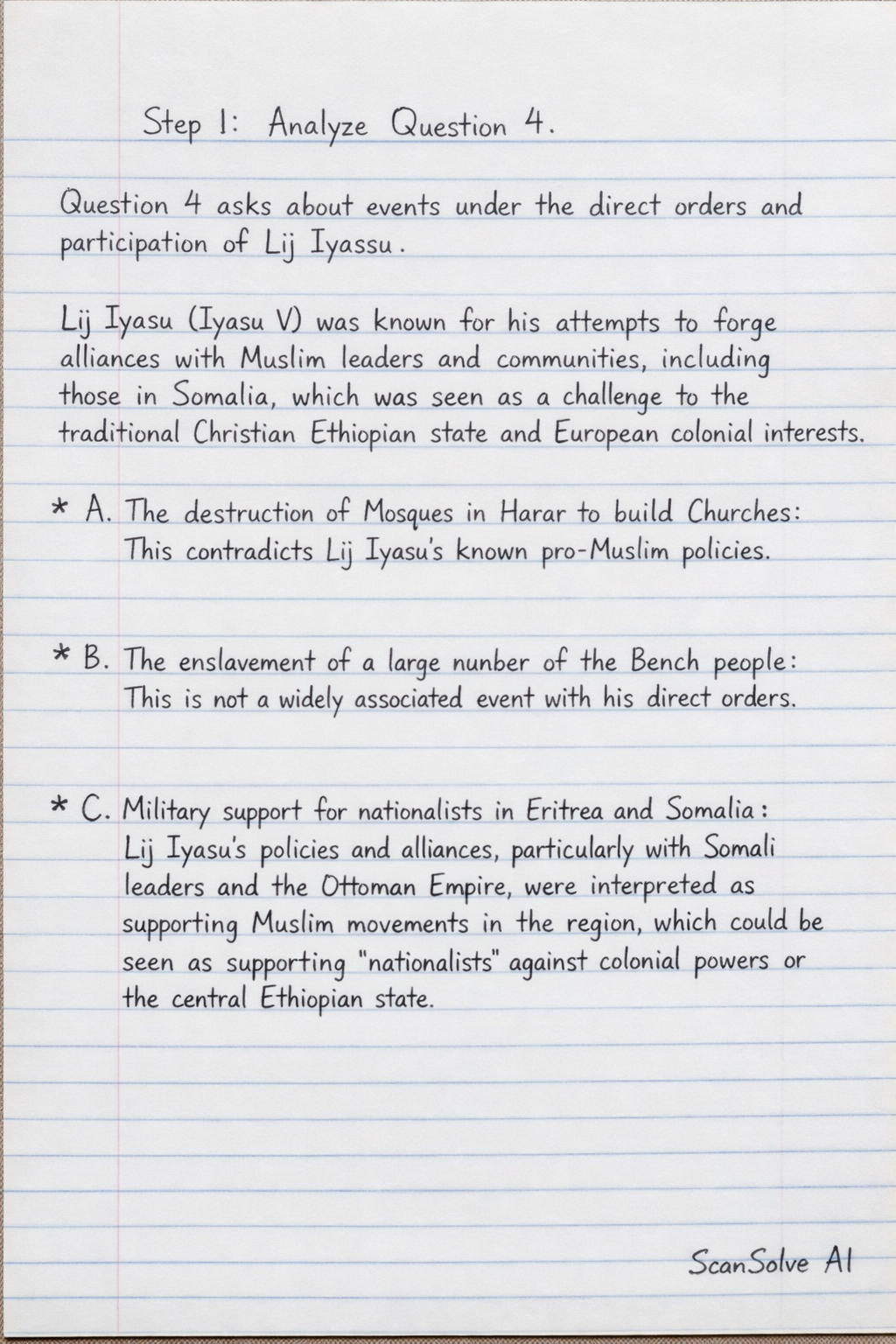
2 stepsStep 1: Analyze Question 4.
Question 4 asks about events under the direct orders and participation of Lij Iyassu. Lij Iyasu (Iyasu V) was known for his attempts to forge alliances with Muslim leaders and communities, including those in Somalia, which was seen as a challenge to the traditional Christian Ethiopian state and European colonial interests.
- A. The destruction of Mosques in Harar to build Churches: This contradicts Lij Iyasu's known pro-Muslim policies.
- B. The enslavement of a large number of the Bench people: This is not a widely associated event with his direct orders.
- C. Military support for nationalists in Eritrea and Somalia: Lij Iyasu's policies and alliances, particularly with Somali leaders and the Ottoman Empire, were interpreted as supporting Muslim movements in the region, which could be seen as supporting "nationalists" against colonial powers or the central Ethiopian state.
- D. The battle fought at Segelle against the forces of Shewa: This battle occurred in 1916, after Lij Iyasu's deposition, and was fought by forces loyal to his father against the new regime. Lij Iyasu was not directly involved in ordering or participating in it as the reigning emperor.
Based on historical context, option C is the most accurate description of his controversial foreign policy and alliances.
The correct option is C.
Step 2: Analyze Question 5.
Part 5· 2 steps
asks about regions in Ethiopia that saw the expansion of commercial agriculture in the 1960s and early 1970s under foreign investment.
- A. The Gibe-Gojeb confluence: Not primarily known for this type of commercial agricultural expansion during that era.
- B. Setit Humera: Known for sesame and other crops, but not as prominent for large-scale foreign-invested commercial agriculture during this specific period as other regions.
- C. Hararge: While having agricultural activity, it was not the primary region for large-scale foreign-backed commercial expansion during this period.
- D. The Awash Valley: This region is historically recognized for significant expansion of large-scale commercial agriculture, particularly cotton and sugar plantations, with substantial foreign investment and irrigation projects during the 1960s and 1970s.
The correct option is D.
Analyze Question 6.
Question 6 asks about the aims of the leaders of the 1960 coup attempt against Haile Selassie. The 1960 coup, led by Germame Neway and Mengistu Neway, aimed to modernize Ethiopia and establish a more democratic system.
- A. creation of a socialist form of government: This was not the primary aim of the 1960 coup leaders; socialism became prominent later with the Derg regime.
- B. introduction of radical land reform: While land reform was a significant issue, the immediate political goal of the coup was to change the system of governance.
- C. establishment of a constitutional monarchy: The coup leaders intended to replace Emperor Haile Selassie with his son, Crown Prince Asfaw Wossen, but under a new system where the monarch's powers would be limited by a constitution.
- D. abolition of the monarchy once and for all: This was not their goal; they sought to reform the monarchy, not abolish it.
The correct option is C.
Analyze Question 7.
Part 7
asks what is true about the 1950 UN decision to federate Eritrea with Ethiopia.
- A. The Eritrean public was consulted before the decision: Historical evidence indicates that the Eritrean public was not consulted through a popular referendum or similar democratic process.
- B. Educated Eritreans were consulted while the masses of the population were not: While various Eritrean political factions and leaders presented their views to the UN commission, there was no comprehensive consultation of "educated Eritreans" in a democratic sense, and certainly not the masses.
- C. The Eritrean people were not consulted before the decision: This is the most accurate statement. The UN decision was largely a geopolitical one, and the Eritrean population as a whole did not have a direct say through a popular vote.
- D. The masses of Eritrea were consulted while the educated were overlooked: This is incorrect.
The correct option is C.
Final Answer: 4. The correct option is C. 5. The correct option is D. 6. The correct option is C. 7. The correct option is C.
Here are the answers: 4. The correct option is 5. The correct option is 6. The correct option is 7. The correct option is
Try one yourself
A new problem that tests the same skill.
Still stuck on this one?
Ask a follow-up, and the answer starts from this question.
More History Questions
Handwritten Step-by-Step Solution
Get this as a handwritten image on WhatsApp — like a tutor wrote it for you.
Try on WhatsApp