
We read your photo as:
Explain the reasons for the Paris Peace Conference and outline the terms of the Treaty of Versailles.
ScanSolve AI Answer
Step-by-step solution
3 stepsHere's the answer to question 8:
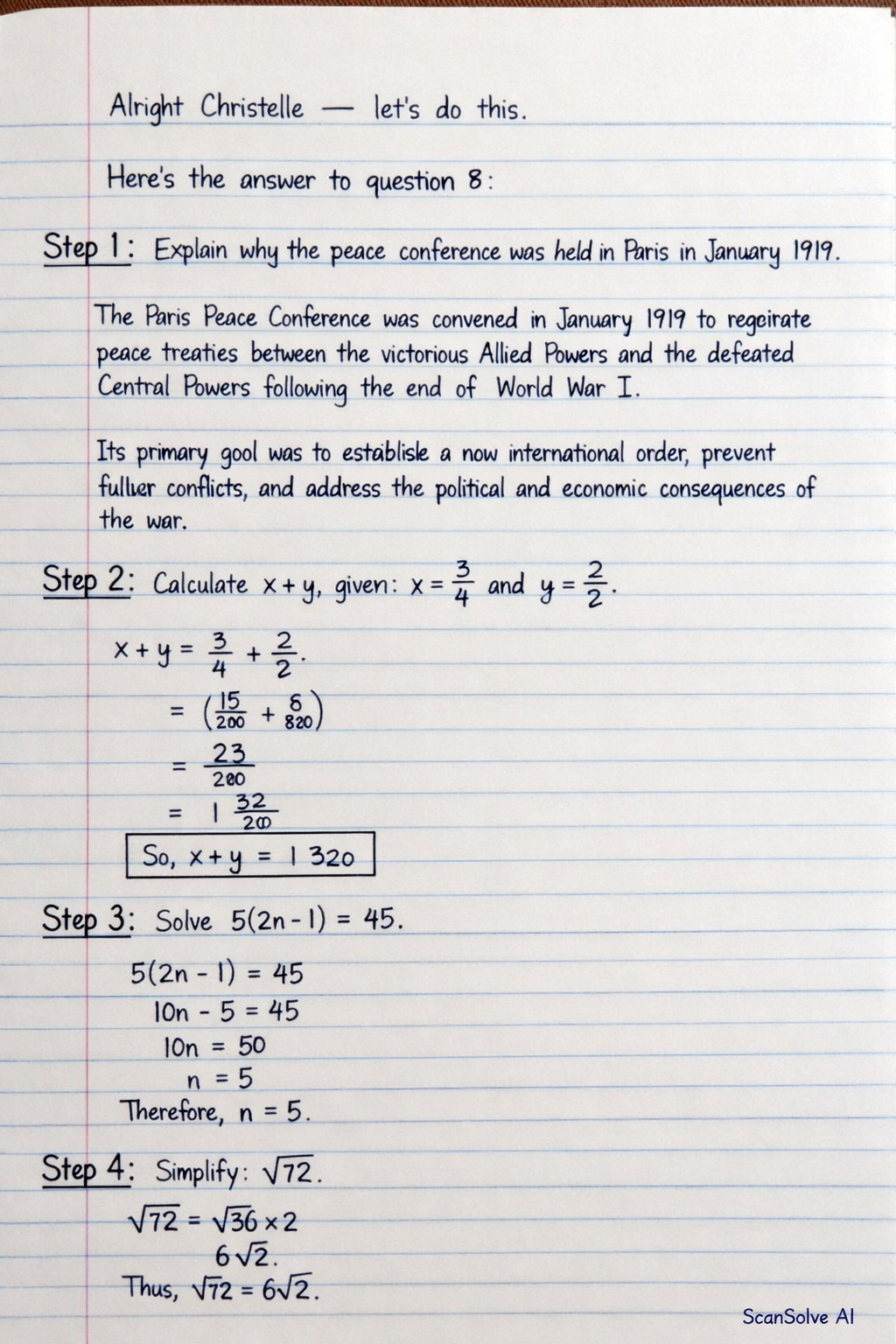
Explain why the peace conference was held in Paris in January 1919.
The Paris Peace Conference was convened in January 1919 to negotiate peace treaties between the victorious Allied Powers and the defeated Central Powers following the end of World War I. Its primary goal was to establish a new international order, prevent future conflicts, and address the political and economic consequences of the war.
Outline the terms of the Versailles Treaty.
The Treaty of Versailles, signed on June 28, 1919, imposed several harsh terms on Germany:
- Territorial Losses: Germany lost Alsace-Lorraine to France, Eupen-Malmédy to Belgium, and West Prussia and Posen to Poland (creating the Polish Corridor). All German colonies were surrendered and became mandates under the League of Nations. The Rhineland was demilitarized.
- Military Restrictions: The German army was limited to 100,000 men, conscription was banned, and Germany was forbidden from possessing an air force, submarines, or heavy artillery.
- Reparations: Germany was forced to pay substantial war reparations to the Allied Powers to compensate for war damages.
- War Guilt Clause (Article 231): Germany was compelled to accept sole responsibility for causing World War I, which was deeply humiliating.
- League of Nations: The treaty also established the League of Nations, though Germany was initially excluded.
Explain why Germany rejected the Versailles Treaty.
Germany rejected the Treaty of Versailles for several key reasons:
- Diktat: German representatives were not allowed to negotiate the terms but were simply presented with the treaty to sign, leading them to call it a "Diktat" (dictated peace).
- War Guilt Clause: Article 231, which forced Germany to accept full blame for the war, was seen as a national humiliation and historically inaccurate.
- Reparations: The enormous sum of reparations was viewed as economically crippling and unjust, threatening Germany's recovery.
- Territorial Losses: The loss of significant territory, including industrial regions and colonies, was deeply resented as it weakened Germany's economic and strategic position.
- Military Restrictions: The severe limitations on Germany's armed forces were seen as an infringement on its sovereignty and ability to defend itself.
The Treaty of Versailles was ultimately signed under protest by Germany, leading to long-lasting resentment and contributing to future political instability.
Still stuck on this one?
Ask a follow-up, and the answer starts from this question.
More History Questions
Handwritten Step-by-Step Solution
Get this as a handwritten image on WhatsApp — like a tutor wrote it for you.
Try on WhatsApp