
We read your photo as:
Section 1: World War II Question. 1.1 Read Sources 1A below and answer the questions. 1.1.1 What was the Weimar Republic? 1.1.2 What made the Weimar Republic weak? 1.1.3 What destroyed the Weimar Republic?
ScanSolve AI Answer
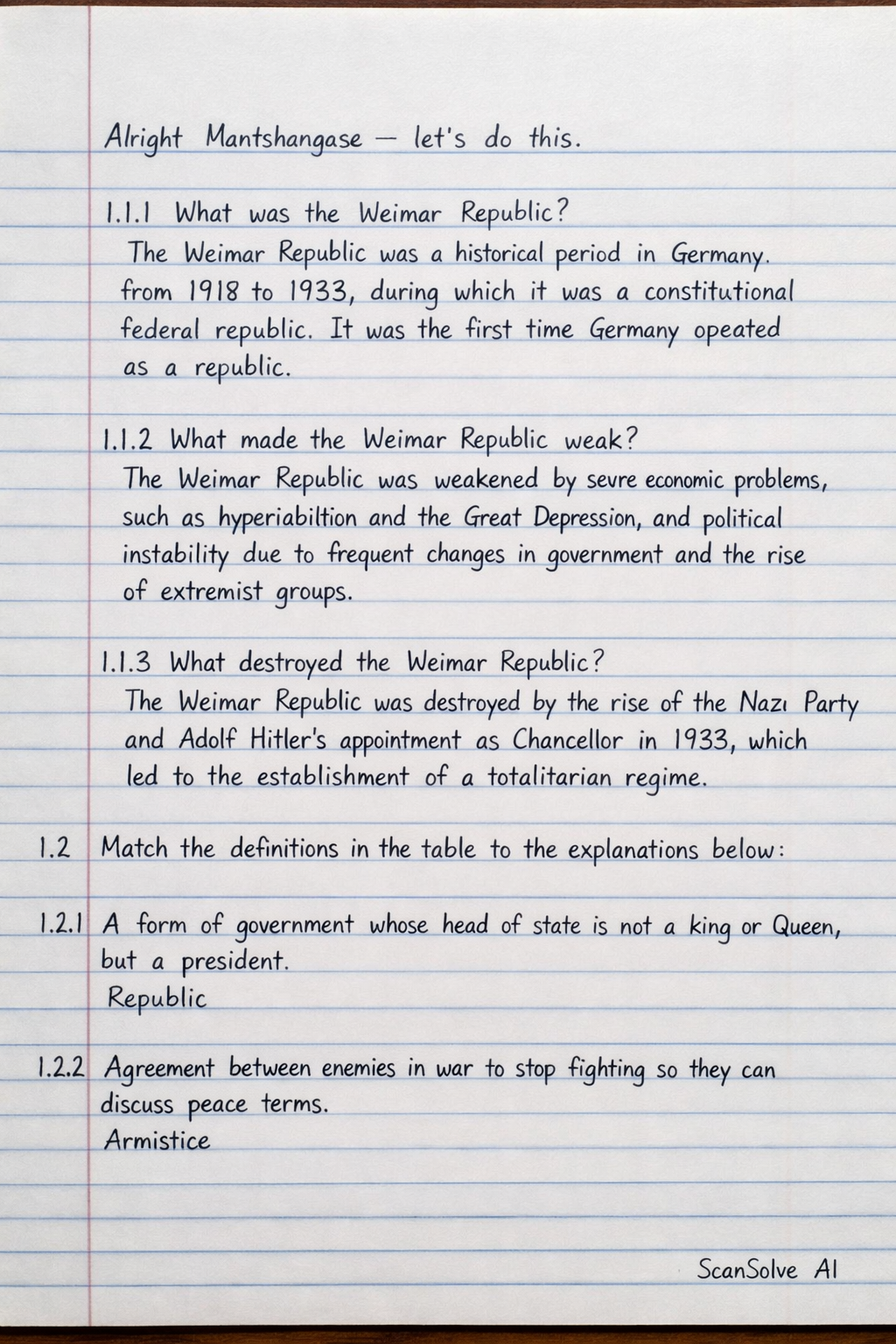
1.1.1 What was the Weimar Republic?
The Weimar Republic was a historical period in Germany from 1918 to 1933, during which it was a constitutional federal republic. It was the first time Germany operated as a republic.
1.1.2 What made the Weimar Republic weak?
The Weimar Republic was weakened by severe economic problems, such as hyperinflation and the Great Depression, and political instability due to frequent changes in government and the rise of extremist groups.
1.1.3 What destroyed the Weimar Republic?
The Weimar Republic was destroyed by the rise of the Nazi Party and Adolf Hitler's appointment as Chancellor in 1933, which led to the establishment of a totalitarian regime.
1.2 Match the definitions in the table to the explanations below:
1.2.1 A form of government whose head of state is not a king or Queen, but a president.
- Republic
1.2.2 Agreement between enemies in war to stop fighting so they can discuss peace terms.
- Armistice
1.3.3 Mention FOUR terms of the Treaty of Versailles which were seen as unfair by the Germans.
- The War Guilt Clause (Article 231) forced Germany to accept sole responsibility for starting World War I.
- Germany was required to pay massive reparations to the Allied powers.
- Germany lost significant territory and all its overseas colonies.
- Germany's military was severely restricted, limiting its army, navy, and air force.
1.3.4 How did the Germans feel about the terms of the Treaty of Versailles towards them?
The Germans felt deeply humiliated, betrayed, and resentful about the terms of the Treaty of Versailles, viewing it as a "Diktat" (dictated peace) rather than a negotiated agreement.
1.3.5 Name two countries that were present at the signing of the treaty.
- France
- Great Britain
Still stuck on this one?
Ask a follow-up, and the answer starts from this question.
More History Questions
Handwritten Step-by-Step Solution
Get this as a handwritten image on WhatsApp — like a tutor wrote it for you.
Try on WhatsApp