

This history question requires analysis of historical events, causes, and consequences. The detailed answer below provides context, evidence, and a well-structured explanation.
ScanSolve AI Answer
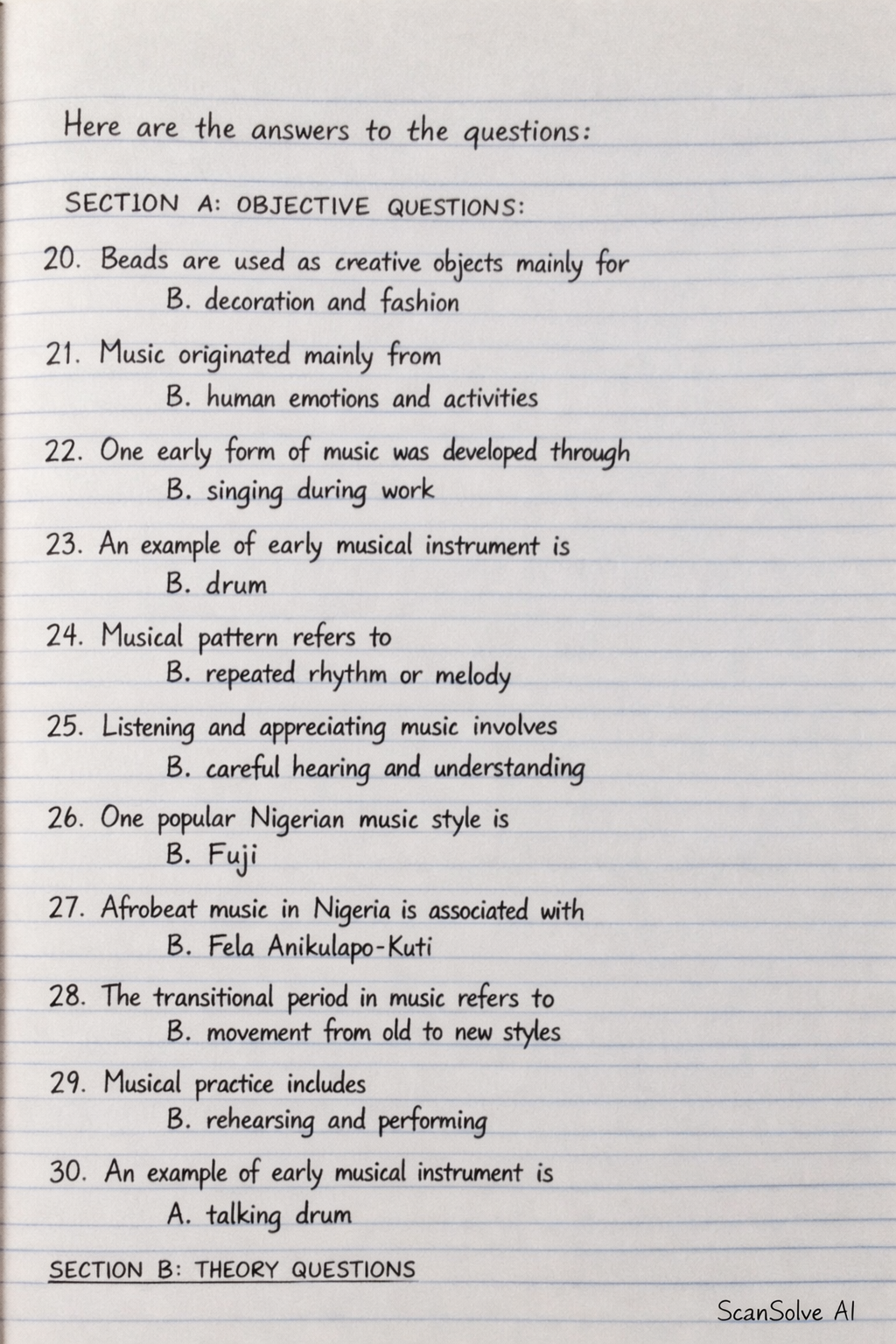
Here are the answers to the questions: SECTION A: OBJECTIVE QUESTIONS 20. Beads are used as creative objects mainly for B. decoration and fashion* 21. Music originated mainly from B. human emotions and activities* 22. One early form of music was developed through B. singing during work* 23. An example of early musical instrument is B. drum* 24. Musical pattern refers to B. repeated rhythm or melody* 25. Listening and appreciating music involves B. careful hearing and understanding* 26. One popular Nigerian music style is B. Fuji* 27. Afrobeat music in Nigeria is associated with B. Fela Anikulapo-Kuti* 28. The transitional period in music refers to B. movement from old to new styles* 29. Musical practice includes B. rehearsing and performing* 30. An example of early musical instrument is A. talking drum* SECTION B: THEORY QUESTIONS 1. Explain painting from observation and outline the steps involved in painting an object using colour. Painting from observation* is the art of creating an image by directly looking at a real object, person, or scene rather than working from imagination or a photograph. It emphasizes capturing what the artist sees in terms of form, light, shadow, and color. Steps involved in painting an object using color: 1. Observation: Carefully study the object's form, light source, shadows, and colors. 2. Sketching: Lightly draw the basic outline and proportions of the object on the canvas or paper. 3. Blocking in major shapes and values: Apply broad areas of color to establish the main light and dark tones. 4. Mixing colors: Accurately mix paints to match the observed hues, values, and intensities. 5. Adding details and refining: Gradually add finer details, textures, and adjust colors and values to create depth and realism. 6. Finishing touches: Review the painting for overall balance, make final adjustments, and ensure all elements are cohesive. 2. What is pattern through design? Explain the process of making a pattern and state two sources of motifs. Pattern through design* refers to the systematic repetition of a visual unit or motif to create a cohesive and often decorative arrangement. This repetition can be regular or irregular, creating rhythm and visual interest. Process of making a pattern: 1. Select a motif: Choose a single design unit, which can be a simple shape, an object, or an abstract form. 2. Determine arrangement: Decide on the method of repetition, such as a simple repeat, half-drop, mirror, or rotational arrangement. 3. Repeat the motif: Systematically duplicate and arrange the chosen motif according to the determined arrangement across the surface. 4. Refine and color: Adjust the spacing, size, and orientation of the motifs, and add colors to enhance the overall pattern. Two sources of motifs: 1. Nature: Flowers, leaves, animals, landscapes, and natural elements. 2. Geometric shapes: Circles, squares, triangles, lines, and other abstract forms. 3. Define beadwork. Explain how beads are produced in different media for jewellery making. Beadwork* is the art or craft of attaching beads to one another by stringing them with a needle and thread or wire, or by sewing them onto a cloth, to create decorative objects, jewelry, or garments. How beads are produced in different media for jewellery making: Glass beads:* Molten glass is shaped by blowing, drawing, or pressing into various forms. It can be cut, faceted, or decorated while hot, then cooled and drilled. Plastic beads:* Plastic pellets are melted and injected into molds, or extruded into rods that are then cut, shaped, and polished. Wood beads:* Wood is carved, turned on a lathe, or drilled and then often sanded, stained, or painted to create various bead shapes and finishes. Metal beads:* Metal is cast into molds, stamped, hammered, or wire-wrapped into bead shapes. They can be polished, plated, or oxidized for different effects. Stone beads:* Natural stones are cut, drilled, tumbled, and polished into desired bead forms, often retaining their unique natural patterns and colors. 4. Discuss the origin of music and mention three early forms of music around the world. The origin of music* is believed to be deeply rooted in prehistoric human history, predating written language. It likely emerged from vocalizations, body percussion, and the use of simple natural objects to express emotions, communicate, coordinate activities, and participate in rituals. Music served as a fundamental aspect of human culture, social bonding, and spiritual practices. Three early forms of music around the world: 1. Chant and Vocalizations: Simple melodic lines, often monophonic, used in religious ceremonies, storytelling, and as a means of communication or expression during work. 2. Percussion-based Music: Rhythmic music created using drums, rattles, clappers, and body percussion (clapping, stomping) for dances, rituals, and communal gatherings. 3. Folk Music: Traditional songs and instrumental pieces passed down orally within communities, often reflecting daily life, historical events, and cultural values of a specific region or group. 5. Explain musical pattern and discuss how Nigerians listen to and appreciate popular music. A musical pattern* refers to the repetition of a specific rhythmic, melodic, or harmonic idea within a piece of music. This repetition creates structure, predictability, and often a sense of groove or familiarity, making the music memorable and engaging. How Nigerians listen to and appreciate popular music: 1. Dance and Movement: A primary way Nigerians engage with popular music is through dancing, as rhythm and beat are central to the appreciation and enjoyment of most genres. 2. Lyrical Content: Lyrics, often delivered in local languages or Pidgin English, are highly valued for their storytelling, social commentary, humor, and ability to convey relatable messages. 3. Social and Communal Experience: Music is integral to social gatherings, celebrations, and parties, fostering a communal sense of enjoyment and shared cultural experience. 4. Call and Response: Active participation through singing along, responding to lead vocals, or engaging in call-and-response patterns is a common and appreciated aspect of listening. 5. Cultural Connection: Appreciation often stems from the music's connection to cultural identity, traditional sounds, and contemporary Nigerian experiences, making it deeply resonant. 6. Write short notes on the following: a) Musical style* A musical style* refers to the characteristic way music is created and performed, defined by its distinct features such as melody, harmony, rhythm, instrumentation, form, and emotional content. Styles evolve over time and are often associated with specific historical periods, cultures, or genres (e.g., Baroque, Jazz, Hip-Hop, Fuji). b) Musical instrument* A musical instrument* is a device created or adapted to make musical sounds. Instruments are typically categorized into families based on how they produce sound, such as aerophones (wind instruments), chordophones (string instruments), membranophones (drums), idiophones (percussion instruments like rattles), and electrophones (electronic instruments).