
SECTION B – CALCULATIONS ESTIMATIONS Q1. Scenario 1: Estimating Disease Prevalence A team of public health researchers conducts a cross-sectional study to estimate the prevalence of anemia among children under the age of five in a rural district. They randomly sample 250 children and find that 60 of them are anemic. Task: a) Calculate the 95% confidence interval for the true prevalence of anemia in this district. b) Based on your calculated interval, provide a public health interpretation of the result. Is it plausible that the true prevalence of anemia in the district is 30%? Why or why not? Q2. Scenario 2: Evaluating Intervention Precision A national health institute is evaluating two independent pilot studies for a new health promotion program designed to reduce average daily sodium intake among adults at risk for hypertension. Both studies report the same mean reduction in sodium intake, but they have different sample sizes and confidence intervals. Study A (Small-Scale Pilot): Involved 85 participants. It reported a mean reduction in sodium intake of 350 mg/day with a 95% confidence interval of (250 mg/day, 450 mg/day). Study B (Large-Scale Pilot): Involved 850 participants. It reported a mean reduction in sodium intake of 350 mg/day with a 95% confidence interval of (330 mg/day, 370 mg/day). Task: a) Which study provides a more precise estimate of the true mean reduction in sodium intake for the target population? b) Justify your answer by explaining what aspect of the confidence intervals allows you to make this conclusion. Scenario-Based Questions on Hypothesis Testing Q3. Scenario 3: Evaluating a Smoking Cessation Intervention A public health agency implements a new 8-week intensive smoking cessation program in a city. To evaluate its effectiveness, they recruit 100 adult smokers who want to quit. They randomly assign 50 of them to the intervention group (which receives the new program) and 50 to the control group (which receives a standard brochure with quitting information). After 8 weeks, they measure the number of cigarettes smoked per day in each group. The results are as follows: Intervention Group (n₁ = 50): Mean (x̄₁) = 12 cigarettes/day, Standard Deviation (s₁) = 4 cigarettes/day. Control Group (n₂ = 50): Mean (x̄₂) = 15 cigarettes/day, Standard Deviation (s₂) = 5 cigarettes/day. Task: Conduct a hypothesis test at the α = 0.05 significance level to determine if the new intervention program is more effective at reducing the mean number of cigarettes smoked per day compared to the standard brochure. Q4. Scenario 4: Investigating a Foodborne Illness Outbreak A local public health department is investigating an outbreak of gastroenteritis following a company banquet. They suspect the cause was the potato salad served. To test this hypothesis, they interview all 120 attendees about whether they ate the potato salad and whether they subsequently became ill. The data is summarized in the following contingency table: Task: Conduct a chi-square test of independence at the α = 0.01 significance level to determine if there is a statistically significant association between eating the potato salad and developing gastroenteritis Scenario-Based Calculation Problem: Linear Correlation Coefficient (r) Q5. Scenario A researcher is investigating the potential association between population-level diet and the prevalence of a chronic non-communicable disease. She collects data from six different regions within a country. For each region, she gathers the average daily per capita consumption of added sugar (in grams) and the age-adjusted prevalence of type 2 diabetes in adults (as a percentage). The data is presented below: Task: a) Calculate the linear correlation coefficient (r) for this dataset to quantify the relationship between average sugar consumption and the prevalence of type 2 diabetes. b) Interpret the meaning of your calculated 'r' value in the context of this public health investigation. Be sure to comment on the direction and strength of the association and its implications. Q6. Scenario A public health officer is investigating the potential link between short-term air pollution and emergency room visits for asthma in a mid-sized city. Over five separate days, following a local festival, she records the average daily concentration of fine particulate matter (PM2.5) and the number of asthma-related emergency room (ER) visits. The data is presented below: Task: a) Calculate the linear correlation coefficient (r) for this dataset to quantify the relationship between PM2.5 levels and asthma ER visits. b) Interpret the meaning of your calculated 'r' value in the context of this public health investigation. Be sure to comment on the direction and strength of the association Q7. A longitudinal study was conducted in a rural district to assess the impact of a new water sanitation program on child health. The program's primary goal was to reduce rates of diarrheal disease. Researchers collected data from 10 different villages. For each village, they calculated the percentage of households with access to the improved sanitation facilities and the corresponding incidence rate of diarrheal disease (cases per 1,000 child-years) over a two-year follow-up period. The statistical analysis from the study reported a linear correlation coefficient of r = -0.82 between the percentage of household sanitation coverage and the incidence rate of childhood diarrheal disease. Task: a) Based on the provided correlation coefficient, describe the direction, strength, and meaning of the observed relationship between sanitation coverage and diarrheal disease incidence. b) The national health ministry is considering investing heavily to expand this sanitation program to other similar districts. Using the value of r = -0.82, what is one key quantitative and one key qualitative conclusion you would advise them to consider regarding the potential impact of this program? (Note: You do not need to perform any further calculations). Q8. Scenario 2: Lassa Fever Outbreak in Kailahun Village The Sierra Leone Ministry of Health and Sanitation (MoHS) dispatches a rapid response team to investigate a suspected Lassa fever outbreak in Kailahun Village, located in the Eastern Province. The outbreak is suspected to have occurred over a three-week period in January. The village has a total population of 2,400 individuals. The team's investigation confirms 96 cases of Lassa fever during this period. Among the confirmed cases, 24 individuals unfortunately succumbed to the disease. Task: a) First, provide a clear definition for each of the following measures: i. Attack Rate ii. Case Fatality Rate (CFR) Then, calculate both the Attack Rate and the Case Fatality Rate for the Lassa fever outbreak in Kailahun Village. b) Interpret the meaning of the calculated Case Fatality Rate. Furthermore, explain the difference in public health utility between the Attack Rate and the Case Fatality Rate. Specifically, why would a health officer use the Attack Rate to guide one type of intervention (e.g., control of spread) and the CFR to guide another type of intervention (e.g., clinical management)? Q9. Scenario : Lassa Fever Outbreak in Kailahun Village The Sierra Leone Ministry of Health and Sanitation (MoHS) dispatches a rapid response team to investigate a suspected Lassa fever outbreak in Kailahun Village, located in the Eastern Province. The outbreak is suspected to have occurred over a three-week period in January. The village has a total population of 2,400 individuals. The team's investigation confirms 96 cases of Lassa fever during this period. Among the confirmed cases, 24 individuals unfortunately succumbed to the disease. Task: a) First, provide a clear definition for each of the following measures: i. Attack Rate ii. Case Fatality Rate (CFR) Then, calculate both the Attack Rate and the Case Fatality Rate for the Lassa fever outbreak in Kailahun Village. b) Interpret the meaning of the calculated Case Fatality Rate. Furthermore, explain the difference in public health utility between the Attack Rate and the Case Fatality Rate. Specifically, why would a health officer use the Attack Rate to guide one type of intervention (e.g., control of spread) and the CFR to guide another type of intervention (e.g., clinical management)?
History
ScanSolve AI Answer
This answer stops before the end.
It was cut off when it was first written. Ask ScanSolve this question again for the full working.
**
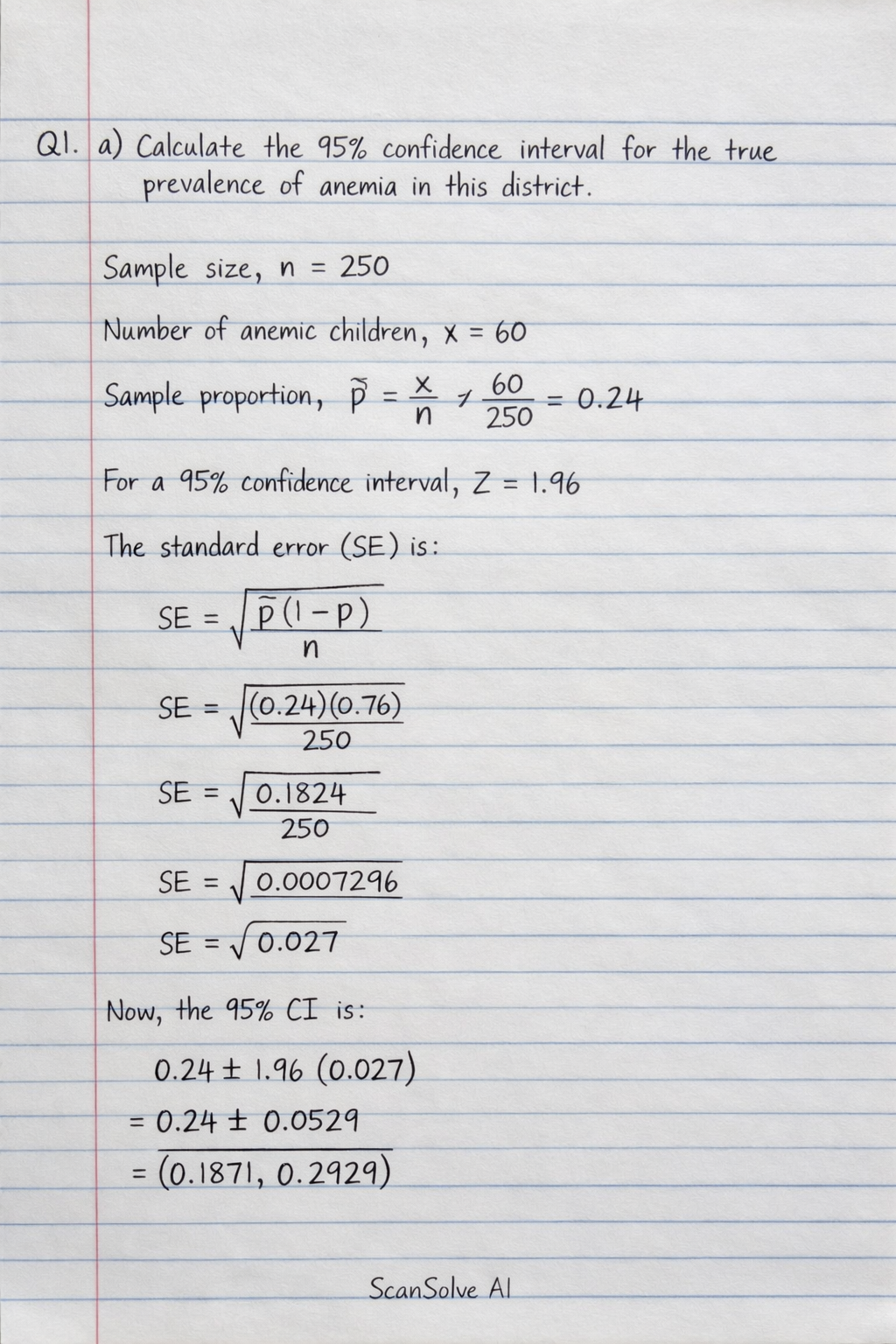
Q1. Scenario 1: Estimating Disease Prevalence
- a) Calculate the 95% confidence interval for the true prevalence of anemia in this district.
- Sample size,
- Number of anemic children,
- Sample proportion (prevalence),
- For a 95% confidence interval, the Z-score (critical value) is .
- The standard error of the proportion is:
Was this helpful?
Still stuck on this one?
Ask a follow-up, and the answer starts from this question.
Got a different question?Ask your own question
More History Questions
QFrequency Measures - The Vital Signs of Population Health: Multiple-Choice Questions 1. What does…QDefine the null hypothesis (H₀) and alternative hypothesis (H₁) in the context of testing whether a…QAnswers have been provided already. Choose the correct one. Kindly attempt all the questions A…QBased on the context provided by previous questions about diseases, their consequences, economic…QFinal Answer The number of students tested in the city is 150. The probability of a student testing…
Handwritten Step-by-Step Solution
Get this as a handwritten image on WhatsApp — like a tutor wrote it for you.
Try on WhatsApp