
We read your photo as:
Write short notes on the following as it affects early days of pathology: a) Clay tablets b) 4 humors c) Galen
ScanSolve AI Answer
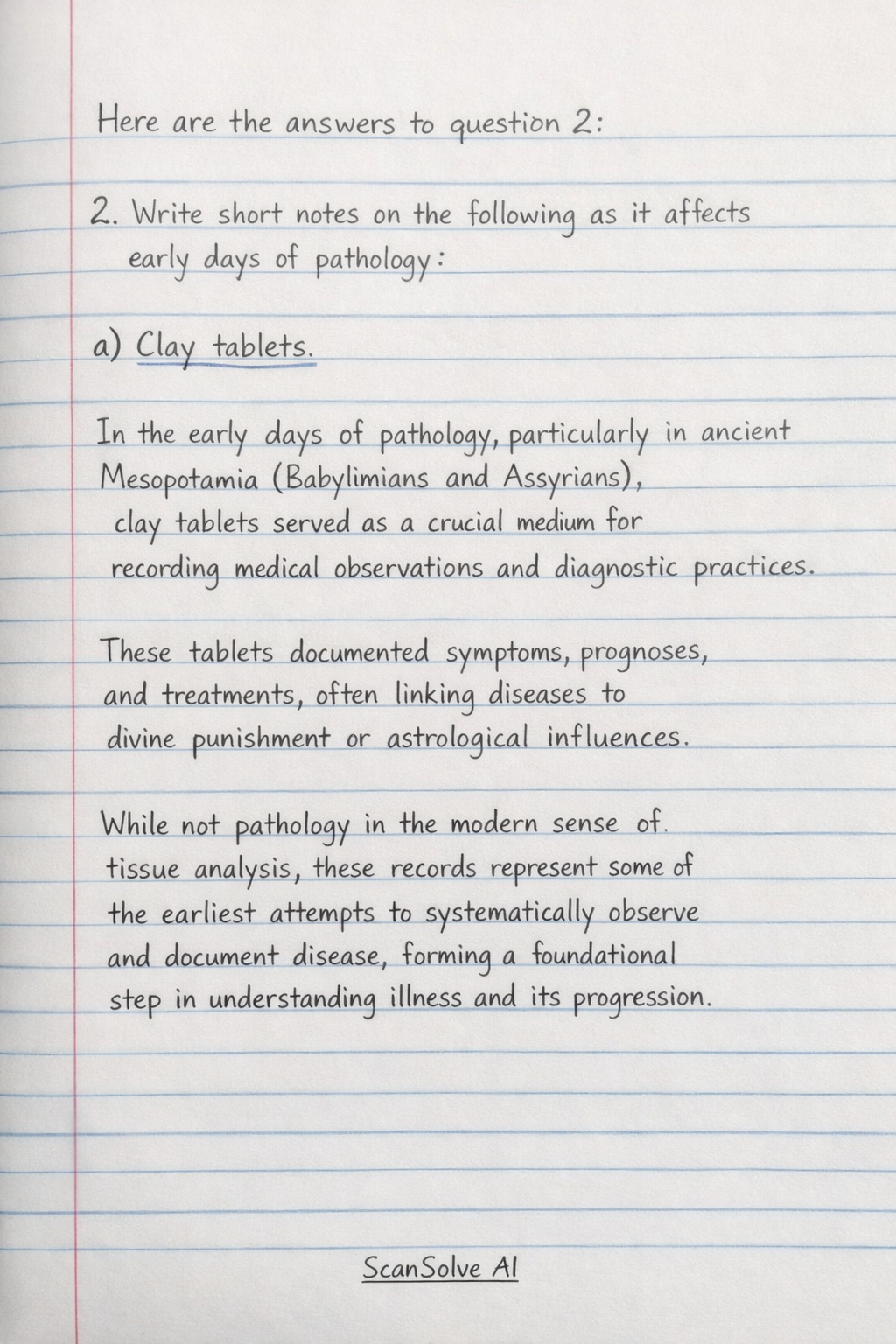
Here are the answers to question 2:
2. Write short notes on the following as it affects early days of pathology:
a) Clay tablets
In the early days of pathology, particularly in ancient Mesopotamia (Babylonians and Assyrians), clay tablets served as a crucial medium for recording medical observations and diagnostic practices. These tablets documented symptoms, prognoses, and treatments, often linking diseases to divine punishment or astrological influences. While not pathology in the modern sense of tissue analysis, these records represent some of the earliest attempts to systematically observe and document disease, forming a foundational step in understanding illness and its progression.
b) 4 humors
The theory of the four humors (blood, phlegm, yellow bile, and black bile) was a dominant medical concept from ancient Greece through the Middle Ages, significantly influencing early pathology. Proposed by Hippocrates and later expanded by Galen, this theory posited that health depended on the balance of these four bodily fluids. Disease was believed to result from an imbalance or corruption of these humors. Early diagnostic practices, therefore, focused on assessing the quantity and quality of these humors through observation of bodily fluids (like urine, blood, and sputum) and symptoms, guiding treatments like bloodletting or purging to restore balance.
c) Galen
Galen (c. 129 – c. 216 AD), a prominent Greek physician and philosopher, profoundly influenced early pathology through his extensive writings and anatomical studies. Building upon Hippocrates' humoral theory, Galen developed a comprehensive system of medicine that dominated Western thought for over a millennium. He performed dissections on animals, contributing significantly to anatomical knowledge, and emphasized the importance of observing symptoms and bodily excretions (like urine) for diagnosis. His detailed descriptions of disease processes and his systematic approach to diagnosis and prognosis laid much of the groundwork for the development of pathology, even though his anatomical findings were often based on animals rather than humans.
d) De Urinis
De Urinis (On Urines) refers to a significant medieval text written by Isaac Judaeus (Isaac Israeli ben Solomon) in the 10th century. This treatise was highly influential in the early days of pathology, particularly in the practice of uroscopy (visual examination of urine). The text systematically described how to diagnose diseases by observing the color, clarity, sediment, and even smell of urine. Uroscopy became a primary diagnostic tool for physicians for centuries, as it was one of the few non-invasive ways to gain insight into a patient's internal state. De Urinis codified these practices, making urine analysis a central component of early medical diagnosis and a precursor to modern clinical pathology.
Still stuck on this one?
Ask a follow-up, and the answer starts from this question.
More History Questions
Handwritten Step-by-Step Solution
Get this as a handwritten image on WhatsApp — like a tutor wrote it for you.
Try on WhatsApp