
Specialized Expertise as a Competitive Advantage The scenario explicitly states that the company’s "competitive advantage is driven by specialised expertise, innovation, and problem-solving capability." This aligns with the core principle of a knowledge economy, where human capital and intellectual abilities are the primary factors of production. According to Gasanov, Boiko, and Frolova (2019), the "creative intellectual development of human capital determines the content and quality of the most innovative economy" . If Imbokodo’s engineers hold the critical knowledge, then the company’s value is tied directly to their specific intellectual capital. Concentration of Intangible Assets The observation that "critical know-how remains concentrated among senior engineers" highlights a common vulnerability in knowledge-intensive firms. Unlike physical capital, knowledge is tacit and often difficult to codify or transfer. The management’s concern about "sustaining knowledge" proves that the firm’s economic value lies in intangible assets rather than tangible machinery. As Gasanov et al. (2019) note, under the influence of the technological revolution, "the concept of 'production' is transformed into the concept of 'innovation'" . Imbokodo is not just producing goods; it is attempting to scale the process of innovation itself. The Shift from Labor to Knowledge The struggle with "uneven learning" as the organisation expands reflects the shift described in the literature regarding the "replacing of labor with knowledge" . In a traditional industrial economy, expansion requires replicating assembly lines; in a knowledge economy, expansion requires replicating the cognitive skills and problem-solving heuristics of the workforce. The challenge Imbokodo faces in transferring know-how from Gauteng to other African markets is indicative of the difficulties of managing an innovation-based business system. Support from Academic Resources While the scenario deals with a South African tech firm, the theoretical framework of the Knowledge Economy as described in the provided readings applies directly: · Human Capital Focus: Gasanov et al. (2019) emphasize that "intellectualization of the economy" is systemic and that the volume of goods produced depends on the "direction of human capital development" . Imbokodo’s reliance on senior engineers validates that human capital is the dominant economic factor here. · Socialization of Knowledge: The scenario implies a risk of knowledge loss if senior engineers leave. This relates to the "anthropic trend" or humanization of production discussed by Gasanov (2019), where the development of a "creative personality" becomes the factor for economic growth . Imbokodo needs to "socialize" the knowledge held by individuals into a systemic organizational asset. Alternative Perspective: Absentee Ownership (Schulze) While the dominant economic model is the Knowledge Economy, there is a sociological subtext regarding power structure that mirrors Robert O. Schulze’s (1958) research. Schulze studied how local economic dominants historically controlled community power but withdrew as corporations became "absentee-owned" and bureaucratic . Similarly, if Imbokodo is structured with senior engineers as the "economic dominants" holding the strategic know-how, management fears a "bifurcation" of power (similar to Schulze’s "Cibola" study) where the holders of critical knowledge become disconnected from the expansion strategy, leading to a loss of local control and uneven growth . Conclusion The scenario describes a Knowledge Economy because the firm's survival and expansion depend entirely on specialized expertise, innovation capability, and the management of tacit intellectual capital rather than physical assets . The specific crisis—concentrated know-how threatening scalability—is a classic symptom of a firm operating in the innovation-driven, human-centric phase of modern economic development. Paraphrase this paragraph with simple grade 4 English, including the intext referencing
ScanSolve AI Answer
-
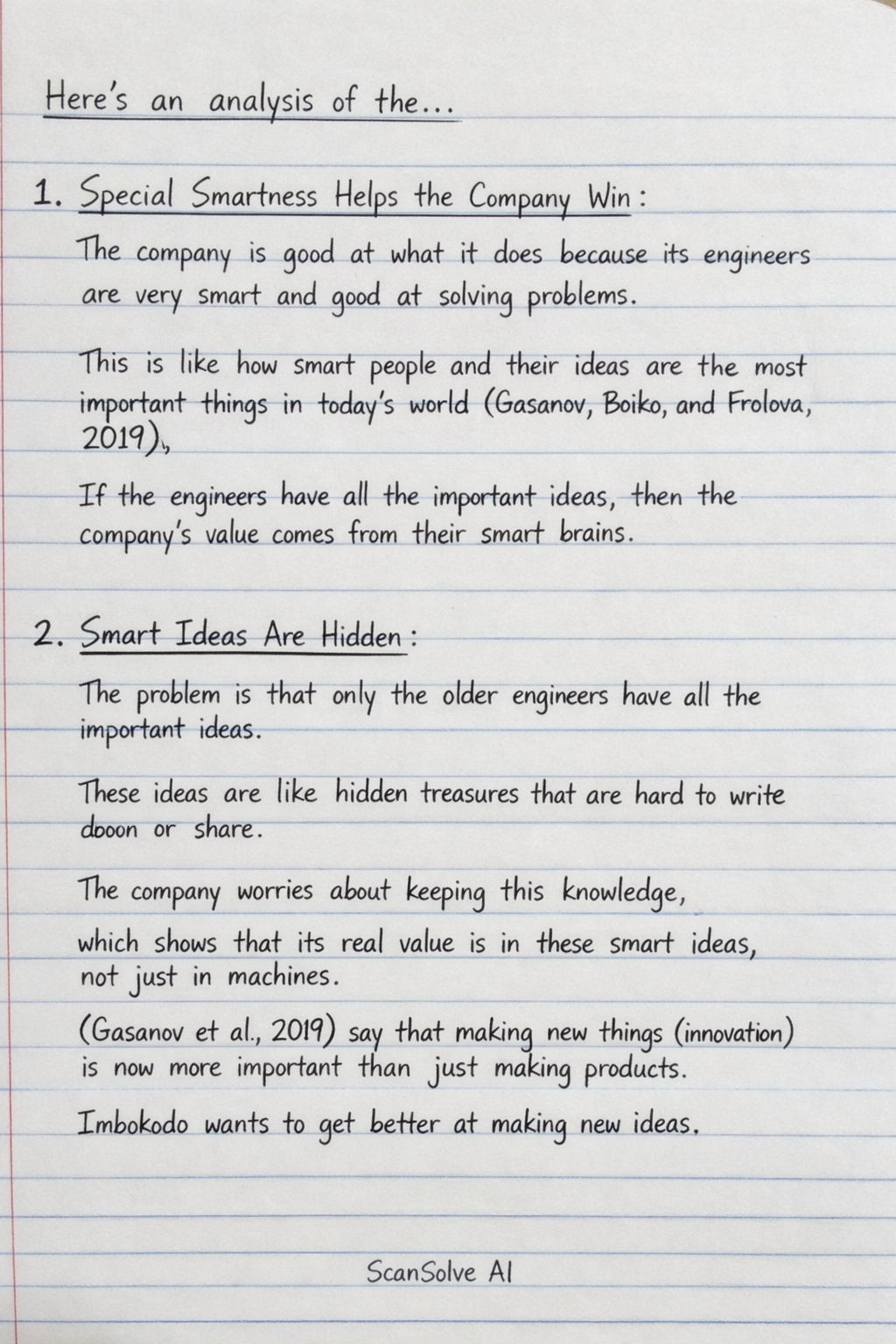
Special Smartness Helps the Company Win: The company is good at what it does because its engineers are very smart and good at solving problems. This is like how smart people and their ideas are the most important things in today's world (Gasanov, Boiko, and Frolova, 2019). If the engineers have all the important ideas, then the company's value comes from their smart brains.
-
Smart Ideas Are Hidden: The problem is that only the older engineers have all the important ideas. These ideas are like hidden treasures that are hard to write down or share. The company worries about keeping this knowledge, which shows that its real value is in these smart ideas, not just in machines. (Gasanov et al., 2019) say that making new things (innovation) is now more important than just making products. Imbokodo wants to get better at making new ideas.
-
Brains Over Brawn: When the company grows, it's hard to teach everyone the smart ideas. This is like how the world has changed from needing many workers to needing many smart ideas. To grow, Imbokodo needs to share the smart ways its workers think and solve problems, not just build more factories. It's hard to share these ideas from one place to another.
Academic Books Help Us Understand:
- People's Brains Are Key: (Gasanov et al., 2019) say that how smart people grow their ideas helps the economy. Imbokodo needs its engineers' smarts to succeed.
- Sharing Knowledge: If the older engineers leave, the company might lose their ideas. (Gasanov, 2019) says that helping smart people grow helps the economy. Imbokodo needs to share the ideas from its smart people so the whole company has them.
Another Idea: Bosses Who Aren't There (Schulze):
Imagine if only a few senior engineers know everything important. It's like they have all the power. The company's leaders worry that these smart engineers might not help the company grow in new places, which could cause problems, like what (Schulze, 1958) found in his studies.
What This All Means:
The company is in a "Knowledge Economy" because its success depends on smart ideas, new inventions, and managing the hidden knowledge in people's heads, not just on machines. The problem of only a few people having all the important ideas is a common sign of a company that relies on new ideas and smart people to grow.
Still stuck on this one?
Ask a follow-up, and the answer starts from this question.
More History Questions
Handwritten Step-by-Step Solution
Get this as a handwritten image on WhatsApp — like a tutor wrote it for you.
Try on WhatsApp