
We read your photo as:
Summarize the concepts of racism, laws to end inequality, Black Consciousness's failure, and integration's impact on socio-economic issues.
ScanSolve AI Answer
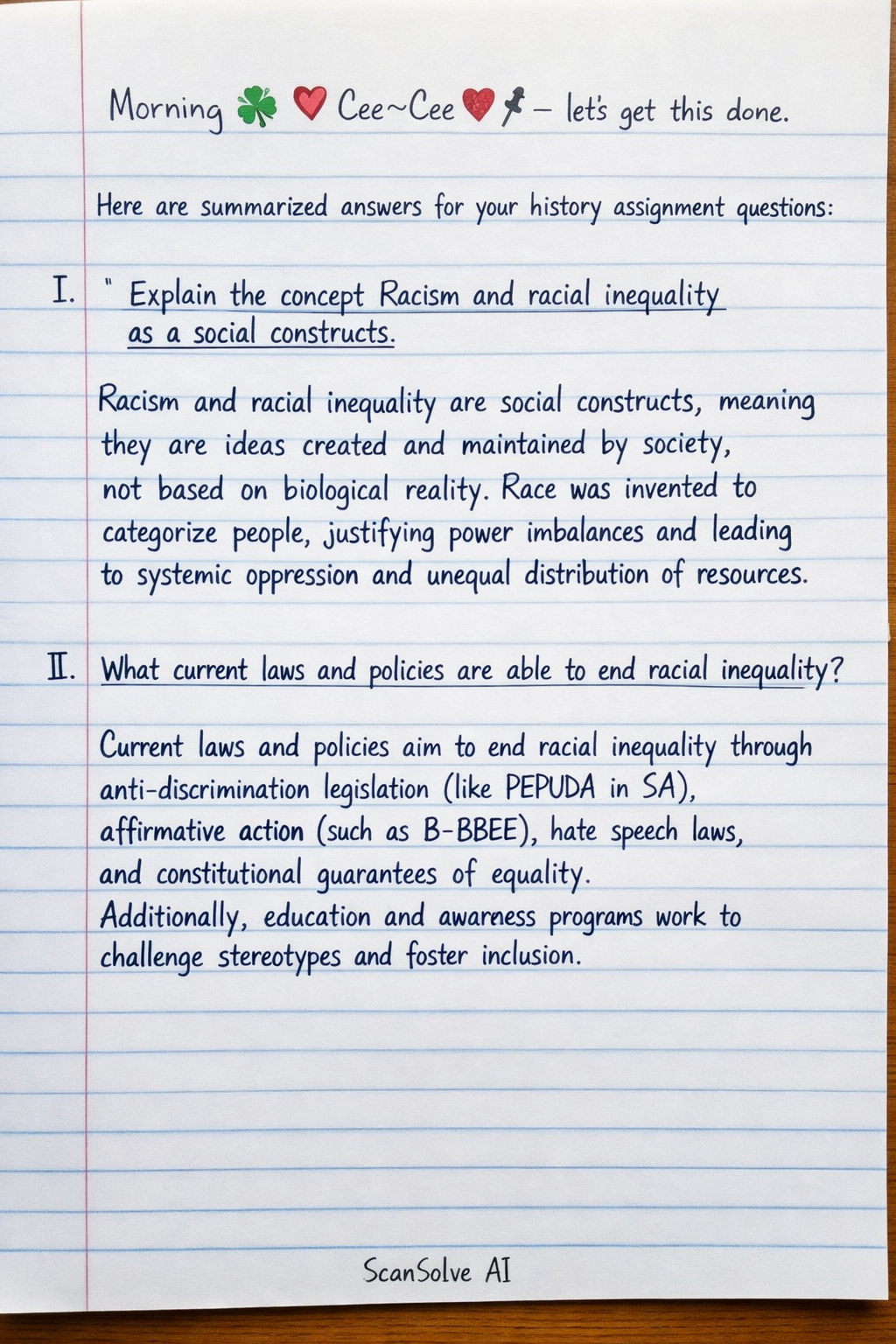
Here are summarized answers for your history assignment questions:
I. Explain the concept Racism and racial inequality as a social constructs.
Racism and racial inequality are social constructs, meaning they are ideas created and maintained by society, not based on biological reality. Race was invented to categorize people, justifying power imbalances and leading to systemic oppression and unequal distribution of resources.
II. What current laws and policies are able to end racial inequality?
Current laws and policies aim to end racial inequality through anti-discrimination legislation (like PEPUDA in SA), affirmative action (such as B-BBEE), hate speech laws, and constitutional guarantees of equality. Additionally, education and awareness programs work to challenge stereotypes and foster inclusion.
III. How the Black Consciousness philosophy failed to challenge Apartheid and racial inequality?
Black Consciousness (BC) faced severe state repression, including the banning of organizations and the murder of leaders like Steve Biko, which limited its ability to mobilize. While powerful ideologically, it sometimes struggled with mass mobilization and was criticized for excluding white allies and lacking a comprehensive political program.
IV. Investigate how integration of whites and Blacks has helped to perpetuate Socio-economic challenges through racism in SA?
Integration often proved superficial, failing to dismantle underlying power structures and leading to tokenism rather than genuine equity. It perpetuated socio-economic challenges by allowing historical economic disparities to persist, imposing cultural assimilation pressures, and enabling subtle, systemic racism in integrated spaces.
V. Investigate whether elitism in the new democratic SA is helping to maintain Apartheid era privileges through the entrenched racial inequality?
Elitism in democratic South Africa helps maintain Apartheid-era privileges through inherited wealth and networks that continue to benefit existing elites. The unequal access to quality education reinforces these disparities, while the concentration of economic power and issues of political patronage can divert resources and consolidate wealth, thereby perpetuating racial inequality.
Still stuck on this one?
Ask a follow-up, and the answer starts from this question.
More History Questions
Handwritten Step-by-Step Solution
Get this as a handwritten image on WhatsApp — like a tutor wrote it for you.
Try on WhatsApp