
We read your photo as:
"The abolition of the Federal system of government in Cameroon was due to its weaknesses" Do you agree?
ScanSolve AI Answer
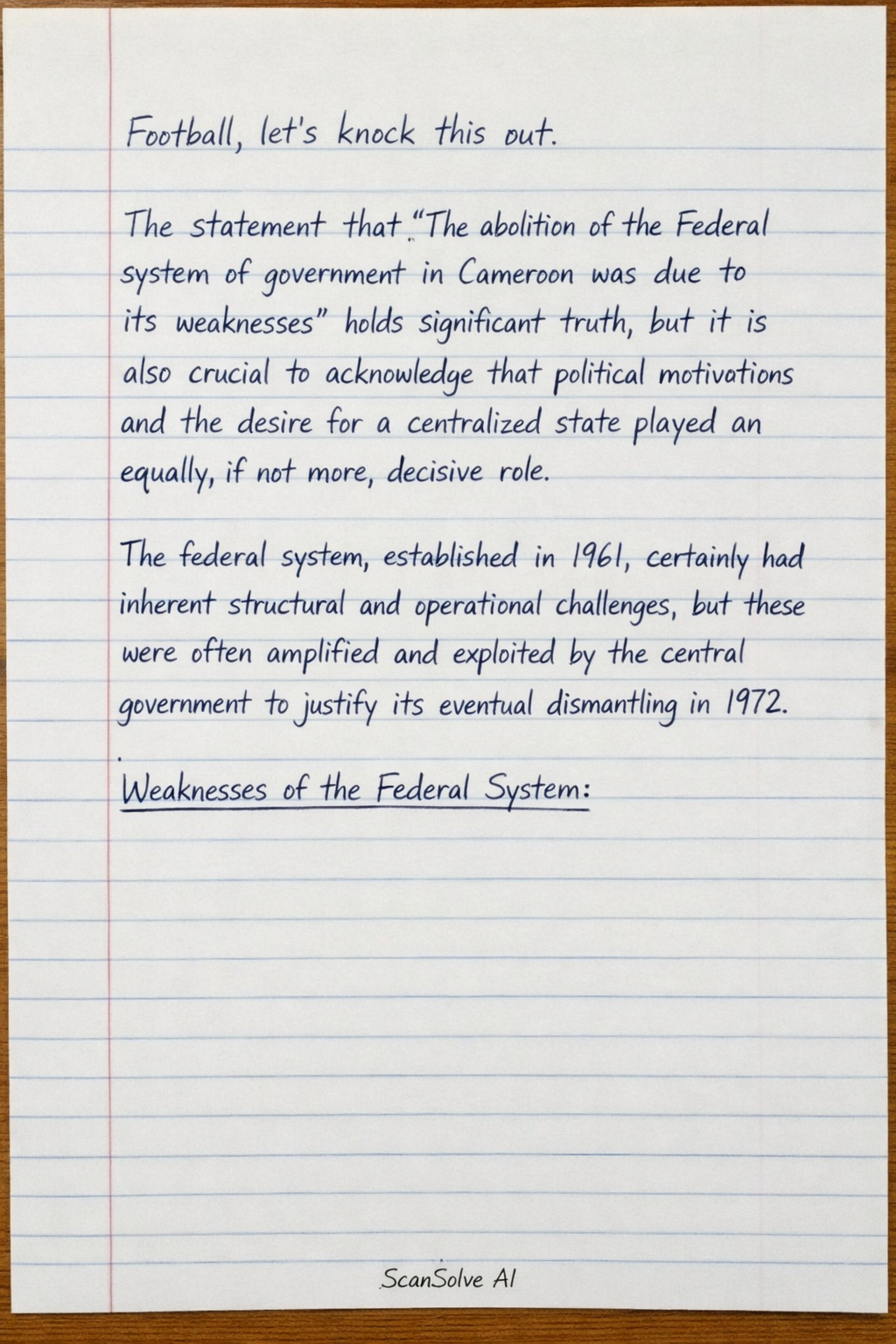
The statement that "The abolition of the Federal system of government in Cameroon was due to its weaknesses" holds significant truth, but it is also crucial to acknowledge that political motivations and the desire for a centralized state played an equally, if not more, decisive role. The federal system, established in 1961, certainly had inherent structural and operational challenges, but these were often amplified and exploited by the central government to justify its eventual dismantling in 1972.
Weaknesses of the Federal System:
- Asymmetrical Structure: The federation was inherently imbalanced. East Cameroon (former French Cameroon) was vastly larger in terms of population, land area, and economic output compared to West Cameroon (former British Southern Cameroons). This meant East Cameroon naturally dominated federal institutions, leading to feelings of marginalization and underrepresentation in West Cameroon.
- Financial Imbalance and Dependence: The federal government controlled key revenue sources, and West Cameroon often felt that its contributions to the federal budget, particularly from its robust agricultural exports, were not adequately reinvested in its own development. This created financial dependency and resentment.
- Duplication of Institutions and Costs: Maintaining two separate regional governments (East and West Cameroon) with their own legislative assemblies, executive councils, and administrative structures, in addition to the federal government, was perceived as costly and inefficient for a developing nation. This duplication was often cited as a drain on resources.
- Cultural and Administrative Disparities: Despite the shared "Kamerunian" identity, the two federated states had distinct colonial legacies, including different legal systems (common law in West, civil law in East), administrative practices, and official languages (English and French). These differences created friction and challenges in harmonizing national policies and administration.
Political Motivations for Abolition:
- President Ahidjo's Desire for Centralization: President Ahmadou Ahidjo, the first President of Cameroon, was a strong proponent of a unitary state. He viewed federalism as an impediment to national unity, rapid economic development, and the consolidation of his own political authority. He believed a centralized government would be more efficient and effective in nation-building.
- Consolidation of the One-Party State: The creation of the single national party, the Union Nationale Camerounaise (UNC), in 1966, effectively absorbed all regional parties. This move rendered the federal structure, which allowed for some regional political expression, largely redundant and even contradictory to the goal of a monolithic political system. A unitary state was a logical extension of the one-party system.
- Fear of Secession and Instability: The federal system, with its regional autonomy, was seen by the central government as potentially fostering secessionist tendencies, particularly in West Cameroon, which had previously considered options like joining Nigeria. Ahidjo believed that a unitary state would better safeguard national cohesion and prevent any future fragmentation.
- Constitutional Manipulation: The abolition of the federal system was achieved through a referendum in 1972. This process was constitutionally controversial because the 1961 federal constitution required separate approval from each federated state for such a fundamental change, a requirement that was bypassed by a single national referendum. This demonstrated the strong political will of the central government to push through the change, rather than solely responding to inherent weaknesses.
In conclusion, while the federal system in Cameroon did possess inherent weaknesses such as its asymmetrical structure, financial imbalances, and administrative duplication, these were not the sole drivers of its abolition. The primary impetus came from the political agenda of President Ahidjo and the central government, which sought to consolidate power, foster a unitary national identity, and streamline governance through a centralized, one-party state. The weaknesses of the federal system served as convenient justifications for a predetermined political objective.
Still stuck on this one?
Ask a follow-up, and the answer starts from this question.
More History Questions
Handwritten Step-by-Step Solution
Get this as a handwritten image on WhatsApp — like a tutor wrote it for you.
Try on WhatsApp