
We read your photo as:
What are the answers to the following history questions regarding early humans, trade, and colonialism in Africa?
History
ScanSolve AI Answer
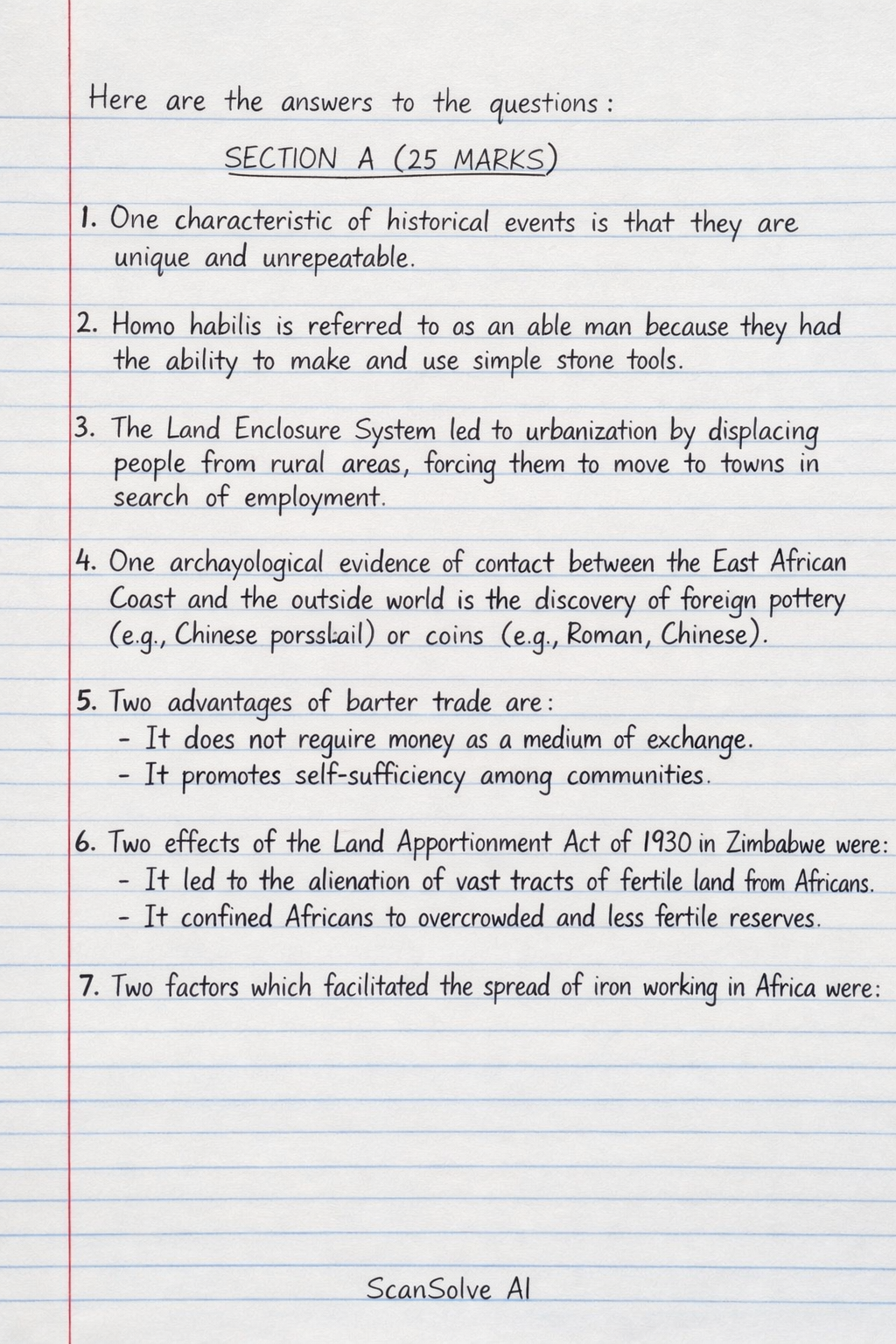
Here are the answers to the questions:
SECTION A (25 MARKS)
- One characteristic of historical events is that they are unique and unrepeatable.
- Homo habilis is referred to as an able man because they had the ability to make and use simple stone tools.
- The Land Enclosure System led to urbanization by displacing people from rural areas, forcing them to move to towns in search of employment.
- One archaeological evidence of contact between the East African Coast and the outside world is the discovery of foreign pottery (e.g., Chinese porcelain) or coins (e.g., Roman, Chinese).
- Two advantages of barter trade are:
- It does not require money as a medium of exchange.
- It promotes self-sufficiency among communities.
- Two effects of the Land Apportionment Act of 1930 in Zimbabwe were:
- It led to the alienation of vast tracts of fertile land from Africans.
- It confined Africans to overcrowded and less fertile reserves.
- Two factors which facilitated the spread of iron working in Africa were:
- The migration of Bantu-speaking communities who possessed iron-working skills.
- The availability of iron ore deposits in various parts of the continent.
- Two methods used by Europeans to acquire colonies in Africa were:
- Treaty making with African chiefs.
- Military conquest and use of superior weaponry.
- The main objective of the Berlin Conference was to regulate European colonization and trade in Africa and prevent conflicts among European powers.
- One community in Kenya that collaborated with the British was the Wanga (a sub-group of the Luhya).
- One term of the Lewanika - Lochner treaty was that Lewanika granted mineral rights to the British South Africa Company (BSAC).
- One commune in Senegal where French rule was applied was Dakar.
- Two functions of chiefs in colonial Kenya were:
- To maintain law and order in their respective areas.
- To collect taxes on behalf of the colonial administration.
- Two ways in which the constitution of Kenya can be amended are:
- Through a bill passed by Parliament (requiring specific majorities).
- Through a popular initiative (referendum) by the people.
- Two characteristics of Indirect Democracy are:
- Citizens elect representatives to make decisions on their behalf.
- There are regular elections to choose these representatives.
- Two rights of Older Members of the society are:
- The right to participate in public life.
- The right to live in dignity and be free from abuse.
- Absolute Monarchy is a form of government where the monarch (king or queen) holds supreme, unchecked power, often claiming divine right.
SECTION B (45 MARKS)
18. a) State five economic aspects of the Buganda in the 19th Century.
- Agriculture: The Buganda were primarily agriculturalists, with matoke (bananas) being their staple food. They also cultivated other crops like millet, yams, and beans.
- Trade: They engaged in long-distance trade with the East African coast, exchanging goods such as ivory, slaves, barkcloth, and iron implements for foreign goods like cloth, beads, and firearms.
- Craft Industries: They had developed various craft industries, including barkcloth making, iron working (for tools and weapons), pottery, and basketry.
- Fishing: Due to their proximity to Lake Victoria, fishing was an important economic activity, providing a source of protein.
- Taxation/Tribute System: The Kabaka (king) collected tributes and taxes from his subjects and conquered territories, which contributed to the kingdom's wealth and power.
b) Explain five factors for the decline of the Shona Kingdom.
- Internal Conflicts and Succession Disputes: Frequent disputes over succession to the throne led to internal divisions and civil wars, weakening the central authority of the Mutapa.
- External Attacks from the Ngoni and Ndebele: The kingdom faced severe attacks from the Ngoni and Ndebele during the Mfecane migrations, which destabilized the region, led to loss of territory, and depleted resources.
- Droughts and Famines: Prolonged periods of drought and subsequent famines led to widespread suffering, reduced agricultural output, and weakened the population, making the kingdom vulnerable.
- Decline in Trade: The shift in trade routes and the decline in the gold trade, partly due to Portuguese interference, reduced the kingdom's economic power and its ability to acquire essential goods and weapons.
- Portuguese Interference and Military Incursions: The Portuguese sought to control the gold trade and establish their influence, leading to military conflicts and the installation of puppet rulers, which undermined the kingdom's sovereignty and stability.
- Rise of Vassal States: Some tributary states within the kingdom grew stronger and asserted their independence, reducing the overall power and territorial control of the central Mutapa.
19. a) Give five economic reasons for the scramble for Africa.
- Search for Raw Materials: European industries, fueled by the Industrial Revolution, needed a continuous supply of raw materials such as cotton, rubber, palm oil, timber, and minerals (gold, diamonds, copper) found in Africa.
- Search for Markets: European manufacturers sought new markets in Africa to sell their surplus manufactured goods, as their domestic markets became saturated.
- Investment Opportunities: Africa offered opportunities for European capitalists to invest their surplus capital in mining, plantations, and infrastructure development, promising high returns.
- Cheap Labour: European powers sought to exploit Africa's abundant and cheap labor force for their mines, plantations, and construction projects.
- Control of Trade Routes: Strategic control over key trade routes, such as the Suez Canal and other maritime passages around Africa, was crucial for global commerce and military dominance.
b) Explain five causes of the Maji Maji Rebellion.
- Forced Labor: The German colonial administration forced Africans to work on cotton and rubber plantations for long hours with little or no pay, causing immense resentment.
- Oppressive Taxation: The imposition of a hut tax and head tax was deeply unpopular. Africans found these taxes difficult to pay, often forcing them into forced labor or selling their produce at low prices.
- Land Alienation: Germans alienated fertile African land for settler farms and plantations, displacing communities and disrupting traditional land tenure systems.
- Disruption of Traditional Social Structures: German rule undermined the authority of traditional chiefs and elders, replacing them with appointed Akidas and Jumbes who were often harsh and corrupt.
- Cultural Interference: The Germans interfered with African customs and beliefs, including forcing communities to cultivate cotton, which was seen as an imposition on their traditional agricultural practices.
- Harsh and Brutal Administration: The German colonial administration was known for its brutality, including flogging, public executions, and other forms of cruel treatment, which fueled widespread anger.
- Religious Factor (Maji Maji Water): The belief in the magic water (Maji) provided by Kinjikitile Ngwale, which was said to turn German bullets into water, united various communities and gave them the courage to rebel.
20. a) Describe the communities in Kenya that showed mixed reactions towards British occupation.
- Kikuyu: Some Kikuyu chiefs and groups initially collaborated with the British, seeing them as a source of power or trade opportunities, or seeking protection against rivals. However, other sections of the Kikuyu fiercely resisted British encroachment, particularly over land alienation and the imposition of taxes.
- Akamba: While some Akamba, especially those involved in long-distance trade, collaborated with the British to maintain their trading networks, other groups resisted British attempts to control their trade, impose taxes, and interfere with their autonomy.
- Luo: The Wanga sub-group under Chief Mumia collaborated extensively with the British, gaining power and territory as agents of colonial rule. However, other Luo sub-groups and clans resisted British expansion and attempts to impose their authority.
Was this helpful?
Still stuck on this one?
Ask a follow-up, and the answer starts from this question.
Got a different question?Ask your own question
More History Questions
QWhat are the answers to the following multiple choice and true/false questions about African…QThe provided text is a solution to multiple-choice questions about the history of ancient African…QWhat were the main characteristics, advantages, and disadvantages of early civilizations in Africa…QWhat are the answers to questions 26-30 regarding the Scramble for Africa and colonialism?QDescribe the socio-economic practices of early humans in Africa during the Early, Middle, and Late…
Browse by topic:World History
Handwritten Step-by-Step Solution
Get this as a handwritten image on WhatsApp — like a tutor wrote it for you.
Try on WhatsApp