
We read your photo as:
What are the answers to the following questions about Indian history, including dates for the partition of Bengal, the launch of Tehzeeb-ul-Akhlaq, the Muhammadan Educational Conference, the Muslim Le
ScanSolve AI Answer
Answer
1905
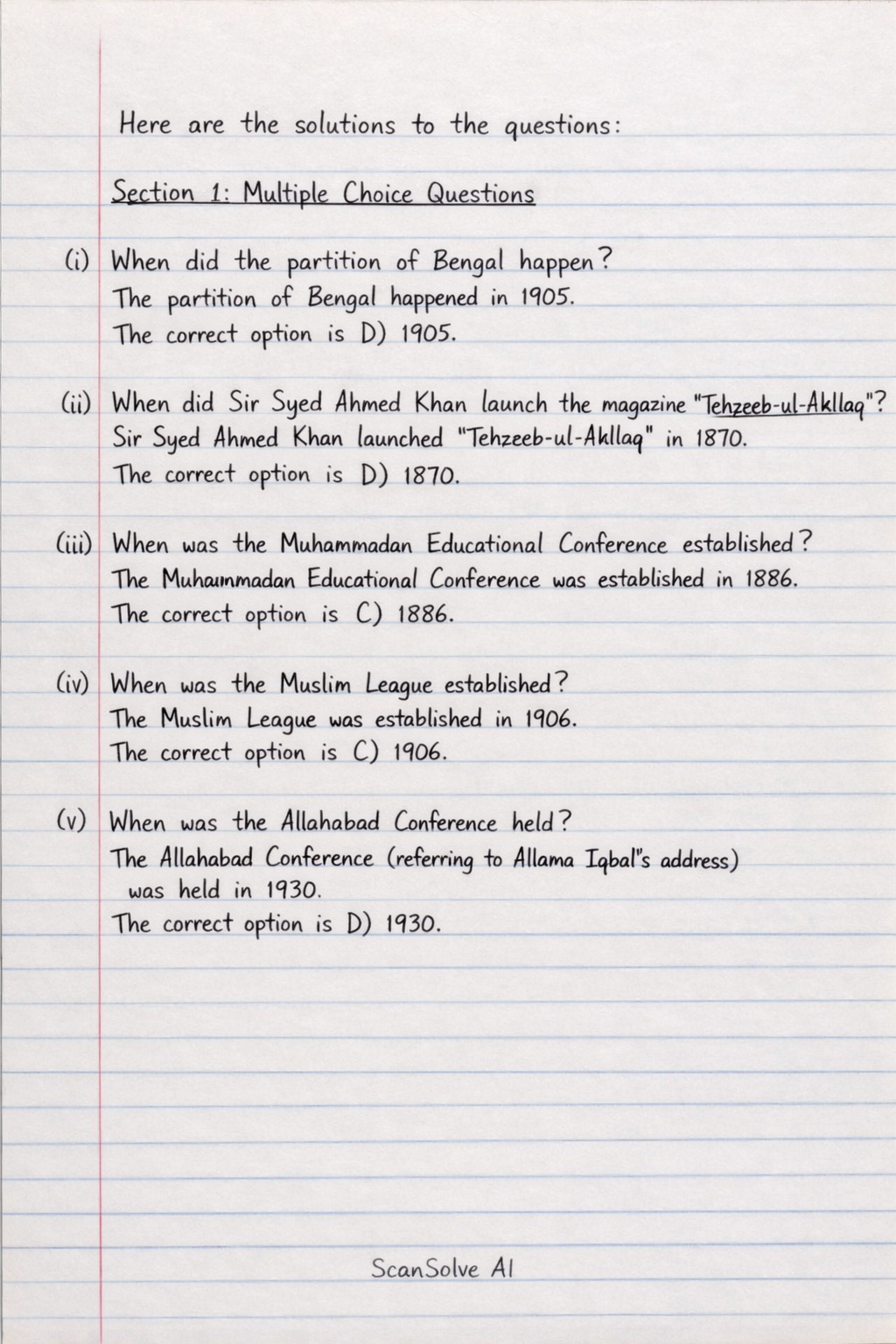
Here are the solutions to the questions:
Section 1: Multiple Choice Questions
-
i) When did the partition of Bengal happen?
- The partition of Bengal happened in 1905.
- The correct option is D) 1905.
-
ii) When did Sir Syed Ahmed Khan launch the magazine "Tehzeeb-ul-Akhlaq"?
- Sir Syed Ahmed Khan launched "Tehzeeb-ul-Akhlaq" in 1870.
- The correct option is D) 1870.
-
iii) When was the Muhammadan Educational Conference established?
- The Muhammadan Educational Conference was established in 1886.
- The correct option is C) 1886.
-
iv) When was the Muslim League established?
- The Muslim League was established in 1906.
- The correct option is C) 1906.
-
v) When was the Allahabad Conference held?
- The Allahabad Conference (referring to Allama Iqbal's address) was held in 1930.
- The correct option is D) 1930.
-
vi) Who was the first secretary of the All-India Muslim League?
- The first General Secretary of the All-India Muslim League was Nawab Waqar-ul-Mulk.
- The correct option is D) وقار الملک (Waqar-ul-Mulk).
Section 2: Short Answer Questions
-
i) Whose book is "Discovery of India"?
- "Discovery of India" is a book written by Jawaharlal Nehru.
-
ii) What did Pandit Nehru say about the Pakistan Resolution?
- Pandit Nehru called the Pakistan Resolution a "foolish idea" and an "impracticable dream", strongly opposing the concept of partition.
-
iii) Why was the Scientific Society established?
- The Scientific Society was established by Sir Syed Ahmed Khan in 1864 to translate Western scientific and literary works into Urdu and promote scientific knowledge among Muslims.
-
iv) Write the names of two books by Maulana Altaf Hussain Hali.
- Two books by Maulana Altaf Hussain Hali are:
- Musaddas-e-Hali
- Hayat-e-Javed
- Two books by Maulana Altaf Hussain Hali are:
-
v) What is meant by separate electorates?
- Separate electorates is an electoral system where different religious or ethnic communities vote for their own representatives in separate constituencies, ensuring their distinct representation.
-
vi) When and with whom did the Simla Deputation meet?
- The Simla Deputation met on October 1, 1906, with Lord Minto, the then Viceroy of India.
Section 3: Long Answer Questions
3) Explain the important points of the Objectives Resolution.
The Objectives Resolution, passed on March 12, 1949, laid down the foundational principles for Pakistan's constitution. Its important points include:
- Sovereignty belongs to Allah Almighty, delegated to the State of Pakistan through its people.
- The State shall exercise its powers through the chosen representatives of the people.
- Principles of democracy, freedom, equality, tolerance, and social justice as enunciated by Islam shall be fully observed.
- Muslims shall be enabled to order their lives according to the teachings of Islam.
- Adequate provision shall be made for minorities to freely profess and practice their religions.
- Fundamental rights including equality, justice, and freedom of thought, expression, belief, faith, worship, and association shall be guaranteed.
- The judiciary shall be independent.
- The integrity of the territories of the Federation, its independence, and all its rights shall be safeguarded.
4) Explain the reasons for the establishment of the All-India Muslim League.
The All-India Muslim League was established on December 30, 1906, due to several key reasons:
- Protection of Muslim political rights: Muslims felt their interests were not adequately represented by the Indian National Congress.
- Fear of Hindu domination: The prospect of a Hindu-majority government after British rule raised concerns among Muslims about their future.
- Separate identity: Muslims sought to preserve their distinct religious, cultural, and political identity.
- Partition of Bengal (1905): The annulment of the partition of Bengal intensified Muslim fears and highlighted the need for a separate political platform.
- Simla Deputation (1906): The successful meeting with Lord Minto demonstrated the effectiveness of a unified Muslim political voice.
- Loyalty to the British: Initially, the League aimed to promote loyalty to the British government and address any misunderstandings regarding Muslim intentions.
Try one yourself
A new problem that tests the same skill.
Still stuck on this one?
Ask a follow-up, and the answer starts from this question.
More History Questions
Handwritten Step-by-Step Solution
Get this as a handwritten image on WhatsApp — like a tutor wrote it for you.
Try on WhatsApp