
We read your photo as:
What are the answers to the following questions about the Bible: 26. Who was the first Gentile convert? 27. Who carried Jesus' cross? 28. Whose request was Jesus' first miracle? 29. Which prophet spok
ScanSolve AI Answer
Answer
Here are the answers to the questions from the image:
26. The first Gentile convert to Christianity, often considered the first uncircumcised Gentile convert, was Cornelius, a Roman centurion, as described in Acts 10.
The correct option is B.
27. The man who was compelled to carry the cross of Jesus was Simon of Cyrene.
The correct option is B.
28. Jesus' first miracle at the wedding in Cana was performed at the request of His mother.
The correct option is C.
29. The prophet who spoke extensively about the 'New Covenant' was Jeremiah, particularly in Jeremiah 31:31-34.
The correct option is B.
30. The primary purpose of Jesus' baptism was to Fulfill all righteousness, as Jesus Himself stated to John the Baptist in Matthew 3:15.
The correct option is B.
31a. The story of God's creation in Genesis describes God creating the heavens and the earth in six days. On the first day, He created light and separated it from darkness. On the second, He created the expanse (sky) to separate the waters above and below. On the third, He gathered the waters to form dry land and created vegetation. On the fourth, He created the sun, moon, and stars to govern day and night. On the fifth, He created sea creatures and birds. On the sixth, He created land animals and finally, humanity—male and female—in His own image, giving them dominion over the earth. On the seventh day, God rested, sanctifying it.
31b. The creation story illustrates the sovereignty of God through several aspects:
- Creation by divine command: God simply speaks, and creation comes into being ("Let there be light"). This demonstrates His absolute power and authority over all existence.
- Order and purpose: Each act of creation is deliberate and ordered, showing God's intelligent design and control over the universe.
- Dominion over creation: God establishes the natural laws and places humanity in charge of the earth, but ultimately, He remains the supreme ruler and sustainer of all He has made.
32a. According to Paul's teaching (e.g., 1 Thessalonians 4:16-17, 1 Corinthians 15:51-52), the Second Coming of the Lord will be a dramatic and sudden event. Jesus will descend from heaven with a loud command, with the voice of an archangel and the trumpet call of God. The dead in Christ will rise first, and then living believers will be caught up together with them in the clouds to meet the Lord in the air. This teaches us about the hope of resurrection, the final victory over death, and the eternal reunion of believers with Christ.
32b. Signs of the Second Coming, as taught in various New Testament passages (including some attributed to Jesus and echoed by Paul), include:
- Increase in wars and rumors of wars: Global conflicts and unrest.
- Famines, pestilences, and earthquakes: Natural disasters and widespread suffering.
- Persecution of Christians: Believers facing tribulation for their faith.
- False prophets and messiahs: Deceptive religious leaders and movements.
- The spread of the Gospel to all nations: The worldwide proclamation of the good news.
- A great apostasy or falling away from faith: A significant decline in belief among some.
33a. Luke's account of the birth of Jesus begins with the angel Gabriel announcing to Mary that she, a virgin, would conceive a son by the Holy Spirit and name Him Jesus. Later, Caesar Augustus issues a decree for a census, requiring Joseph and a heavily pregnant Mary to travel from Nazareth to Bethlehem, Joseph's ancestral town. While there, Mary gives birth to Jesus in a stable because there is no room in the inn, and she lays Him in a manger. Angels appear to shepherds in the fields, announcing the birth of the Savior, Christ the Lord, and the shepherds go to Bethlehem to see the baby. Eight days later, Jesus is circumcised and named.
33b. Two lessons that can be learned from the circumstances of Jesus' birth are:
- Humility and simplicity: Jesus, the Son of God, was born in humble circumstances, in a stable and laid in a manger, demonstrating that true greatness is not found in worldly power or wealth but in humility and service.
- God's plan unfolds in unexpected ways: The birth of the Savior occurred not in a grand palace but in a lowly setting, and the first to receive the news were humble shepherds, showing that God often works through the ordinary and overlooked to accomplish His extraordinary purposes.
Try one yourself
A new problem that tests the same skill.
Still stuck on this one?
Ask a follow-up, and the answer starts from this question.
More History Questions
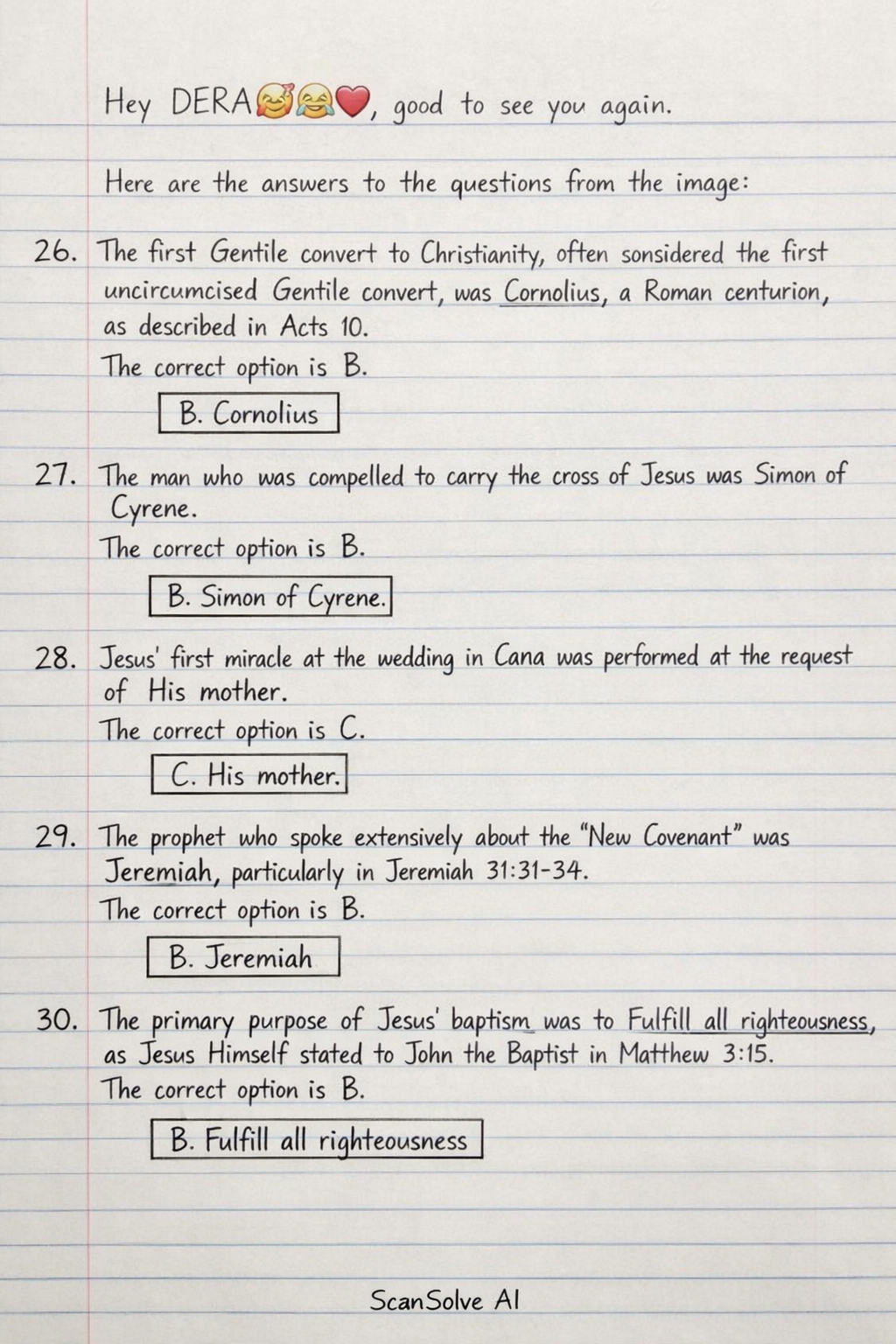
Handwritten Step-by-Step Solution
Get this as a handwritten image on WhatsApp — like a tutor wrote it for you.
Try on WhatsApp