
We read your photo as:
What are the answers to these multiple choice questions about the history of Cameroon?
ScanSolve AI Answer
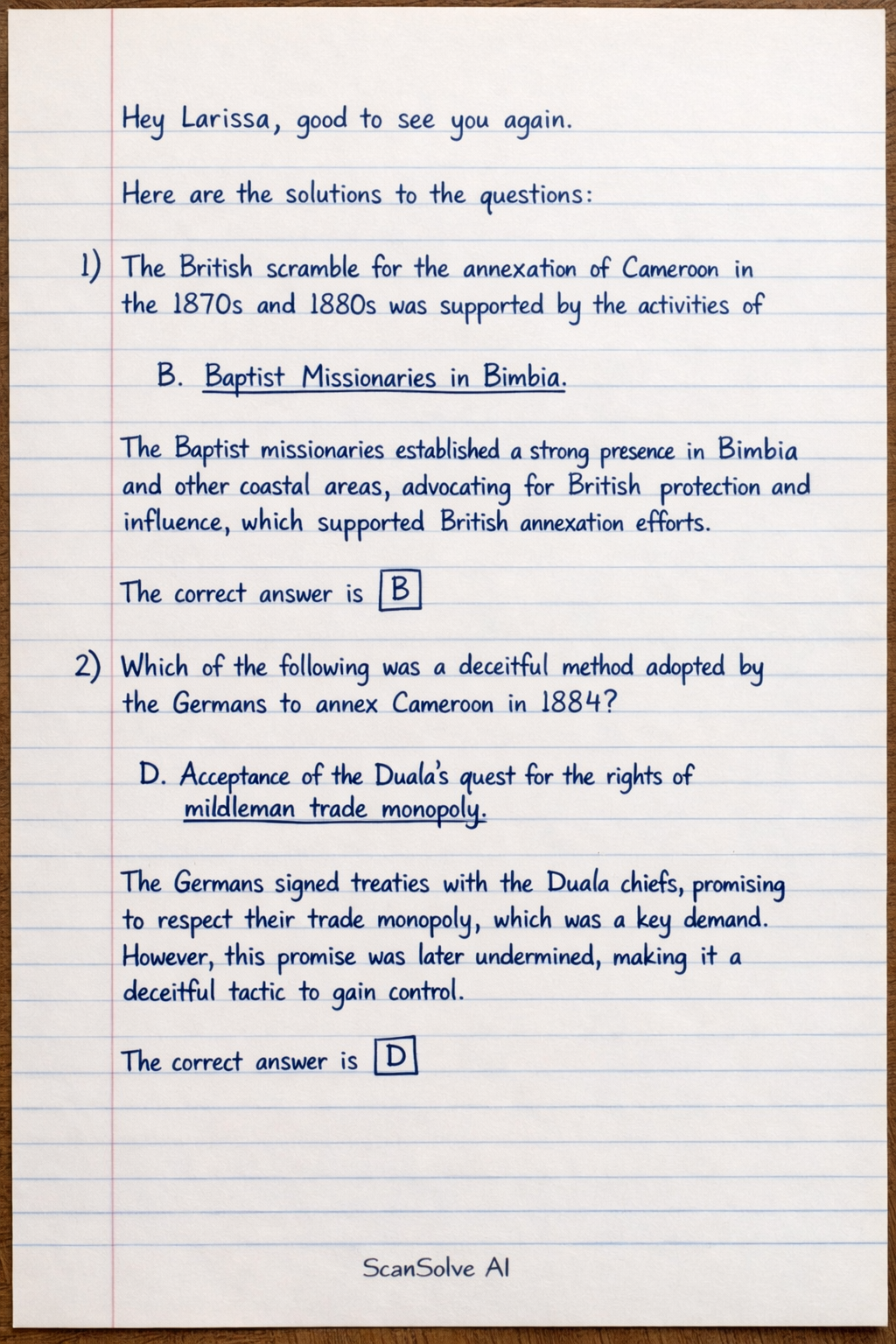
Here are the solutions to the questions:
1) The British scramble for the annexation of Cameroon in the 1870s and 1880s was supported by the activities of
B. Baptist Missionaries in Bimbia.
The Baptist missionaries established a strong presence in Bimbia and other coastal areas, advocating for British protection and influence, which supported British annexation efforts.
The correct answer is
2) Which of the following was a deceitful method adopted by the Germans to annex Cameroon in 1884?
D. Acceptance of the Duala's quest for the rights of middleman trade monopoly.
The Germans signed treaties with the Duala chiefs, promising to respect their trade monopoly, which was a key demand. However, this promise was later undermined, making it a deceitful tactic to gain control.
The correct answer is
3) 1885 is very significant in the history of German Cameroon because it was the year the Germans
C. purchased Victoria from the British.
In 1885, Germany purchased Victoria (Ambas Bay) from the British, consolidating its territorial claims in the region.
The correct answer is
4) Identify the German Governor who opened the Botanical Garden in Victoria for Agricultural research in 1892?
B. Eugene Von Zimmerer.
Eugene Von Zimmerer served as Governor of German Cameroon from 1891 to 1895, a period during which the Botanical Garden in Victoria was established for agricultural research.
The correct answer is
5) Which of the following was a non-violent method adopted by the indigenes in fighting against the German violation of their rights?
A. Petitions to the German Parliament.
Indigenous leaders and educated elites often sent petitions and appeals to the German Parliament (Reichstag) to protest colonial injustices and violations of their rights.
The correct answer is
6) An economic activity the Germans copied from the natives and modernized was
D. cultivation of palm trees.
The cultivation of palm trees for palm oil was a traditional economic activity among the natives. The Germans later commercialized and modernized its production for export.
The correct answer is
7) The West African Expeditionary Force, commanded by General Charles Dobell, was NOT involved in the August 1914 war in Cameroon against the Germans in the
D. Mora battle.
The Mora battle was a prolonged siege in the far north of Cameroon, primarily involving Nigerian (British) forces under Captain Webb, and was largely separate from the main campaign led by General Dobell's forces in the south.
The correct answer is
8) The principal factor for the defeat of the German Colonial forces in Cameroon in 1916 was that the Allied Powers had more
A. troops and arms.
The Allied Powers (British, French, and Belgian forces) had overwhelming numerical superiority in troops and a greater supply of arms and resources compared to the isolated German forces.
The correct answer is
9) Identify the effect of the First World War in Cameroons that has slowed down national integration.
C. The Anglo-French partition.
The division of Cameroon into British and French mandates after World War I created two distinct administrative, educational, and cultural systems, which significantly hindered the development of a unified national identity and integration.
The correct answer is
10) Which of the following towns was NOT a divisional headquarter in the Cameroon Province during the Mandate era by 1938?
A. Buea.
Buea was the provincial capital of the British Southern Cameroons (Cameroon Province), holding a higher administrative status than a mere divisional headquarters. Mamfe, Bamenda, and Kumba were divisional headquarters.
The correct answer is
11) An economic project for promoting developments in the Cameroon Province neglected by the British was
D. railway transport.
While the British developed roads, they largely neglected the expansion and maintenance of the German-built railway network in British Cameroon, which was a significant economic infrastructure project.
The correct answer is
12) A socially motivated reason for the British application of the colonial policy of indirect rule in the Cameroon was
C. to preserve Native Culture.
Indirect rule was often justified by the British as a means to preserve existing traditional institutions and native cultures, even though practical reasons like cost-effectiveness and ease of administration were also significant.
The correct answer is
Still stuck on this one?
Ask a follow-up, and the answer starts from this question.
More History Questions
Handwritten Step-by-Step Solution
Get this as a handwritten image on WhatsApp — like a tutor wrote it for you.
Try on WhatsApp