
We read your photo as:
The provided text lists answers to multiple-choice questions about the Naxalite movement and democracy. It seems to be the latter part of a larger set of questions, ending abruptly. To infer a single
ScanSolve AI Answer
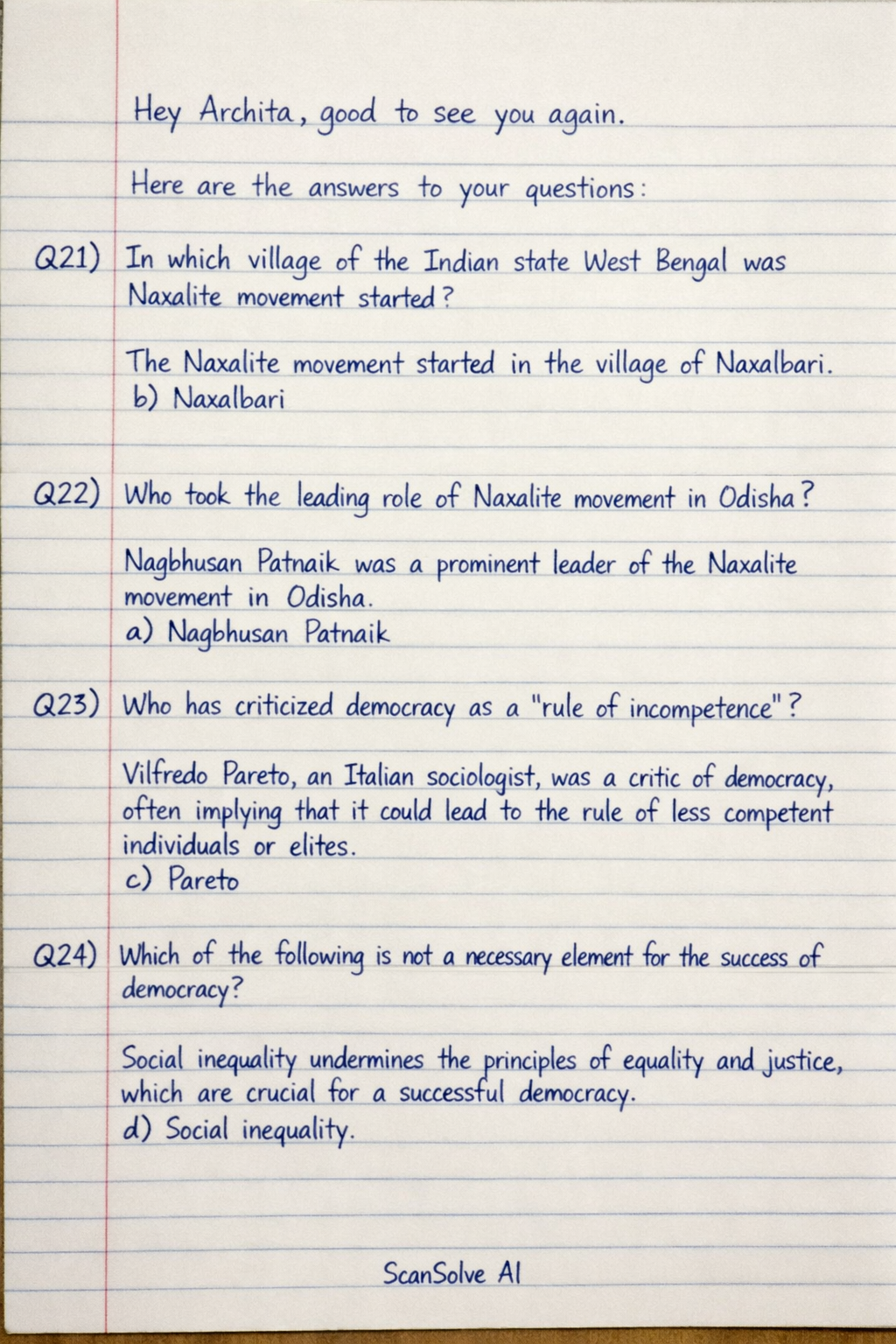
Here are the answers to your questions:
Q21: In which village of the Indian state West Bengal was Naxalite movement started?
- The Naxalite movement started in the village of Naxalbari.
- b) Naxalbari
Q22: Who took the leading role of Naxalite movement in Odisha?
- Nagbhusan Patnaik was a prominent leader of the Naxalite movement in Odisha.
- a) Nagbhusan Patnaik
Q23: Who has criticized democracy as a "rule of incompetence"?
- Vilfredo Pareto, an Italian sociologist, was a critic of democracy, often implying that it could lead to the rule of less competent individuals or elites.
- c) Pareto
Q24: Which of the following is not a necessary element for the success of democracy?
- Social inequality undermines the principles of equality and justice, which are crucial for a successful democracy.
- d) Social inequality
Q25: Which of the following is not a milestone of Democracy?
- Untouchability is a form of discrimination and is contrary to the principles of equality and human rights that democracy upholds.
- c) Untouchability
Q26: Which of the following rights is not exercised by the people in a democracy?
- Taking the law into your own hands (vigilantism) is against the rule of law and is not a right in a democracy.
- a) Taking the law into your own hands
Q27: What is called the small provinces of Switzerland?
- The small provinces or constituent states of Switzerland are called Cantons.
- c) Canton
Q28: Switzerland consists of how many Cantons?
- Switzerland is composed of 26 cantons.
- c) 26
Q29: People of which country make law in Landsgemeinde together?
- Landsgemeinde is a traditional form of direct democracy practiced in some cantons of Switzerland.
- d) Switzerland
Q30: What is the meaning of "Democracy"?
- Democracy literally means "rule by the people" or "people's power," derived from Greek words.
- a) People's power
Still stuck on this one?
Ask a follow-up, and the answer starts from this question.
More History Questions
Handwritten Step-by-Step Solution
Get this as a handwritten image on WhatsApp — like a tutor wrote it for you.
Try on WhatsApp