
We read your photo as:
The question is asking which group's merchants dominated trade, including the sale of slaves, within their land. The Igbo people were significantly involved in internal and external slave trade, sup
ScanSolve AI Answer
Answer
Step-by-step solution
9 stepsStep 1: Answer Question 6.
Part 6· 9 steps
is missing from the provided image.
Answer Question 7.
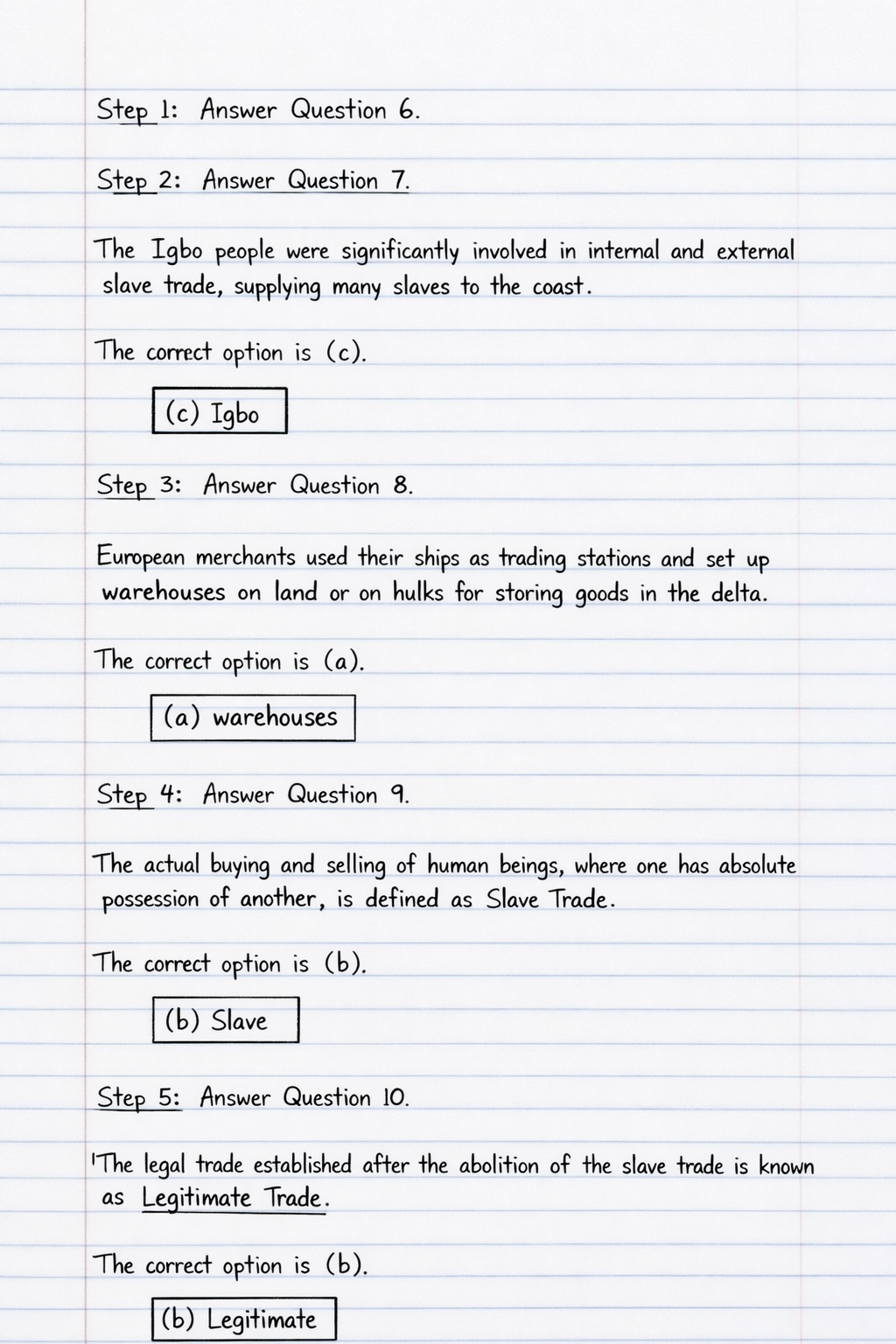
The question is asking which group's merchants dominated trade, including the sale of slaves, within their land. The Igbo people were significantly involved in internal and external slave trade, supplying many slaves to the coast.
The correct option is (c).Answer Question 8.
European merchants used their ships as trading stations and also established warehouses on land or on hulks for storing goods in the delta.
The correct option is (a).Answer Question 9.
The actual buying and selling of human beings, where one has absolute possession of another, is defined as Slave Trade.
The correct option is (b).Answer Question 10.
The legal trade established after the abolition of the slave trade is known as Legitimate Trade.
The correct option is (b).Answer Question 11.
The campaign against the slave trade, which led to its abolition in 1807 and slavery in 1833, was primarily led by Britain.
The correct option is (c).Answer Question 12.
Up to 1850, palm oil was continuously exported from West Africa, primarily by the people of the Delta region (Niger Delta).
The correct option is (c).Answer Question 13.
Up to 1850, slaves were exported from the Niger Delta region in West Africa.
The correct option is (d).Answer Question 14.
The transatlantic slave trade, which started in West Africa, covered a period of approximately 400 years (from the 16th to the 19th century).
The correct option is (b).Answer Question 15.
Part 15
is incomplete and does not have options.
Try one yourself
A new problem that tests the same skill.
Still stuck on this one?
Ask a follow-up, and the answer starts from this question.
More History Questions
Handwritten Step-by-Step Solution
Get this as a handwritten image on WhatsApp — like a tutor wrote it for you.
Try on WhatsApp