
We read your photo as:
The unwritten constitution is best defined as the (1) Amendments to the United States Constitution (2) Powers that the Constitution reserves for the states (3) Powers that the Constitution denies to Congress (4) Practices of the government that are based on custom and tradition
ScanSolve AI Answer
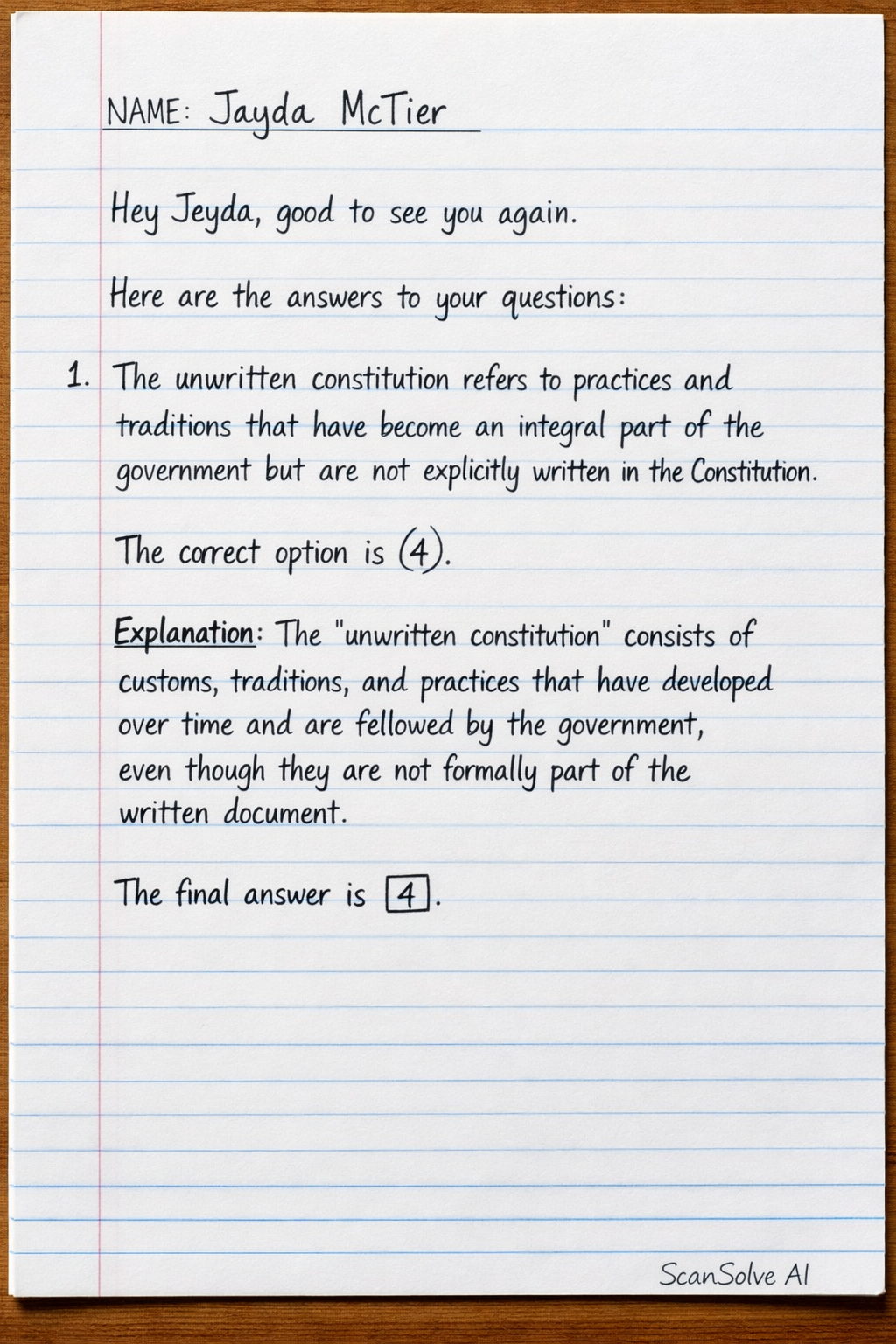
Here are the answers to your questions:
-
The unwritten constitution refers to practices and traditions that have become an integral part of the government but are not explicitly written in the Constitution.
- The correct option is (4).
- Explanation: The "unwritten constitution" consists of customs, traditions, and practices that have developed over time and are followed by the government, even though they are not formally part of the written document.
- The final answer is
-
The necessary and proper clause, the amendment process, and the unwritten constitution all demonstrate the ability of the U.S. government and its foundational document to adapt and change over time.
- The correct option is (3).
- Explanation: The necessary and proper clause allows Congress to make laws deemed essential for carrying out its enumerated powers, enabling adaptation. The amendment process provides a formal way to change the Constitution. The unwritten constitution allows for the evolution of governmental practices through custom. All three contribute to the system's ability to be flexible.
- The final answer is
-
The development of political parties and the committee system are examples of governmental structures and practices that have evolved over time and are not explicitly detailed in the written Constitution.
- The correct option is (3).
- Explanation: Neither political parties nor the committee system are directly mentioned in the U.S. Constitution. They developed through custom and tradition as the government evolved, making them key components of the "unwritten constitution."
- The final answer is
-
Thomas Jefferson, a strict constructionist, believed that the federal government should only exercise powers explicitly granted by the Constitution. Hamilton's plan for a national bank relied on an expansive reading of the "necessary and proper" clause, which Jefferson viewed as an overreach of federal power.
- The correct option is (4).
- Explanation: Jefferson opposed the national bank because he believed the Constitution did not explicitly grant Congress the power to create one. He feared that a loose interpretation of the Constitution would lead to an overly powerful federal government.
- The final answer is
Still stuck on this one?
Ask a follow-up, and the answer starts from this question.
Handwritten Step-by-Step Solution
Get this as a handwritten image on WhatsApp — like a tutor wrote it for you.
Try on WhatsApp