
TITLE: HISTORY REVISION SECTION A – ANSWER ALL QUESTIONS THE FIRST WORLD WAR 1914-1918 [10 marks] Sub-topic: Causes and Consequences of WWI a) Outline 5 factors that led to the outbreak of the First World War in 1914. [5 marks] b) Describe 5 impacts of the First World War on Europe and the world. [5 marks] BRITISH COLONIAL POLICY IN CAMEROON [10 marks] Sub-topic: British Attitude Towards Annexation of Cameroon a) Give 5 reasons why Britain initially opposed the annexation of Cameroon during the Scramble for Africa. [5 marks] b) Explain 5 reasons why Britain later decided to take control of Southern Cameroons after WWI. [5 marks] ---
History
ScanSolve AI Answer
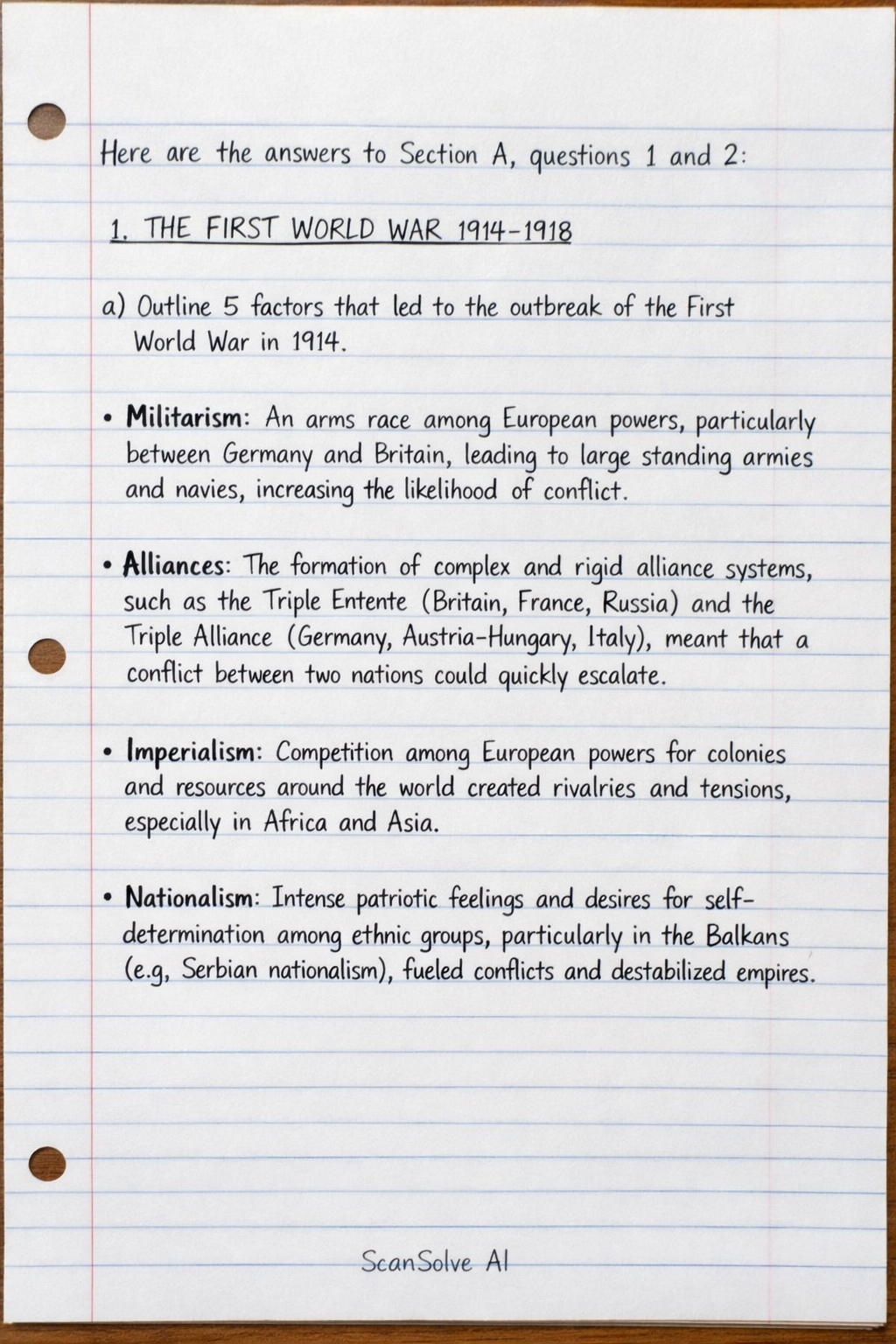
Here are the answers to Section A, questions 1 and 2:
1. THE FIRST WORLD WAR 1914-1918
a) Outline 5 factors that led to the outbreak of the First World War in 1914.
- Militarism: An arms race among European powers, particularly between Germany and Britain, leading to large standing armies and navies, increasing the likelihood of conflict.
- Alliances: The formation of complex and rigid alliance systems, such as the Triple Entente (Britain, France, Russia) and the Triple Alliance (Germany, Austria-Hungary, Italy), meant that a conflict between two nations could quickly escalate.
- Imperialism: Competition among European powers for colonies and resources around the world created rivalries and tensions, especially in Africa and Asia.
- Nationalism: Intense patriotic feelings and desires for self-determination among ethnic groups, particularly in the Balkans (e.g., Serbian nationalism), fueled conflicts and destabilized empires.
- Assassination of Archduke Franz Ferdinand: The immediate trigger was the assassination of the Austro-Hungarian heir by a Serbian nationalist in Sarajevo, which led to Austria-Hungary declaring war on Serbia, setting off the chain reaction of alliances.
b) Describe 5 impacts of the First World War on Europe and the world.
- Massive Loss of Life and Destruction: The war resulted in an unprecedented number of casualties, with millions of soldiers and civilians killed, and widespread physical destruction across Europe.
- Economic Devastation: European economies were severely damaged, leading to massive debts, inflation, and unemployment, which shifted global economic power towards the United States.
- Political Changes and Fall of Empires: The war led to the collapse of major empires, including the Austro-Hungarian, Ottoman, Russian, and German empires, and the creation of new nation-states in Central and Eastern Europe.
- Social Transformation: Women played crucial roles in the workforce during the war, leading to increased demands for suffrage and greater social equality. There was also widespread disillusionment and social unrest.
- Treaty of Versailles and League of Nations: The punitive Treaty of Versailles imposed harsh terms on Germany, contributing to future tensions. The war also led to the creation of the League of Nations, an international organization aimed at preventing future conflicts.
2. BRITISH COLONIAL POLICY IN CAMEROON
a) Give 5 reasons why Britain initially opposed the annexation of Cameroon during the Scramble for Africa.
- Existing Trade Interests: Britain already had significant informal trade links and influence in Cameroon through British merchants and missionaries, which they felt did not require formal annexation.
- Cost of Administration: Annexing and administering a new territory would incur significant financial costs, which the British government was reluctant to bear at the time.
- Lack of Strategic Importance: Cameroon was not considered as strategically vital as other territories like Egypt (Suez Canal) or South Africa, which were priorities for British imperial expansion.
- Focus on Other Regions: Britain was heavily engaged in consolidating its control over other, more valuable territories in Africa and elsewhere, such as Nigeria and East Africa.
- Desire to Avoid Conflict: Britain preferred to avoid direct confrontation or diplomatic disputes with other European powers, particularly Germany, over a territory they did not deem essential.
b) Explain 5 reasons why Britain later decided to take control of Southern Cameroons after WWI.
- War Spoils and Defeat of Germany: As a victor in WWI, Britain, along with France, divided Germany's colonial possessions, including Cameroon, as part of the peace settlement.
- Strategic Link to Nigeria: Taking control of Southern Cameroons provided a direct land link and a buffer zone for its existing colony of Nigeria, enhancing its security and administrative coherence.
- Economic Potential: The region possessed valuable resources, particularly plantations (e.g., rubber, cocoa) and fertile land, which Britain could exploit for its own economic benefit.
- Preventing French Dominance: Britain wanted to prevent France from gaining sole control over the entire former German colony, ensuring a balance of power in the region.
- League of Nations Mandate System: The newly established League of Nations provided a legitimate international framework for Britain to administer Southern Cameroons as a mandated territory, rather than outright annexation.
Was this helpful?
Still stuck on this one?
Ask a follow-up, and the answer starts from this question.
Got a different question?Ask your own question
More History Questions
QGCE HISTORY – CAMEROON & WWI QUESTIONS - Q1: What part was played in Cameroon during the First World…QRead the extract carefully and answer the questions that follow. "On 14 July 1884, German…QSECTION A CAMEROON HISTORY SINCE 1884 Question one is compulsory. Answer either 1A or 1B and one…QVoici quelques exemples de questions d'histoire qui pourraient sortir au BFEM. La colonisation…QSECTION A CAMEROON SINCE 1850. This section contains multiple choice questions covering the history…
Browse by topic:World History
Handwritten Step-by-Step Solution
Get this as a handwritten image on WhatsApp — like a tutor wrote it for you.
Try on WhatsApp