

This history question requires analysis of historical events, causes, and consequences. The detailed answer below provides context, evidence, and a well-structured explanation.
ScanSolve AI Answer
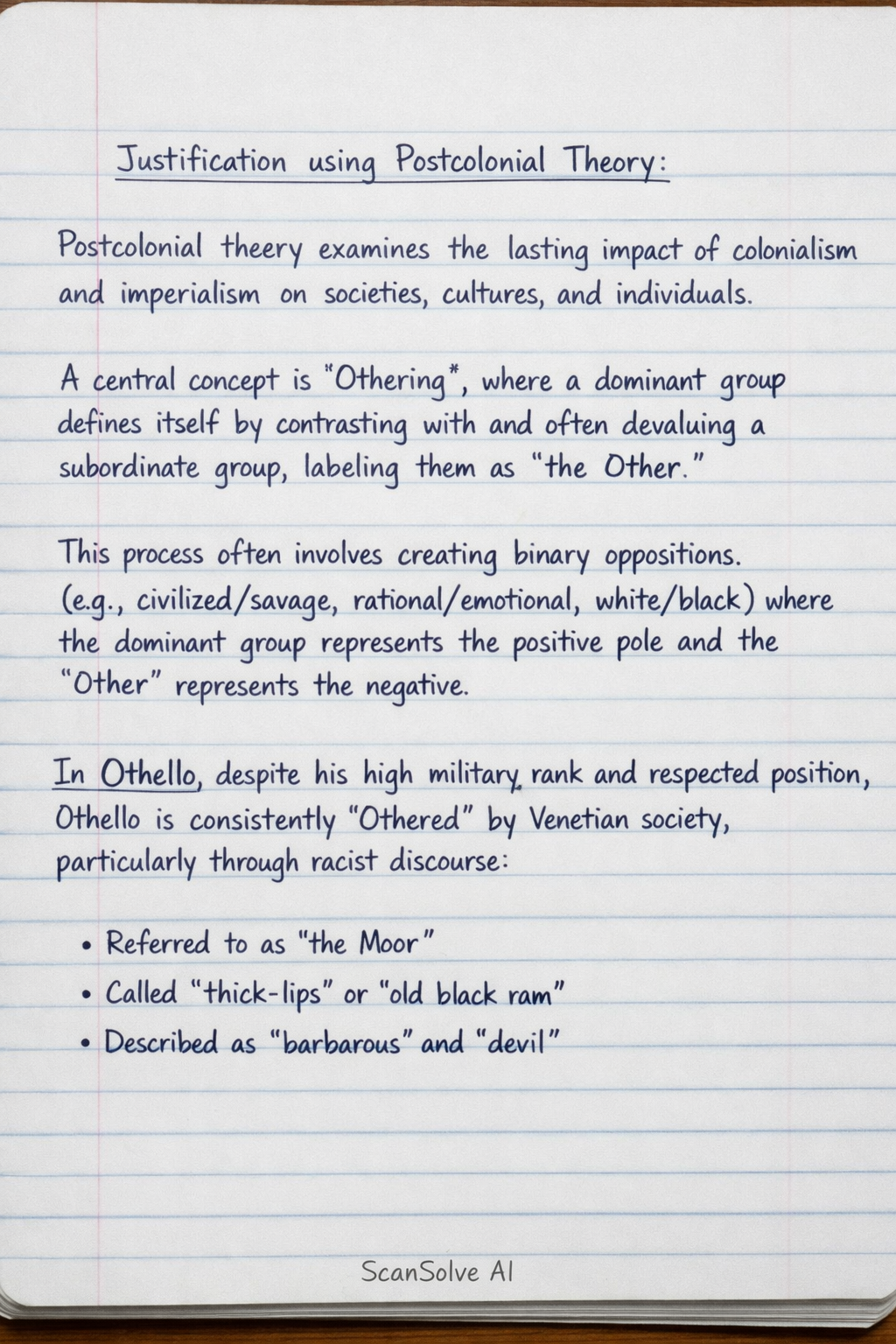
To justify the statement "Othello = 'Other' in dominant society" using Postcolonial Theory, we need to understand how the theory defines "Othering" and then apply it to Othello's situation in Venice. Justification using Postcolonial Theory: Postcolonial theory examines the lasting impact of colonialism and imperialism on societies, cultures, and individuals. A central concept is Othering, where a dominant group defines itself by contrasting with and often devaluing a subordinate group, labeling them as "the Other." This process often involves creating binary oppositions (e.g., civilized/savage, rational/emotional, white/black) where the dominant group represents the positive pole and the "Other" represents the negative. In Othello, despite his high military rank and respected position, Othello is consistently "Othered" by Venetian society, particularly through racist discourse: Racial and Cultural Difference: Othello is repeatedly referred to as "the Moor," a term that immediately marks him as racially and culturally distinct from the white Venetian characters. This label reduces his complex identity to a single racial characteristic, positioning him as an outsider. Dehumanizing Language and Stereotypes: Characters like Iago and Roderigo, and even Brabantio, use racist language and animal imagery* to describe Othello. He is called a "black ram," "Barbary horse," and "thick-lips." This dehumanizing language strips him of his humanity and reinforces negative stereotypes associated with his race, portraying him as primitive, lustful, and dangerous. Conditional Acceptance: Despite his military prowess and service to Venice, Othello is not fully accepted* into the dominant society. His marriage to Desdemona, a white Venetian noblewoman, is seen as unnatural and scandalous, provoking outrage and accusations of witchcraft from Brabantio. This highlights that his acceptance is conditional and fragile, easily undermined by racial prejudice. Internalized Othering: The constant barrage of racial prejudice and the pressure to conform to Venetian ideals contribute to Othello's insecurity and ultimately make him susceptible to Iago's manipulations. He begins to see himself through the prejudiced lens of the "Other," leading to his tragic downfall. Through these elements, Othello exemplifies how a dominant society constructs an "Other" based on race and origin, even when that individual holds a position of power. Postcolonial theory helps us understand how this process of Othering leads to marginalization, dehumanization, and ultimately, the destruction of the "Othered" individual, regardless of their achievements or character.