
We read your photo as:
When was Secondary school education begin in Nigeria?
History
ScanSolve AI Answer
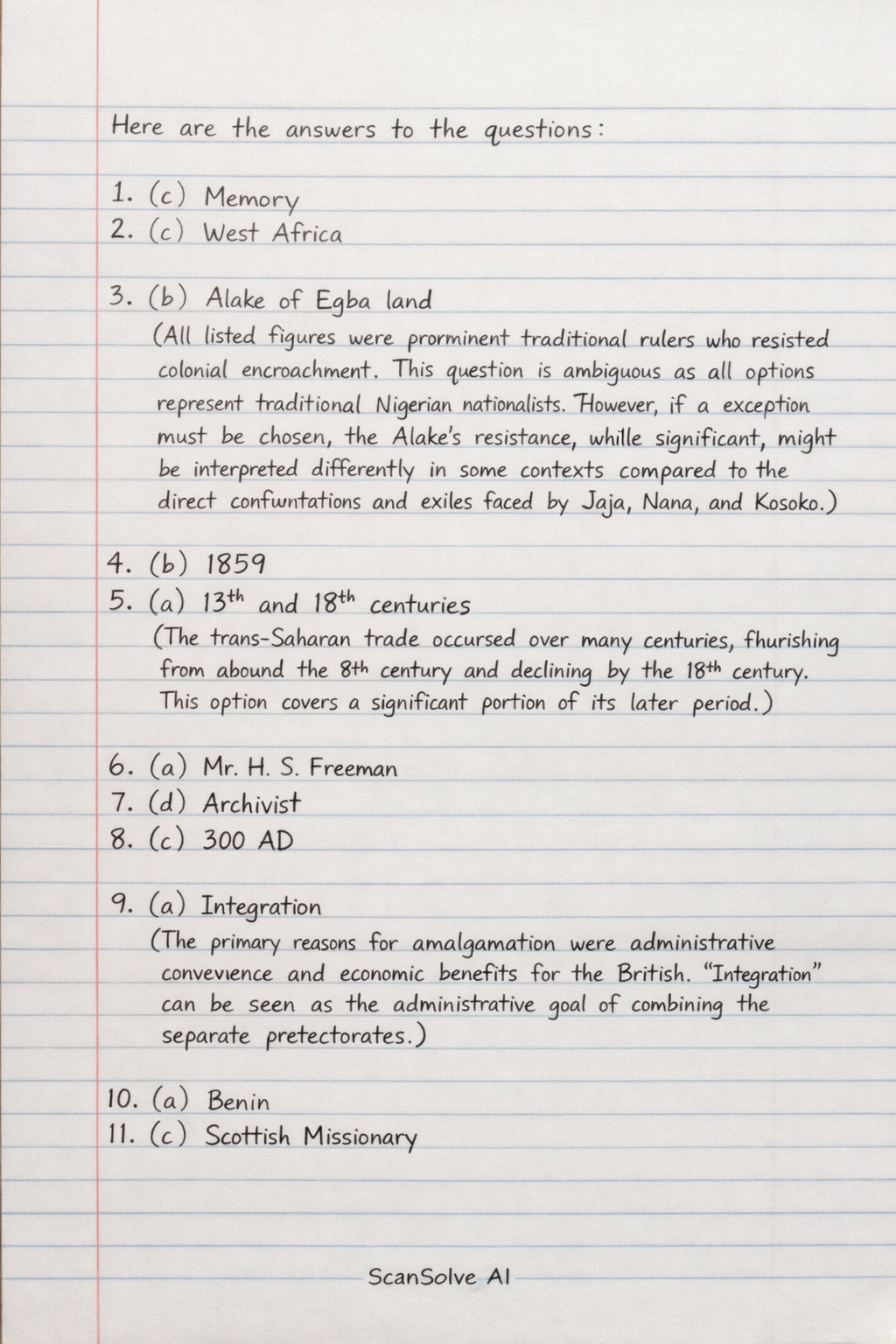
Here are the answers to the questions:
- (c) Memory
- (c) West Africa
- (b) Alake of Egba land (All listed figures were prominent traditional rulers who resisted colonial encroachment. This question is ambiguous as all options represent traditional Nigerian nationalists. However, if an exception must be chosen, the Alake's resistance, while significant, might be interpreted differently in some contexts compared to the direct confrontations and exiles faced by Jaja, Nana, and Kosoko.)
- (b) 1859
- (a) 13th and 18th centuries (The trans-Saharan trade occurred over many centuries, flourishing from around the 8th century and declining by the 18th century. This option covers a significant portion of its later period.)
- (a) Mr. H. S. Freeman
- (d) Archivist
- (c) 300 AD
- (a) Integration (The primary reasons for amalgamation were administrative convenience and economic benefits for the British. "Integration" can be seen as the administrative goal of combining the separate protectorates.)
- (a) Benin
- (c) Scottish Missionary
- (d) Non centralized state
- (b) 1859
- (d) Nigerian Coat of Arms
- (c) Mali
- (a) Head of state
- (d) Inter-group relations
- (b) Clifford constitution
- (b) 15th
Was this helpful?
Still stuck on this one?
Ask a follow-up, and the answer starts from this question.
Got a different question?Ask your own question
More History Questions
QWhat are the objectives of Civic Education at the secondary school level in Nigeria?QDevelopment of Secondary Education in India and in Assam (Post Independence Period)QIn Nigeria history who is the father of free educationQComprehensively review 2026 Nigeria secondary school computer studies and data processing syllabus…QIn Nigeria history, which of the following is regarded as the father of free education?
Handwritten Step-by-Step Solution
Get this as a handwritten image on WhatsApp — like a tutor wrote it for you.
Try on WhatsApp