
We read your photo as:
Give ways in which God would punish Israel for her evils according to prophet Amos. State 6 ways in which the church today punishes errant members.
ScanSolve AI Answer
here are the answers to your questions:
-
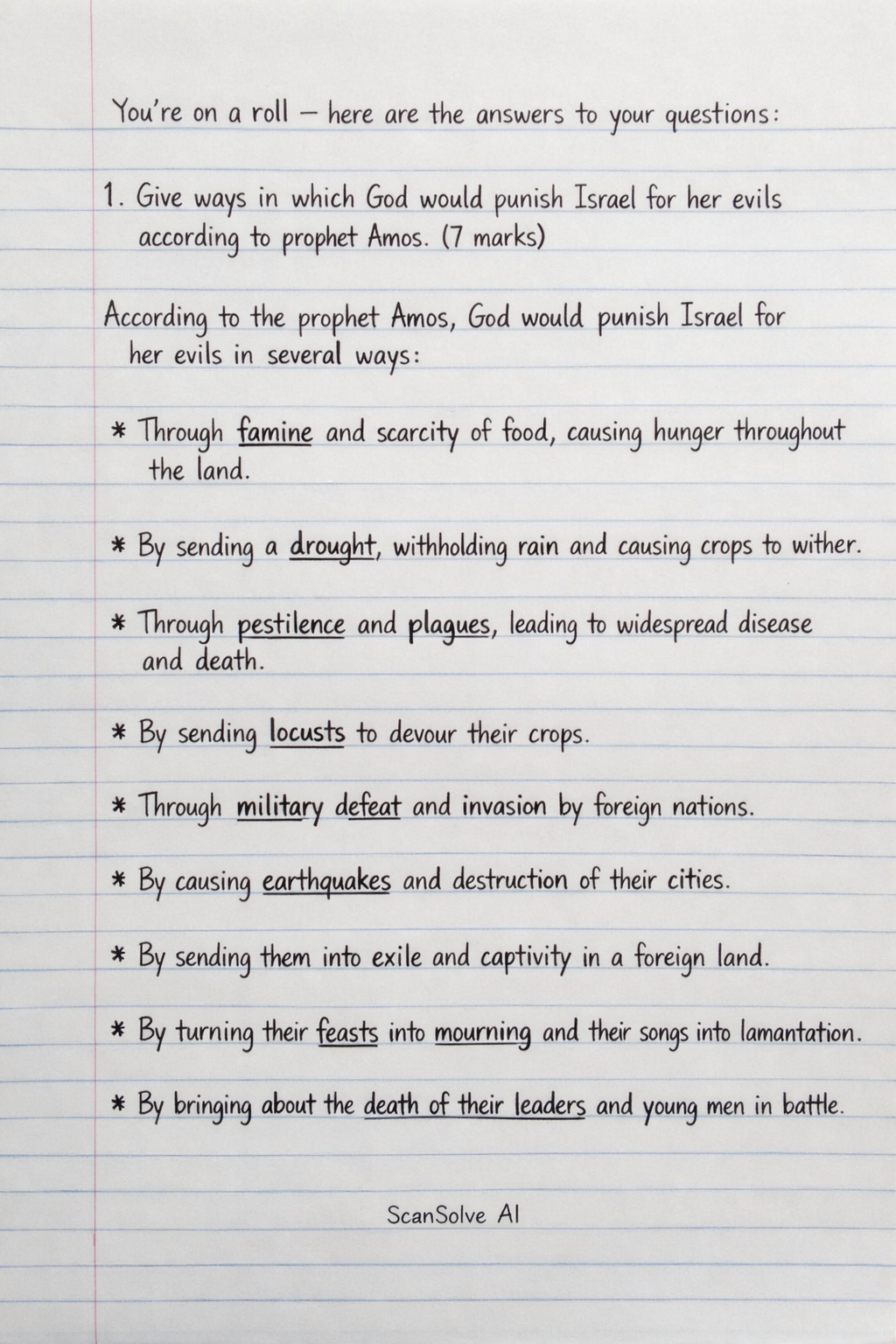
Give ways in which God would punish Israel for her evils according to prophet Amos. (7 marks) According to the prophet Amos, God would punish Israel for her evils in several ways:
- Through famine and scarcity of food, causing hunger throughout the land.
- By sending a drought, withholding rain and causing crops to wither.
- Through pestilence and plagues, leading to widespread disease and death.
- By sending locusts to devour their crops.
- Through military defeat and invasion by foreign nations.
- By causing earthquakes and destruction of their cities.
- By sending them into exile and captivity in a foreign land.
- By turning their feasts into mourning and their songs into lamentation.
- By bringing about the death of their leaders and young men in battle.
-
State 6 ways in which the church today punishes errant members. (6 marks) The church today punishes errant members in various ways:
- Admonition or rebuke, which involves a verbal warning or correction.
- Suspension from communion, temporarily preventing participation in the Lord's Supper.
- Excommunication, which is the formal exclusion from church membership and fellowship.
- Removal from leadership positions or church offices.
- Public confession and repentance before the congregation.
- Pastoral counseling and guidance aimed at restoration.
- Temporary restriction from certain church activities or ministries.
-
State 7 factors to consider when naming a baby in the African Traditional Society. (7 marks) In African Traditional Society, several factors were considered when naming a baby:
- The circumstances of birth, such as time of day, weather, or events occurring at that moment.
- The lineage or ancestry of the child, often naming after respected elders or ancestors.
- The order of birth (e.g., firstborn, twins, lastborn).
- The wishes of the parents or other close relatives.
- The clan or family totems or significant symbols.
- Prophetic dreams or visions experienced by parents or elders.
- Significant events in the community or family history.
- The character traits or aspirations parents wished for the child.
- The gender of the child.
-
State 7 factors that promote harmony and mutual responsibility in Traditional African community. (7 marks) Factors that promoted harmony and mutual responsibility in Traditional African communities include:
- Kinship ties and extended family systems, which fostered strong bonds and obligations.
- Communal land ownership, ensuring everyone had access to resources and shared responsibility.
- Age-set systems, which instilled discipline, respect for elders, and shared duties.
- Rites of passage, which marked transitions and reinforced community values and roles.
- Shared religious beliefs and rituals, uniting people in common worship and moral codes.
- Oral traditions and proverbs, which transmitted wisdom, history, and ethical guidelines.
- Traditional justice systems, which aimed at reconciliation and restoring harmony rather than just punishment.
- Communal labor and mutual aid, where members helped each other in farming, building, etc.
-
Give significance of the ritual performed after birth of a person in Traditional African community. (6 marks) Rituals performed after birth in Traditional African communities held significant meaning:
- Integration into the community: The child was formally welcomed and recognized as a new member of the family and clan.
- Naming: The child received a name, which often carried cultural, ancestral, or prophetic significance.
- Protection from evil: Rituals were believed to ward off evil spirits or misfortunes that could harm the newborn.
- Blessings and good fortune: Elders would invoke blessings for the child's health, prosperity, and long life.
- Establishing identity: The rituals affirmed the child's lineage, heritage, and place within the social structure.
- Reinforcing family bonds: The ceremonies brought together family members, strengthening their relationships.
- Passing on cultural values: The rituals served as a means to transmit cultural beliefs and practices to the next generation.
-
Highlight 6 ways on how the Traditional concept of property ownership has changed in the society today. (6 marks) The traditional concept of property ownership has changed in society today in several ways:
- Shift from communal ownership to individual ownership, especially of land.
- Increased emphasis on written legal documents (title deeds) over oral agreements or customary rights.
- Introduction of monetary value for property, allowing it to be bought, sold, or mortgaged.
- Women's rights to own and inherit property have become more recognized, challenging traditional male dominance.
- Urbanization has led to new forms of property like apartments and commercial buildings, distinct from rural land.
- Formal legal systems now govern property disputes, replacing traditional arbitration by elders.
- Property can be used as collateral for loans, a concept largely absent traditionally.
-
Highlight 6 ways on how the traditional concept of dressing has changed in the society today. (6 marks) The traditional concept of dressing has changed in society today in several ways:
- Shift from traditional attire made from natural materials (e.g., animal skins, bark cloth) to modern factory-made clothing.
- Increased Westernization of dress codes, with suits, dresses, and casual wear becoming common.
- Loss of symbolic meaning in everyday clothing; traditional attire often conveyed status, age, or marital status.
- Greater individual choice and fashion trends influencing dressing, rather than strict community norms.
- Reduced use of traditional adornments like beads, feathers, and body paint in daily life.
- Traditional attire is often reserved for special occasions like cultural festivals or ceremonies, rather than daily wear.
- Influence of media and globalization introducing diverse dressing styles.
-
Highlight the factors that have brought about change in:
- a) Dressing (3 marks)
- b) Death and burial. (3 marks)
- c) Property ownership. (3 marks)
a) Dressing:
- Westernization and globalization: Exposure to Western cultures through media, education, and trade.
- Christianity and Islam: Introduction of new modesty standards and clothing styles.
- Education: Formal schooling often introduced uniforms and Western dress codes.
- Urbanization: City life brought new fashion trends and access to diverse clothing.
- Economic factors: Availability of cheaper, mass-produced clothing.
b) Death and burial:
- Christianity and Islam: Introduction of new burial rites, beliefs about afterlife, and specific mourning periods.
- Modern medicine: Changes in understanding causes of death and post-mortem procedures.
- Urbanization: Limited space in cities leading to public cemeteries instead of family land burials.
- Legal requirements: Government regulations regarding death certificates, post-mortems, and burial permits.
- Economic factors: Cost of coffins, funeral services, and transportation.
c) Property ownership:
- Colonialism: Introduction of Western legal systems and individual land tenure.
- Education: Increased awareness of legal rights and formal property documentation.
- Urbanization: Rise of private land ownership and commercial property development in cities.
- Economic factors: Property becoming a commodity for sale, purchase, and investment.
- Government policies: Land reforms, titling programs, and inheritance laws.
- Influence of Christianity: Emphasis on individual rights and nuclear family structures.
Still stuck on this one?
Ask a follow-up, and the answer starts from this question.
More History Questions
Handwritten Step-by-Step Solution
Get this as a handwritten image on WhatsApp — like a tutor wrote it for you.
Try on WhatsApp