
This history question requires analysis of historical events, causes, and consequences. The detailed answer below provides context, evidence, and a well-structured explanation.
ScanSolve AI Answer
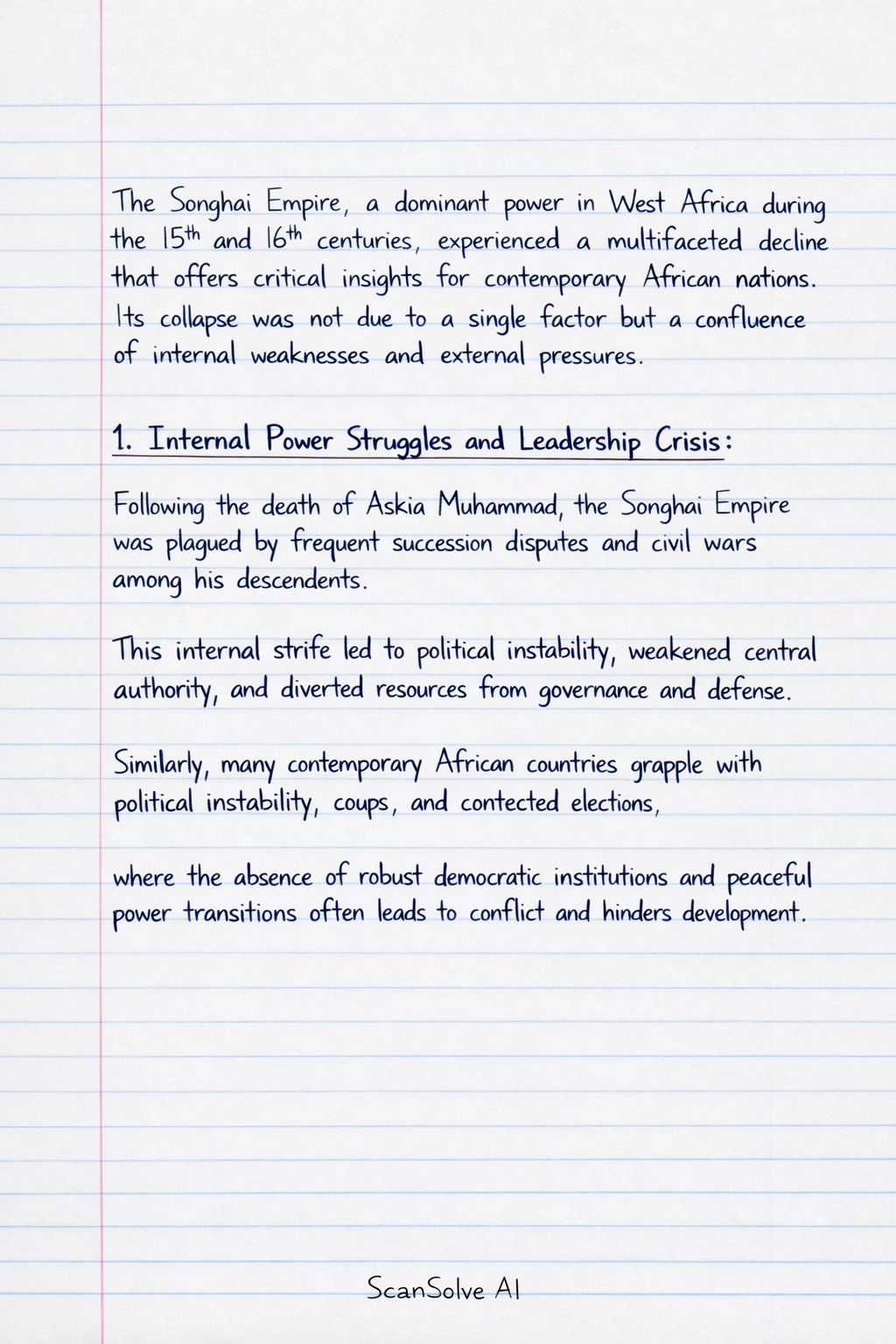
here's an analysis of the Songhai Empire's decline and its lessons for modern Africa. The Songhai Empire, a dominant power in West Africa during the 15th and 16th centuries, experienced a multifaceted decline that offers critical insights for contemporary African nations. Its collapse was not due to a single factor but a confluence of internal weaknesses and external pressures. 1. Internal Power Struggles and Leadership Crisis: Following the death of Askia Muhammad, the Songhai Empire was plagued by frequent succession disputes and civil wars among his descendants. This internal strife led to political instability, weakened central authority, and diverted resources from governance and defense. Similarly, many contemporary African countries grapple with political instability, coups, and contested elections, where the absence of robust democratic institutions and peaceful power transitions often leads to conflict and hinders development. 2. External Pressure (Moroccan Invasion, European Colonization): The most immediate cause of Songhai's collapse was the Moroccan invasion in 1591. Armed with firearms, the Moroccans decisively defeated the Songhai army, which relied on traditional weaponry. This external military pressure, coupled with the later encroachment of European powers seeking new trade routes and resources, dismantled the empire. Today, African nations face various forms of external pressure, including neo-colonial economic policies, foreign intervention in internal affairs, and the global impact of terrorism, which can destabilize regions and undermine national sovereignty. 3. Economic Shifts (Decline of the Trans-Saharan Trade): The Songhai Empire's wealth was largely built on its control of the Trans-Saharan trade routes, facilitating the exchange of gold, salt, and other goods. However, the emergence of new maritime trade routes along the Atlantic coast, pioneered by Europeans, gradually diminished the importance and profitability of the Trans-Saharan networks. This economic shift deprived Songhai of its primary revenue source. Many modern African economies remain vulnerable due to over-reliance on a few primary commodities, making them susceptible to global price fluctuations and external economic shocks, highlighting the need for diversification. 4. Governance and Institutional Weakness: While Askia Muhammad established a centralized administration, the empire's governance structure ultimately lacked strong, enduring institutions independent of individual leaders. The absence of clear succession protocols and robust checks and balances allowed internal power struggles to escalate into full-blown crises. Contemporary African nations often struggle with institutional weaknesses, including corruption, weak rule of law, and a lack of accountability, which erode public trust, hinder effective governance, and impede sustainable development. In conclusion, the decline of the Songhai Empire serves as a stark historical lesson. It underscores the critical importance for modern African nations to cultivate strong, inclusive institutions, ensure peaceful and legitimate transitions of power, diversify their economies, and build resilience against both internal divisions and external pressures to maintain stability and achieve sustainable progress. What's next?