
We read your photo as:
What were the key aspects of the Greek War of Independence, Young Italy, Count Cavour's ideology, and the Frankfurt Parliament?
ScanSolve AI Answer
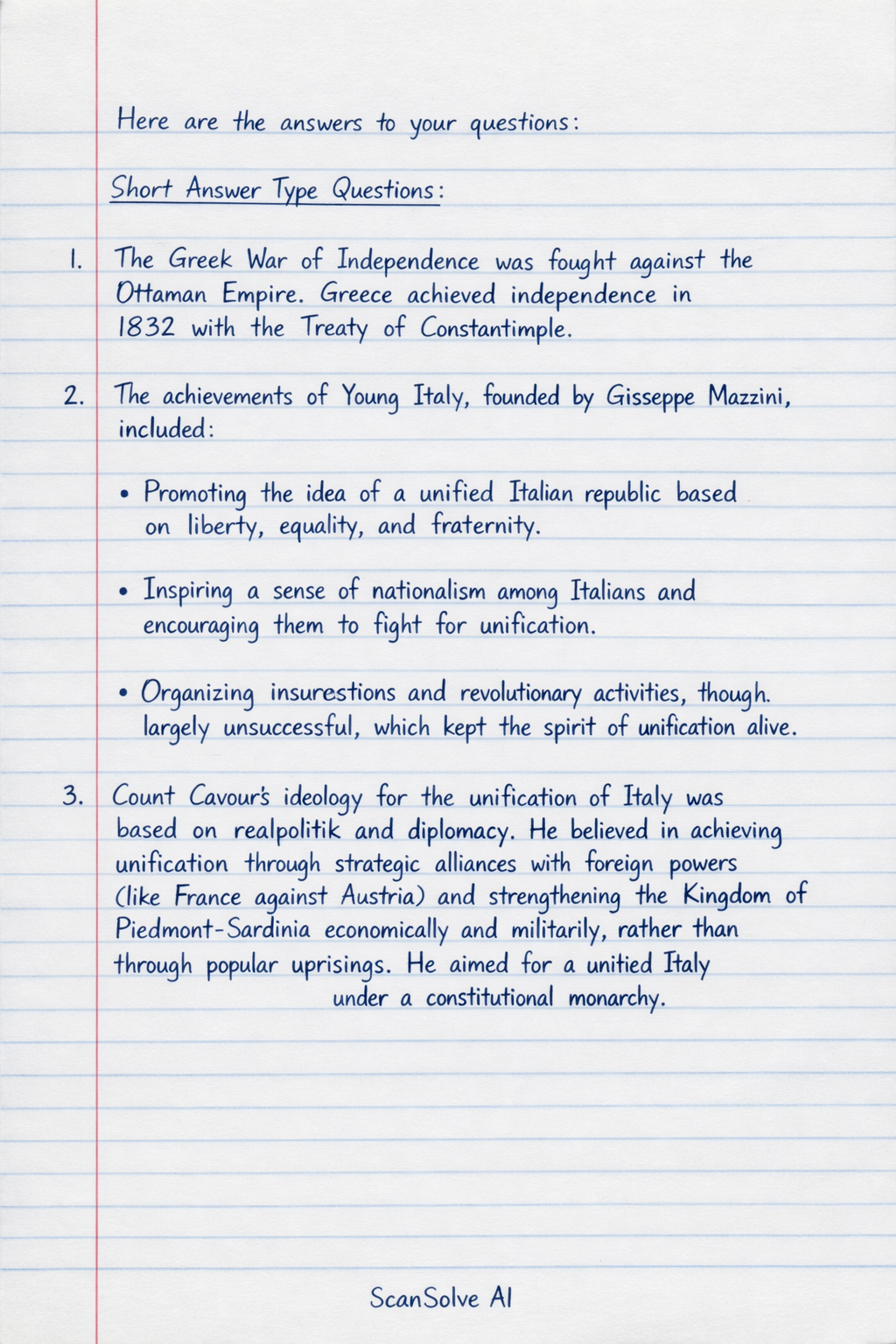
Here are the answers to your questions:
Short Answer Type Questions:
-
The Greek War of Independence was fought against the Ottoman Empire. Greece achieved independence in 1832 with the Treaty of Constantinople.
-
The achievements of Young Italy, founded by Giuseppe Mazzini, included:
- Promoting the idea of a unified Italian republic based on liberty, equality, and fraternity.
- Inspiring a sense of nationalism among Italians and encouraging them to fight for unification.
- Organizing insurrections and revolutionary activities, though largely unsuccessful, which kept the spirit of unification alive.
-
Count Cavour's ideology for the unification of Italy was based on realpolitik and diplomacy. He believed in achieving unification through strategic alliances with foreign powers (like France against Austria) and strengthening the Kingdom of Piedmont-Sardinia economically and militarily, rather than through popular uprisings. He aimed for a unified Italy under a constitutional monarchy.
-
The Frankfurt Parliament was an all-German national assembly formed in 1848, following the liberal revolutions across German states. Its main aim was to draft a constitution for a unified German empire based on parliamentary principles. However, it ultimately failed to achieve its goal due to a lack of support from monarchs and internal divisions.
-
Giuseppe Garibaldi's contribution to the unification of Italy was significant through his military leadership and popular appeal. He led the "Expedition of the Thousand" (Red Shirts) in 1860, conquering Sicily and Naples from the Bourbon rulers, and then handed these territories over to King Victor Emmanuel II of Piedmont-Sardinia, playing a crucial role in uniting southern Italy with the north.
-
After the United Kingdom of Italy was proclaimed, the Pope of Rome, Pius IX, lost his temporal power over the Papal States. He became a voluntary prisoner in the Vatican, refusing to recognize the new Italian state and maintaining a hostile stance towards it until the Lateran Treaty of 1929.
-
Magyarization policy in Hungary was a program implemented by the Hungarian government in the late 19th and early 20th centuries to assimilate non-Magyar ethnic groups within the Kingdom of Hungary into Hungarian culture. This involved promoting the Hungarian language in education, administration, and public life, often at the expense of minority languages and cultures.
-
Language played a crucial role in national movements in Europe by serving as a unifying factor for people sharing a common linguistic heritage. It helped in forging a collective identity, distinguishing one group from another, and became a symbol of national pride and cultural distinctiveness, often leading to demands for political autonomy or unification based on linguistic boundaries.
Very Short Answer Type Questions:
-
The unified German empire was proclaimed in the Hall of Mirrors at the Palace of Versailles on January 18, 1871.
-
Klemens von Metternich was an Austrian statesman and diplomat who served as the Foreign Minister of Austria for over 30 years. He was a key figure in European diplomacy for three decades, known for his conservative policies and his role in the Congress of Vienna and the Concert of Europe.
-
The Carbonari was a secret revolutionary society in early 19th-century Italy. They advocated for liberal and patriotic ideas and played a role in various uprisings against conservative regimes, aiming for Italian unification and constitutional government.
-
The Magyars are an ethnic group primarily associated with Hungary. They are the descendants of nomadic tribes who settled in the Carpathian Basin in the 9th century and established the Kingdom of Hungary.
-
Louis Philippe was the King of the French from 1830 to 1848, during the July Monarchy. He came to power after the July Revolution, replacing Charles X, and was known as the "Citizen King."
-
Louis Napoleon (Napoleon III) was dethroned in France on September 4, 1870, following the French defeat in the Battle of Sedan during the Franco-Prussian War.
-
The Prussian Zollverein was a customs union formed in 1834 among German states, led by Prussia. It abolished internal customs barriers and created a free trade area, significantly contributing to economic integration and laying the groundwork for German political unification.
-
The King of Prussia, Wilhelm I, became the German Emperor (Kaiser) at the time of German unification.
-
Ludwig van Beethoven was a renowned German composer and pianist, a crucial figure in the transition between the Classical and Romantic eras in Western music.
-
Giuseppe Garibaldi was known as the "Knight-errant of the Italian unification" due to his heroic military campaigns and unwavering dedication to uniting Italy.
Still stuck on this one?
Ask a follow-up, and the answer starts from this question.
More History Questions
Handwritten Step-by-Step Solution
Get this as a handwritten image on WhatsApp — like a tutor wrote it for you.
Try on WhatsApp