
We read your photo as:
What were the main political and historical reasons for the separation of British Southern Cameroons from Nigeria and its subsequent reunification?
ScanSolve AI Answer
here are the answers to the next questions:
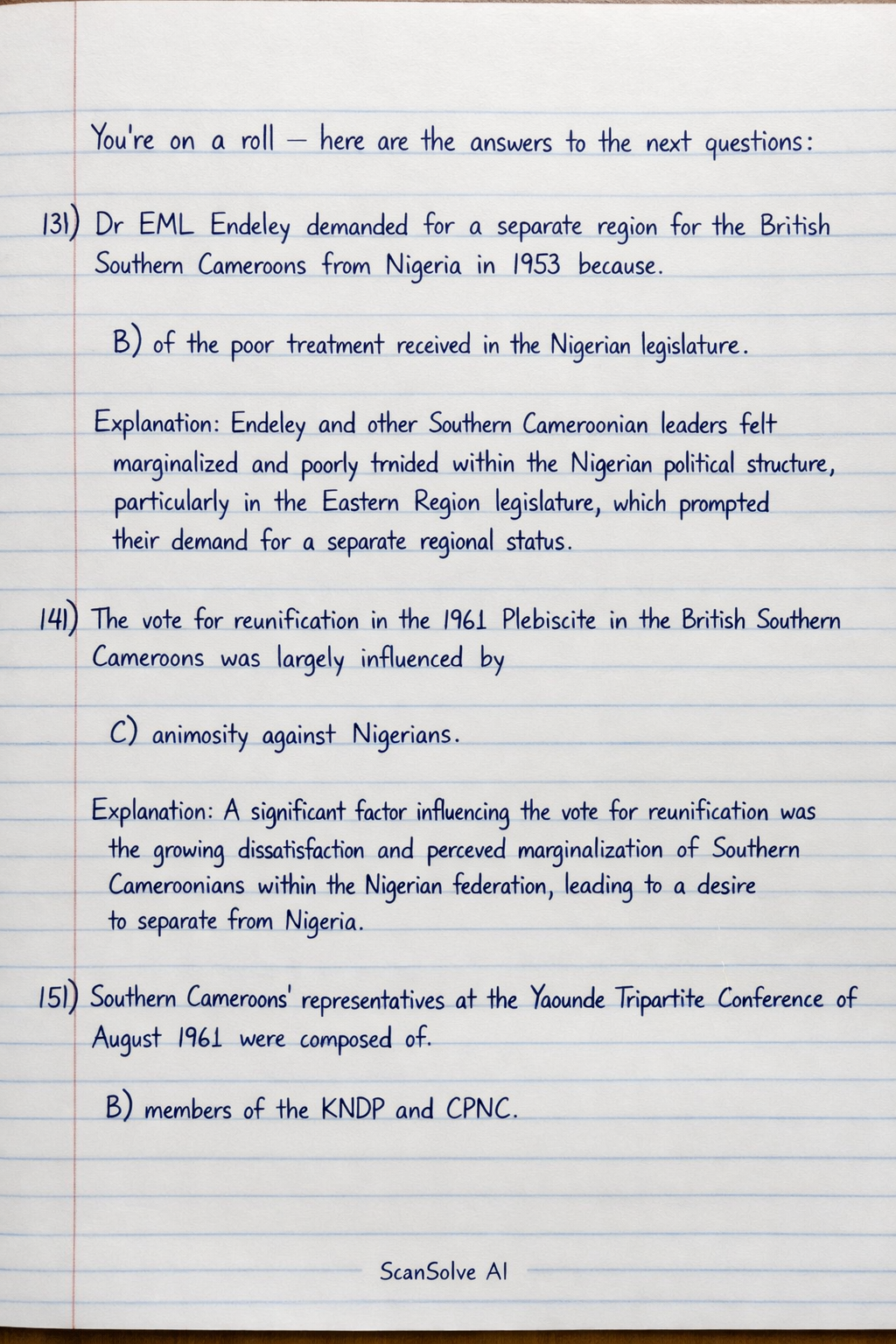
13) Dr EML Endeley demanded for a separate region for the British Southern Cameroons from Nigeria in 1953 because
- B) of the poor treatment received in the Nigerian legislature.
Explanation: Endeley and other Southern Cameroonian leaders felt marginalized and poorly treated within the Nigerian political structure, particularly in the Eastern Region legislature, which prompted their demand for a separate regional status.
14) The vote for reunification in the 1961 Plebiscite in the British Southern Cameroons was largely influenced by
- C) animosity against Nigerians.
Explanation: A significant factor influencing the vote for reunification was the growing dissatisfaction and perceived marginalization of Southern Cameroonians within the Nigerian federation, leading to a desire to separate from Nigeria.
15) Southern Cameroons' representatives at the Yaounde Tripartite Conference of August 1961 were composed of
- B) members of the KNDP and CPNC.
Explanation: Both the ruling party, the KNDP (Cameroon National Democratic Party), and the main opposition party, the CPNC (Cameroon People's National Convention), sent representatives to the conference to discuss the terms of reunification.
16) The reason for the absence of opposition parties in East Cameroon by 1965 was because
- A) they were oppressed or coerced to join Ahidjo's government.
Explanation: President Ahmadou Ahidjo systematically consolidated power by pressuring, co-opting, or suppressing opposition parties and their leaders, leading to their eventual disappearance or absorption into the ruling party.
Still stuck on this one?
Ask a follow-up, and the answer starts from this question.
More History Questions
Handwritten Step-by-Step Solution
Get this as a handwritten image on WhatsApp — like a tutor wrote it for you.
Try on WhatsApp