
We read your photo as:
What were the major consequences of World War I on Europe and the Middle East, including changes in political structures and alliances?
ScanSolve AI Answer
Answer
You've already sent these questions, and I've answered them in our previous chat!
Here are the answers again for your convenience:
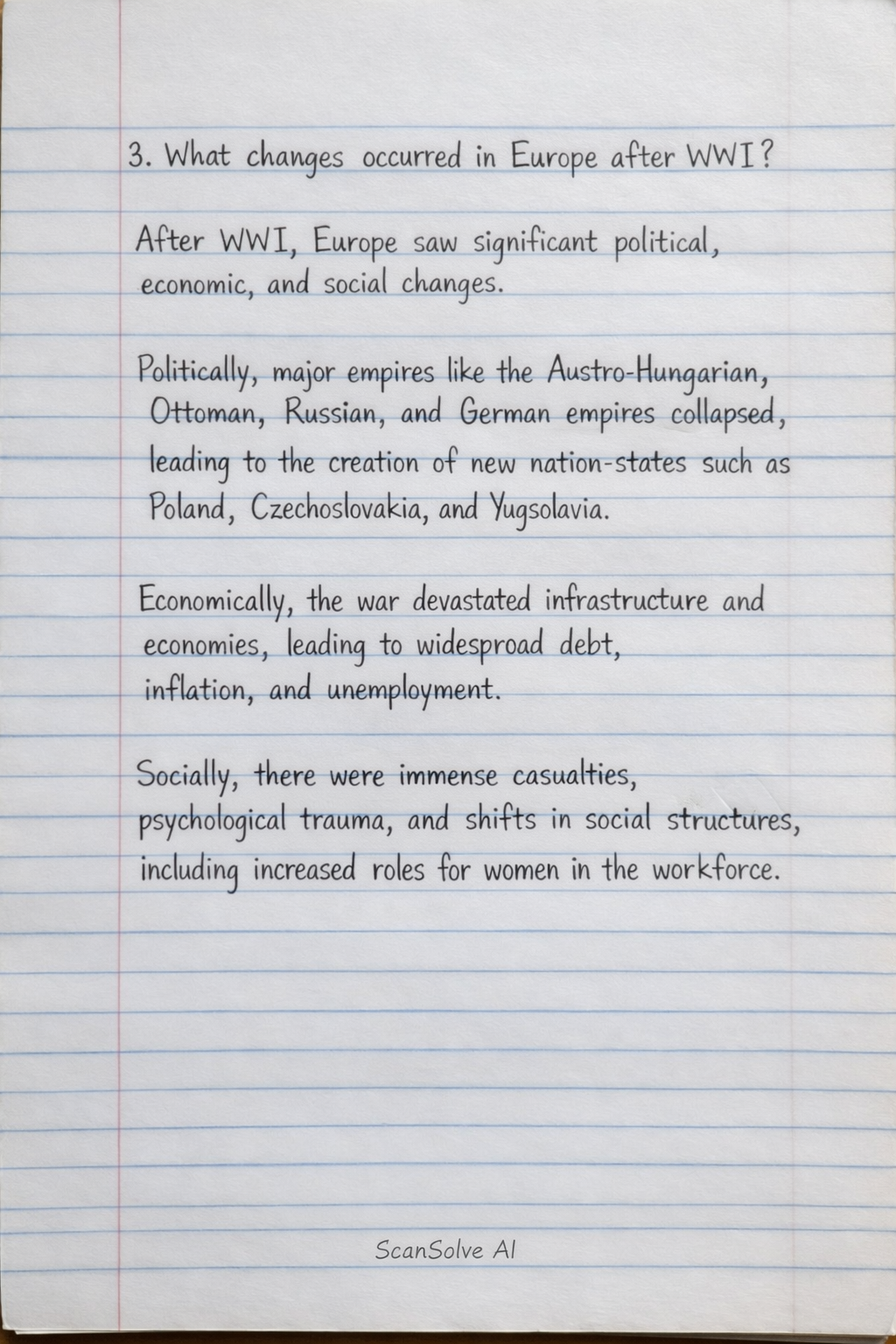
3. What changes occurred in Europe after WWI?
After WWI, Europe saw significant political, economic, and social changes. Politically, major empires like the Austro-Hungarian, Ottoman, Russian, and German empires collapsed, leading to the creation of new nation-states such as Poland, Czechoslovakia, and Yugoslavia. Economically, the war devastated infrastructure and economies, leading to widespread debt, inflation, and unemployment. Socially, there were immense casualties, psychological trauma, and shifts in social structures, including increased roles for women in the workforce.
4. How did WWI affect the Middle East?
WWI led to the collapse of the Ottoman Empire, which had controlled much of the Middle East for centuries. Its territories were subsequently divided into mandates under British and French control through agreements like the Sykes-Picot Agreement. This division and increased European influence laid the groundwork for future conflicts and the rise of nationalist movements in the region. The Balfour Declaration also promised a national home for the Jewish people in Palestine, adding another layer of complexity.
5. How did WWI change alliances in Europe?
WWI fundamentally reshaped the system of alliances in Europe. The pre-war alliances, such as the Triple Entente and Triple Alliance, were dissolved or transformed. The war's outcome led to the defeat of the Central Powers and the rise of new states, altering the balance of power. Instead of a rigid alliance system, the post-war period saw the creation of the League of Nations, an international organization intended to promote collective security and prevent future conflicts through diplomacy rather than military pacts.
c. Peace Treaties and Wilson's Fourteen Points
1. What was the peace agreement that was signed after WWI?
The primary peace agreement signed after WWI was the Treaty of Versailles.
2. Where and when was the peace agreement signed which ended WWI?
The Treaty of Versailles was signed at the Palace of Versailles in France on June 28, 1919.
3. What were the aims of the peacemakers at Versailles?
The main peacemakers, known as the "Big Four" (Georges Clemenceau of France, David Lloyd George of Britain, Woodrow Wilson of the USA, and Vittorio Orlando of Italy), had differing aims:
- France (Clemenceau) sought to severely punish Germany, ensure French security, and weaken Germany militarily and economically to prevent future aggression.
- Britain (Lloyd George) aimed to punish Germany but not so harshly as to provoke future revenge, gain German colonies, and restore European trade.
- USA (Wilson) focused on establishing a lasting peace based on his Fourteen Points, which included self-determination, disarmament, open diplomacy, and the creation of the League of Nations.
- Italy (Orlando) primarily aimed to gain the territorial concessions promised to Italy by the Allies.
Still stuck on this one?
Ask a follow-up, and the answer starts from this question.
More History Questions
Handwritten Step-by-Step Solution
Get this as a handwritten image on WhatsApp — like a tutor wrote it for you.
Try on WhatsApp