
We read your photo as:
What were the primary causes and consequences of military coups in post-colonial African nations?
History
ScanSolve AI Answer
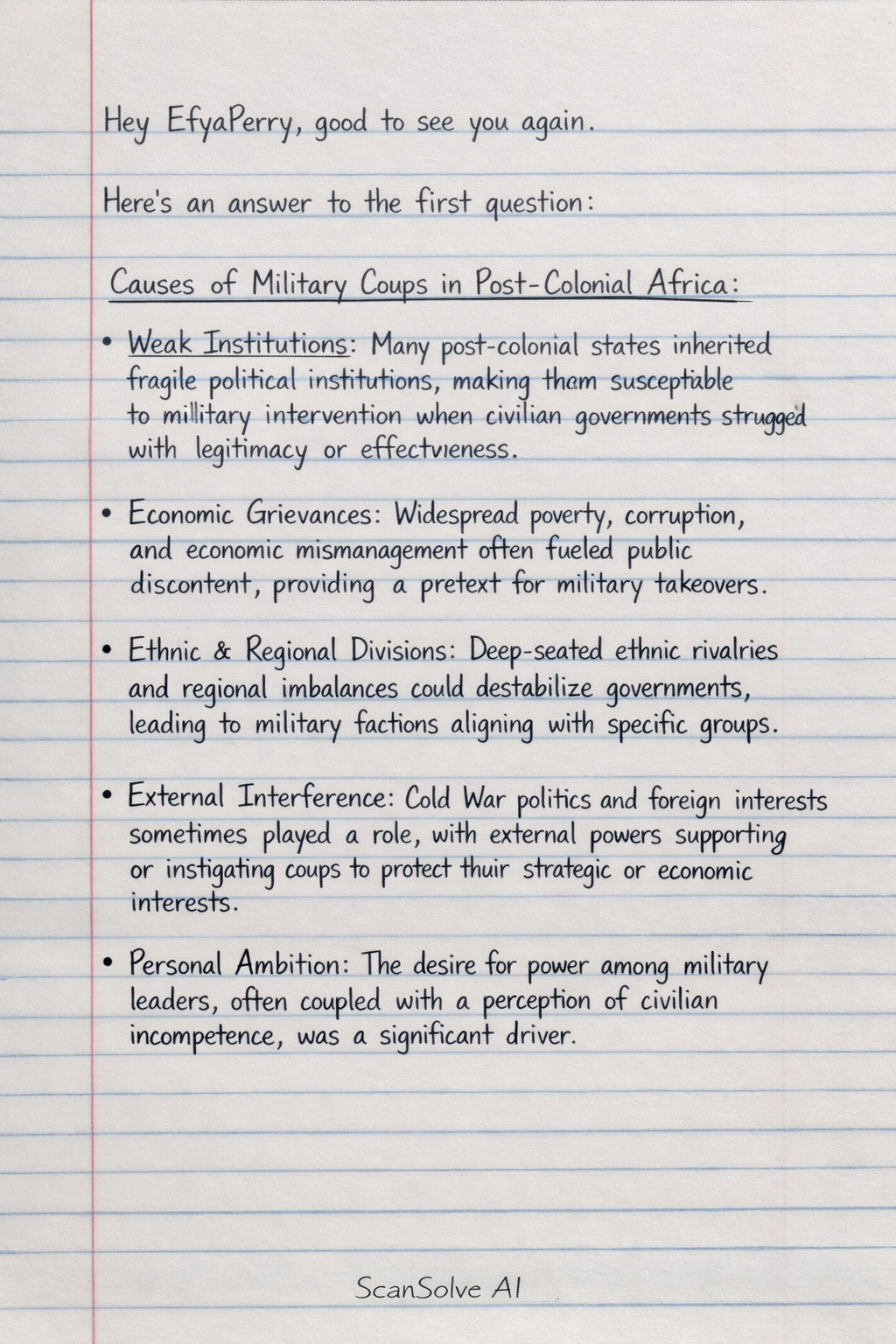
Here's an answer to the first question:
-
Causes of Military Coups in Post-Colonial Africa:
- Weak Institutions: Many post-colonial states inherited fragile political institutions, making them susceptible to military intervention when civilian governments struggled with legitimacy or effectiveness.
- Economic Grievances: Widespread poverty, corruption, and economic mismanagement often fueled public discontent, providing a pretext for military takeovers.
- Ethnic and Regional Divisions: Deep-seated ethnic rivalries and regional imbalances could destabilize governments, leading to military factions aligning with specific groups.
- External Interference: Cold War politics and foreign interests sometimes played a role, with external powers supporting or instigating coups to protect their strategic or economic interests.
- Personal Ambition: The desire for power among military leaders, often coupled with a perception of civilian incompetence, was a significant driver.
-
Consequences of Military Coups:
- Political Instability: Coups often led to cycles of counter-coups, prolonged periods of military rule, and a lack of democratic continuity.
- Human Rights Abuses: Military regimes frequently suppressed dissent, curtailed civil liberties, and committed human rights violations.
- Economic Decline: Instability, corruption, and a lack of investor confidence under military rule often hindered economic development.
- Erosion of Rule of Law: Military governments typically operated outside constitutional frameworks, undermining legal systems and accountability.
-
Coups and Governance Problems (Case Studies):
- Worsened Governance (e.g., Nigeria, Sierra Leone): In Nigeria, a series of coups and counter-coups from the 1960s to the 1990s led to prolonged military dictatorships, widespread corruption, and a severe decline in democratic institutions and human rights under regimes like Sani Abacha's. Similarly, in Sierra Leone, military interventions exacerbated civil conflict and state collapse.
- Addressed Governance (Rarely, and often temporarily): While some coups were initially welcomed by populations fed up with corrupt civilian rule, they rarely led to sustained improvements in governance. For instance, Jerry Rawlings's initial coup in Ghana in 1979 aimed to address corruption, but it was his later transition to democratic rule that brought more stable governance. Even when coups initially removed deeply unpopular or corrupt leaders, the military regimes that followed often became equally, if not more, authoritarian and corrupt, failing to establish lasting good governance.
In conclusion, military coups in post-colonial Africa overwhelmingly worsened governance problems by undermining democratic development, fostering instability, and often replacing one form of misrule with another.
Was this helpful?
Still stuck on this one?
Ask a follow-up, and the answer starts from this question.
Got a different question?Ask your own question
More History Questions
QWhat were the internal and external factors that contributed to the rise of nationalist movements in…QWhich of these African states has NOT experienced a military coup since independence?QThe longterm impact of colonialism on contemporary African stateQExamine and Discuss the causes, manifestation, and consequences of Democratic backsliding or the…QWhat were colonial policies in Africa, and what were some examples?
Browse by topic:World History
Handwritten Step-by-Step Solution
Get this as a handwritten image on WhatsApp — like a tutor wrote it for you.
Try on WhatsApp