
We read your photo as:
With reference to specific Examples, examine the Pull and Push factors that triggered the 19th Century population movements in Cameroon.
ScanSolve AI Answer
here are the answers to your history questions.
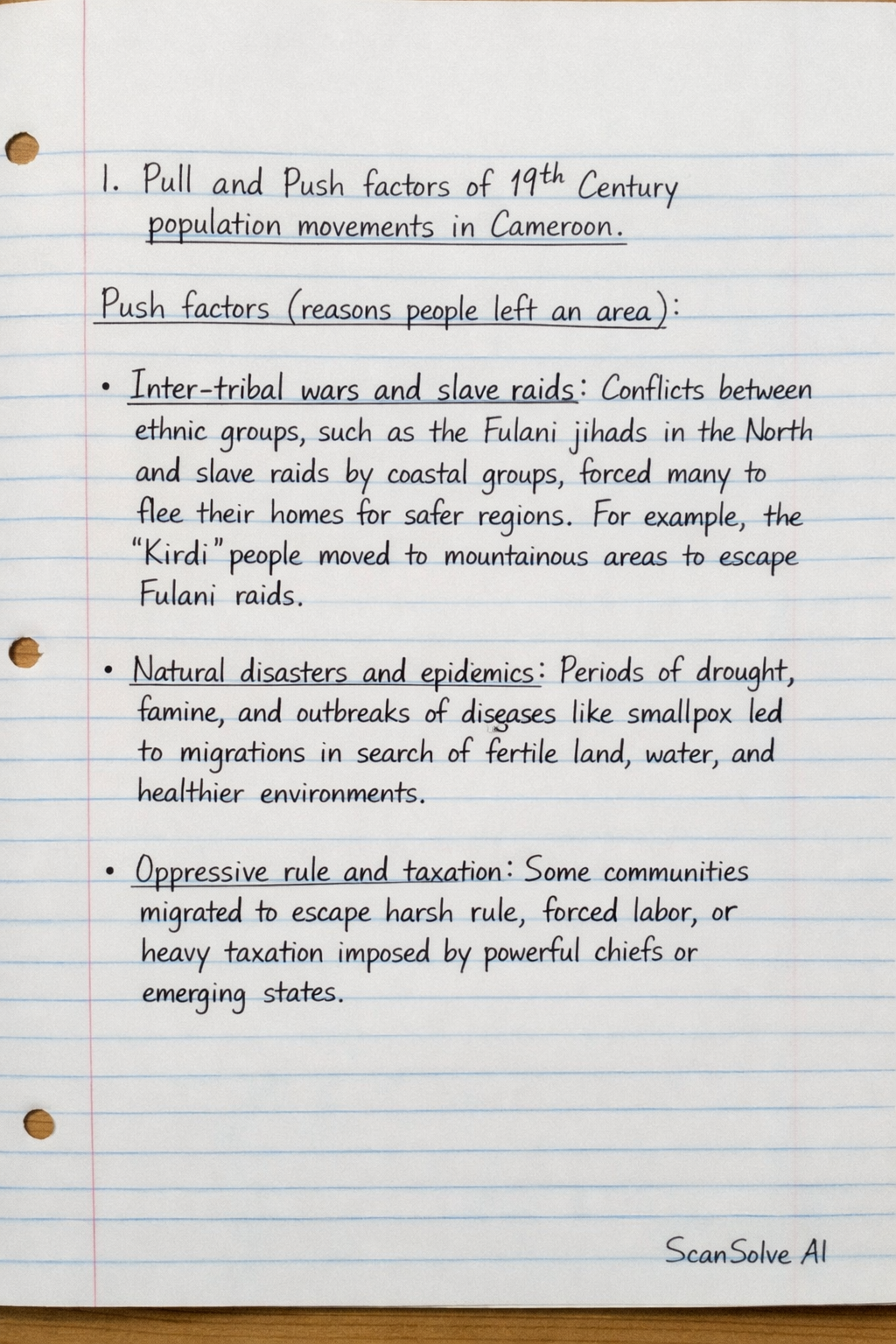
1. Pull and Push factors of 19th Century population movements in Cameroon
Push factors (reasons people left an area):
- Inter-tribal wars and slave raids: Conflicts between ethnic groups, such as the Fulani jihads in the North and slave raids by coastal groups, forced many to flee their homes for safer regions. For example, the Kirdi people moved to mountainous areas to escape Fulani raids.
- Natural disasters and epidemics: Periods of drought, famine, and outbreaks of diseases like smallpox led to migrations in search of fertile land, water, and healthier environments.
- Oppressive rule and taxation: Some communities migrated to escape harsh rule, forced labor, or heavy taxation imposed by powerful chiefs or emerging states.
Pull factors (reasons people moved to an area):
- Economic opportunities: The growth of trade, particularly in palm oil, ivory, and rubber, attracted people to coastal areas and trade routes where they could engage in commerce or find work. For instance, people moved to Douala and Victoria (Limbe) for trade.
- Fertile land and resources: Areas with abundant agricultural land, water sources, and rich hunting grounds attracted migrants seeking better livelihoods.
- Security and stability: Regions offering protection from slave raids and inter-tribal conflicts, often under the protection of stronger communities or natural barriers, became destinations for displaced populations.
2. Missionary activities in 19th Century Cameroon as a blessing
Missionary activities in 19th Century Cameroon brought both positive and negative impacts, making the assertion of them being solely a blessing debatable.
Blessings (Positive Impacts):
- Education: Missionaries established the first formal schools, teaching literacy and vocational skills, which laid the foundation for modern education in Cameroon. Examples include the Baptist Mission Society in Victoria.
- Healthcare: They introduced Western medicine, built dispensaries, and combated diseases, significantly improving public health in some areas.
- Abolition of harmful practices: Missionaries actively campaigned against practices like slavery, human sacrifice, and infanticide, contributing to social reform.
- Introduction of new crops and technologies: They often brought new agricultural techniques and crops, diversifying local economies.
Challenges (Negative Impacts):
- Cultural disruption: Missionaries often condemned indigenous customs, religions, and traditions as "pagan," leading to the erosion of local cultures and social structures.
- Divisions: The introduction of different Christian denominations sometimes created new social and political divisions within communities.
- Paving the way for colonialism: Missionaries sometimes acted as agents of European influence, gathering intelligence and softening resistance, which inadvertently facilitated the later colonial takeover.
- Economic exploitation: Some missionary enterprises were linked to colonial economic interests, using local labor for plantations or resource extraction.
Therefore, while missionaries brought significant advancements in education and healthcare, their activities also led to cultural disruption and inadvertently aided colonial expansion, making their overall impact complex rather than a simple blessing.
3. Impact of German rule in Cameroon (1884-1916)
The German rule in Cameroon (1884-1916) had a profound and lasting impact, characterized by both modernization efforts and severe exploitation.
Positive Impacts:
- Infrastructure development: The Germans built roads, railways (e.g., the Northern Railway from Douala to Nkongsamba), bridges, and ports, which facilitated trade and administration.
- Economic development: They introduced large-scale plantation agriculture (e.g., cocoa, rubber, palm oil) and established trading companies, integrating Cameroon into the global economy.
- Administrative structure: They established a centralized administrative system, including a legal framework and a police force, bringing a degree of order and uniformity.
- Healthcare and education: Limited efforts were made to establish hospitals and schools, primarily for the benefit of their administration and local elites.
Negative Impacts:
- Brutal exploitation and forced labor: The German administration implemented harsh policies of forced labor for public works and plantations, leading to widespread suffering, high mortality rates, and displacement.
- Land alienation: Indigenous lands were often seized for German plantations and settlements, dispossessing local communities.
- Suppression of resistance: Any form of resistance was met with brutal military force, resulting in massacres and punitive expeditions, such as the Bakweri uprising.
- Cultural disruption: German rule imposed foreign laws and customs, undermining traditional authority and cultural practices.
- Economic dependency: The focus on export-oriented cash crops made the Cameroonian economy dependent on European markets and vulnerable to price fluctuations.
In conclusion, German rule brought some infrastructural and economic modernization but at an immense human cost, characterized by severe exploitation, violence, and the suppression of indigenous rights and cultures.
4. German prolonged resistance and final defeat in the First World War in Cameroon (1914-1916)
The German forces in Cameroon mounted a prolonged resistance during World War I due to several factors, but ultimately succumbed to the superior Allied forces.
Reasons for prolonged resistance:
- Well-trained and disciplined forces: The German Schutztruppe (colonial troops) were well-trained, disciplined, and led by experienced officers, often utilizing local askaris effectively.
- Strategic fortifications: The Germans had established strong defensive positions, particularly around key towns like Douala and Garoua, and along natural barriers.
- Knowledge of the terrain: German forces had superior knowledge of Cameroon's challenging terrain, including dense forests, mountains, and rivers, which they used to their advantage for ambushes and defensive maneuvers.
- Logistical preparedness: They had stockpiled arms, ammunition, and supplies, allowing them to sustain operations for an extended period despite being cut off from Germany.
Reasons for final defeat:
- Overwhelming Allied numerical superiority: The Germans faced a combined force of British, French, and Belgian troops, significantly outnumbering their own forces.
- Naval blockade: The Allied naval blockade cut off German Cameroon from external supplies and reinforcements, gradually depleting their resources.
- Multi-pronged invasion: Allied forces launched coordinated attacks from multiple directions (Nigeria, French Equatorial Africa, and the sea), stretching German defenses thin.
- Lack of reinforcements: Unlike the Allies, Germany could not send reinforcements or significant supplies to its distant colony, making their position untenable in the long run.
- Disease and attrition: Prolonged fighting in the harsh tropical environment led to significant casualties from disease and combat, further weakening German forces.
Ultimately, despite their initial preparedness and tactical advantages, the Germans were overwhelmed by the sheer scale and coordinated efforts of the Allied invasion, leading to their final defeat and the end of German colonial rule in Cameroon by early 1916.
Still stuck on this one?
Ask a follow-up, and the answer starts from this question.
More History Questions
Handwritten Step-by-Step Solution
Get this as a handwritten image on WhatsApp — like a tutor wrote it for you.
Try on WhatsApp