ScanSolve logoScanSolve
Toggle sidebar
  • Homework
  • Tutor
  • Humanizer
  • AI Detector
  • Questions
  • Blog
  • History
  • Mobile App

  • Homework
  • Tutor
  • Humanizer
  • AI Detector

  • Questions
  • Math homework helpMath
    Physics homework helpPhysics
    Chemistry homework helpChemistry
    Biology homework helpBiology
    Computer Science homework helpComputer Science
    History homework helpHistory
    More homework helpMore
  • Blog
  • History

  • Mobile App
ScanSolvePLUS
  • Unlimited answers
  • ScanSolve AI Pro
Start Free Trial →
Try on WhatsApp
Home > English Homework Help > Solution

Give the difference between sign language vs cultural competence, interlingua vs intralingua interpretation, cognitive load vs interpretive theory of translation, editing and proofreading, and turn-taking vs interview.

Asked on March 26, 2026|English

This English question involves literary analysis, grammar, or writing skills. The detailed response below provides a well-structured answer with supporting evidence and clear explanations.

ScanSolve AI AnswerAnswered on March 26, 2026
1. (a) Give the difference between the following linguistic terms: i. Sign language versus cultural competence Sign language* is a visual-manual language system used for communication, primarily by deaf communities. Cultural competence* is the ability to understand, appreciate, and interact effectively with people from cultures and belief systems different from one's own. ii. Interlingua versus intralingua interpretation Interlingua interpretation* involves translating between two different languages (e.g., English to French). Intralingua interpretation* involves rephrasing or explaining within the same language (e.g., simplifying a complex legal text in English for a layperson). iii. Cognitive load versus interpretive theory of translation Cognitive load* refers to the total amount of mental effort being used in working memory during a task, such as processing information in translation. Interpretive theory of translation (or Seleskovitch's theory*) posits that translation involves understanding the meaning of the source text, de-verbalizing it, and then re-expressing that meaning in the target language, rather than focusing on linguistic forms. iv. Editing and proofreading Editing* involves reviewing content for overall clarity, coherence, style, tone, and accuracy, often making significant structural or content changes. Proofreading* is the final stage of review, focusing on surface-level errors such as typos, grammatical mistakes, punctuation errors, and formatting issues. v. Turn-taking versus interview Turn-taking* is a fundamental aspect of conversation where participants alternate speaking, following implicit rules. An interview* is a structured conversation with a specific purpose, where one person (interviewer) asks questions and another (interviewee) provides answers. 1. (b) Add approximate prefixes to the words in the brackets to make the given statement meaningful. i. The police managed to disarm the bandits. ii. Taking these drugs could seriously endanger your life. iii. I do not know the answers. Therefore I left many questions unanswered. iv. The email could not be delivered. Therefore I resent it. v. It is time to empower the youth with effective life skills. 1. (c) With examples mention qualities or characteristics of the derivational morpheme. Derivational morphemes are affixes that change the meaning or grammatical category of a word. Qualities/Characteristics: They can change the part of speech of a word. For example, adding -ness to the adjective happy creates the noun happiness*. They can change the meaning of a word. For example, adding un- to happy creates unhappy*, which means the opposite. They are not required* by syntactic rules; their use is optional to create new words. They are generally less productive* than inflectional morphemes, meaning they don't apply to all words of a certain type. They typically appear before inflectional morphemes in a word (e.g., govern-ment-s*). Examples: happy (adjective) $\rightarrow$ unhappy* (adjective, changed meaning) teach (verb) $\rightarrow$ teacher* (noun, changed part of speech) modern (adjective) $\rightarrow$ modernize* (verb, changed part of speech) 2. (a) Identify the initial sound of the word and show the active and passive articulatory organs used in production of the following sound. i. Meeting Initial sound: /m/ (voiced bilabial nasal) Active articulator: Lower lip Passive articulator: Upper lip ii. Teacher Initial sound: /tʃ/ (voiceless palato-alveolar affricate) Active articulator: Blade of the tongue Passive articulator: Alveolar ridge and hard palate iii. Go Initial sound: /g/ (voiced velar plosive) Active articulator: Back of the tongue Passive articulator: Soft palate (velum) iv. Think Initial sound: /θ/ (voiceless dental fricative) Active articulator: Tip of the tongue Passive articulator: Upper teeth v. Knife Initial sound: /n/ (voiced alveolar nasal) Active articulator: Tip/blade of the tongue Passive articulator: Alveolar ridge

Related English Questions

  • 9. With the aid of "The Concubine" by Elechi Amadi, here are five ideas communicated in the novel and their relevance to...
  • Your poem must only have 3 stanzas**.
  • A noun is a word that names a person, place, thing, or idea. For example, teacher, city, book, and happiness are all nou...
  • 1. (a) Seven literary forms used in the writing of the Bible are:
  • I snaped and send a reading passage with multiple Choice questions and you didn't solve it . Why ?
  • The question is incomplete. Please provide the full question or the rest of the sentence for "Bhola Grandpa was returnin...
See all English questions

This step-by-step solution was generated by ScanSolve AI. Need help with more english problems? Browse English solutions or ask your own question.

Home›English Homework Help›Give the difference between sign language vs cultural compet…
Q

Give the difference between sign language vs cultural competence, interlingua vs intralingua interpretation, cognitive load vs interpretive theory of translation, editing and proofreading, and turn-taking vs interview.

March 26, 2026|English
Give the difference between sign language vs cultural competence, interlingua vs intralingua interpretation, cognitive load vs interpretive theory of translation, editing and proofreading, and turn-taking vs interview.

Give the difference between sign language vs cultural competence, interlingua vs intralingua interpretation, cognitive load vs interpretive theory of translation, editing and proofreading, and turn-taking vs interview.

ScanSolve AI

ScanSolve AI Answer

Answered on March 26, 2026

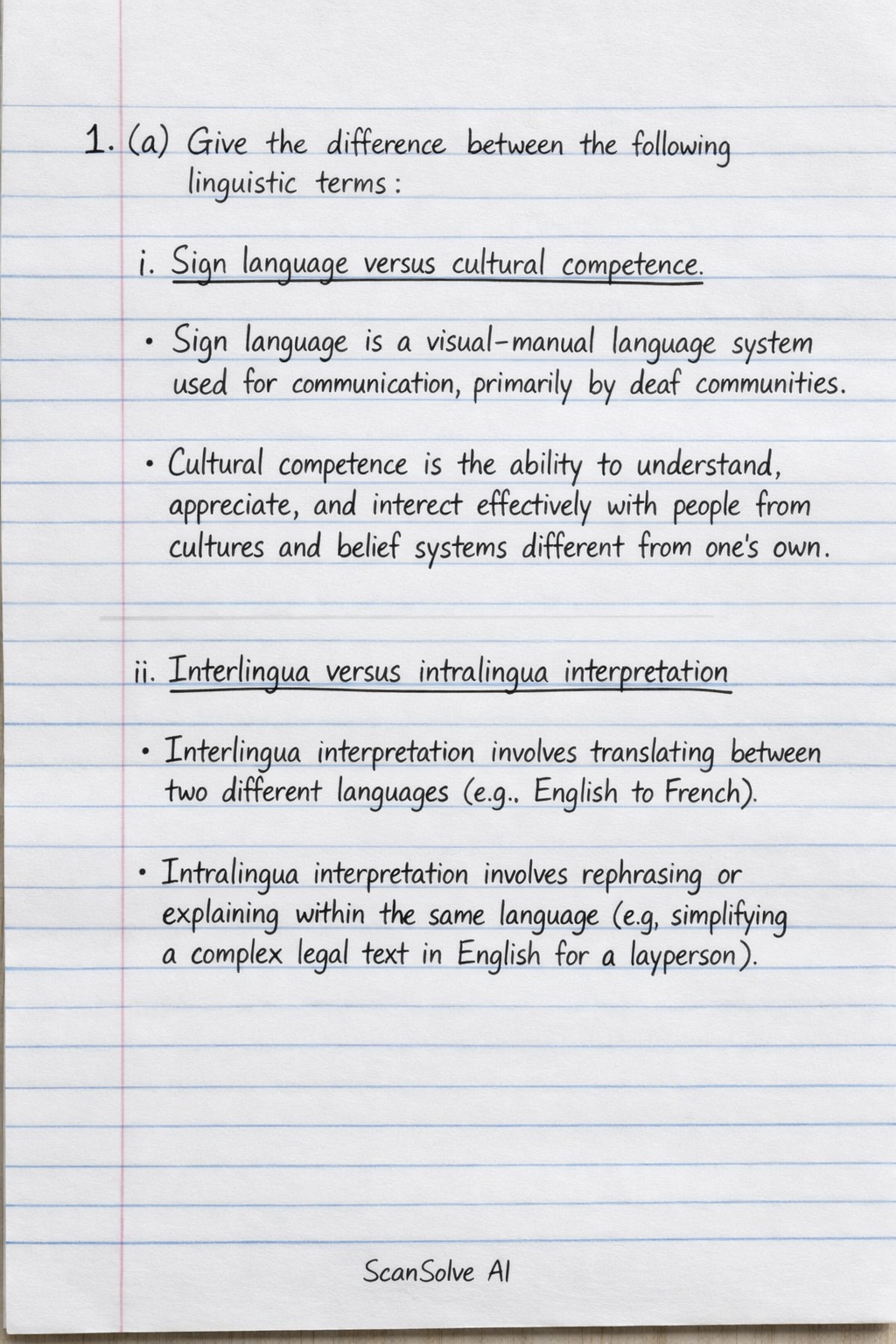
1. (a) Give the difference between the following linguistic terms:

  • i. Sign language versus cultural competence

    • Sign language is a visual-manual language system used for communication, primarily by deaf communities.
    • Cultural competence is the ability to understand, appreciate, and interact effectively with people from cultures and belief systems different from one's own.
  • ii. Interlingua versus intralingua interpretation

    • Interlingua interpretation involves translating between two different languages (e.g., English to French).
    • Intralingua interpretation involves rephrasing or explaining within the same language (e.g., simplifying a complex legal text in English for a layperson).
  • iii. Cognitive load versus interpretive theory of translation

    • Cognitive load refers to the total amount of mental effort being used in working memory during a task, such as processing information in translation.
    • Interpretive theory of translation (or Seleskovitch's theory) posits that translation involves understanding the meaning of the source text, de-verbalizing it, and then re-expressing that meaning in the target language, rather than focusing on linguistic forms.
  • iv. Editing and proofreading

    • Editing involves reviewing content for overall clarity, coherence, style, tone, and accuracy, often making significant structural or content changes.
    • Proofreading is the final stage of review, focusing on surface-level errors such as typos, grammatical mistakes, punctuation errors, and formatting issues.
  • v. Turn-taking versus interview

    • Turn-taking is a fundamental aspect of conversation where participants alternate speaking, following implicit rules.
    • An interview is a structured conversation with a specific purpose, where one person (interviewer) asks questions and another (interviewee) provides answers.

1. (b) Add approximate prefixes to the words in the brackets to make the given statement meaningful.

  • i. The police managed to disarm the bandits.
  • ii. Taking these drugs could seriously endanger your life.
  • iii. I do not know the answers. Therefore I left many questions unanswered.
  • iv. The email could not be delivered. Therefore I resent it.
  • v. It is time to empower the youth with effective life skills.

1. (c) With examples mention qualities or characteristics of the derivational morpheme.

Derivational morphemes are affixes that change the meaning or grammatical category of a word.

  • Qualities/Characteristics:

    • They can change the part of speech of a word. For example, adding -ness to the adjective happy creates the noun happiness.
    • They can change the meaning of a word. For example, adding un- to happy creates unhappy, which means the opposite.
    • They are not required by syntactic rules; their use is optional to create new words.
    • They are generally less productive than inflectional morphemes, meaning they don't apply to all words of a certain type.
    • They typically appear before inflectional morphemes in a word (e.g., govern-ment-s).
  • Examples:

    • happy (adjective) →\rightarrow→ unhappy (adjective, changed meaning)
    • teach (verb) →\rightarrow→ teacher (noun, changed part of speech)
    • modern (adjective) →\rightarrow→ modernize (verb, changed part of speech)

2. (a) Identify the initial sound of the word and show the active and passive articulatory organs used in production of the following sound.

  • i. Meeting

    • Initial sound: /m/ (voiced bilabial nasal)
    • Active articulator: Lower lip
    • Passive articulator: Upper lip
  • ii. Teacher

    • Initial sound: /tʃ/ (voiceless palato-alveolar affricate)
    • Active articulator: Blade of the tongue
    • Passive articulator: Alveolar ridge and hard palate
  • iii. Go

    • Initial sound: /g/ (voiced velar plosive)
    • Active articulator: Back of the tongue
    • Passive articulator: Soft palate (velum)
  • iv. Think

    • Initial sound: /θ/ (voiceless dental fricative)
    • Active articulator: Tip of the tongue
    • Passive articulator: Upper teeth
  • v. Knife

    • Initial sound: /n/ (voiced alveolar nasal)
    • Active articulator: Tip/blade of the tongue
    • Passive articulator: Alveolar ridge

Need help with your own homework?

Get instant step-by-step solutions to any question. Free to start.

Ask Your Question
Handwritten step-by-step solution

Handwritten Step-by-Step Solution

Get this solution as a handwritten image on WhatsApp — just like a tutor wrote it for you.

Try on WhatsApp

More English Questions

9. With the aid of "The Concubine" by Elechi Amadi, here are five ideas communicated in the novel an…Your poem must only have 3 stanzas**.A noun is a word that names a person, place, thing, or idea. For example, teacher, city, book, and h…1. (a) Seven literary forms used in the writing of the Bible are:I snaped and send a reading passage with multiple Choice questions and you didn't solve it . Why ?The question is incomplete. Please provide the full question or the rest of the sentence for "Bhola…
See all Englishquestions →