

This languages problem is solved step by step below, with detailed explanations to help you understand the method and arrive at the correct answer.
ScanSolve AI Answer
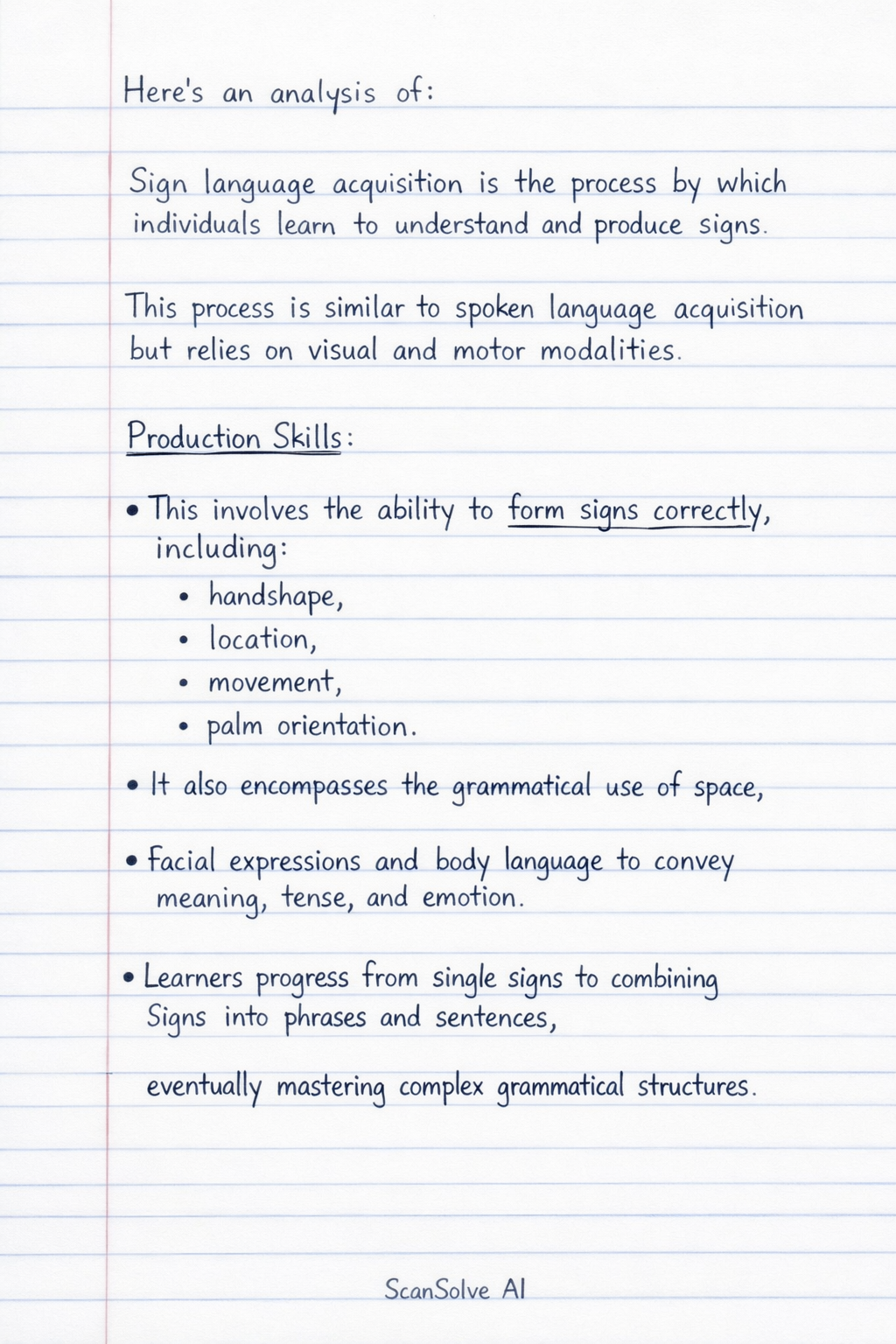
a) Discuss the process of sign language acquisition, focusing on production and reception skills. Sign language acquisition is the process by which individuals learn to understand and produce signs. This process is similar to spoken language acquisition but relies on visual and motor modalities. Production Skills: This involves the ability to form signs correctly, including handshape, location, movement, and palm orientation. It also encompasses the grammatical use of space, facial expressions, and body language* to convey meaning, tense, and emotion. Learners progress from single signs to combining signs into phrases and sentences, eventually mastering complex grammatical structures. Reception Skills: This involves the ability to perceive and understand signs produced by others. It requires keen visual attention to hand movements, facial expressions, and body posture. Learners develop the ability to decode rapid signing, distinguish subtle differences in signs, and comprehend the overall message* within its linguistic and cultural context. Early stages involve recognizing individual signs, progressing to understanding signed conversations and narratives. b) What four strategies can interpreters use to improve their practical interpreting competence. 1. Continuous professional development through workshops and courses. 2. Regular practice with diverse speakers and topics. 3. Seeking feedback from peers and mentors. 4. Specializing in specific domains (e.g., medical, legal). c) Explain the relationship between the five language skills (reading, writing, speaking, listening, and thinking) and how they relate to learners with hearing impairment. The five language skills are interconnected and crucial for communication and learning. For learners with hearing impairment, these skills are often developed through visual and tactile means, primarily via sign language. Reading: Learners with hearing impairment may access reading through visual phonics or by connecting written words to signs*. They might develop strong visual literacy. Writing: Writing allows expression and is often developed by translating signed thoughts into written language*. It can be a primary mode of communication. Speaking: For many, speaking is replaced or supplemented by signing*. Some may use spoken language with assistive devices, but sign language is their natural "spoken" form. Listening: Listening is primarily replaced by watching or visual reception* of sign language. They "listen" with their eyes, processing visual cues. Thinking: Thinking processes are developed through their primary language, which is often sign language*. Sign language provides the framework for cognitive development and abstract thought, just as spoken language does for hearing individuals. d) As a teacher interpreter, how would you maintain professionalism in an inclusive educational setting. 1. Maintain confidentiality: Ensure all student and classroom information remains private. 2. Adhere to ethical codes: Follow professional interpreting guidelines, including impartiality and accuracy. 3. Continuously improve skills: Stay updated on sign language developments and educational best practices. 4. Collaborate respectfully: Work effectively with teachers, parents, and other professionals to support the student. e) Using examples, explain four consequences of unethical interpreting practices. 1. Miscommunication and misunderstanding: If an interpreter omits crucial information or misrepresents a message, it can lead to serious errors. For example, a medical interpreter failing to accurately convey a patient's symptoms could result in incorrect diagnosis and treatment. 2. Loss of trust: Unethical behavior, such as breaching confidentiality or showing bias, erodes trust between the interpreter, the deaf individual, and other parties. For instance, an interpreter sharing personal information about a deaf client with others would destroy the client's trust. 3. Legal repercussions: Interpreters can face legal action for negligence, misrepresentation, or violating privacy laws. An interpreter providing legal advice instead of interpreting, leading to a client making a poor decision, could face a lawsuit. 4. Harm to the deaf individual: Ultimately, unethical practices can directly harm the deaf person's well-being, rights, or opportunities. An interpreter failing to advocate for appropriate access or misrepresenting a deaf student's abilities could hinder their educational progress.