
We read your photo as:
What is a vowel chart and how does it represent vowel sounds using tongue height and frontness/backness?
Languages
ScanSolve AI Answer
Answer
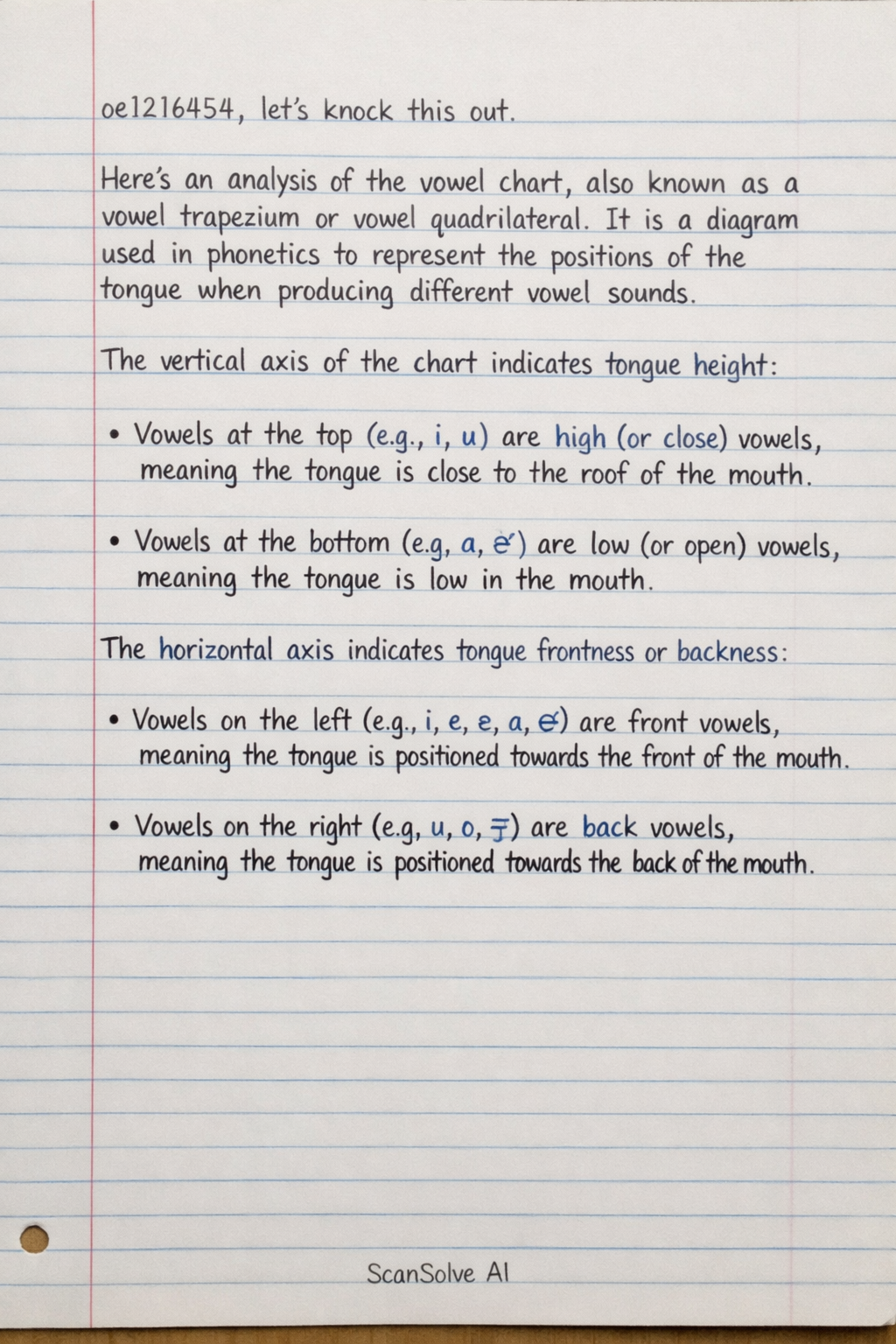
This image displays a vowel chart, also known as a vowel trapezium or vowel quadrilateral. It is a diagram used in phonetics to represent the positions of the tongue when producing different vowel sounds.
- The vertical axis of the chart indicates tongue height:
- Vowels at the top (e.g., , ) are high (or close) vowels, meaning the tongue is close to the roof of the mouth.
- Vowels at the bottom (e.g., , ) are low (or open) vowels, meaning the tongue is low in the mouth.
- The horizontal axis indicates tongue frontness or backness:
- Vowels on the left (e.g., , , , , ) are front vowels, meaning the tongue is positioned towards the front of the mouth.
- Vowels on the right (e.g., , , ) are back vowels, meaning the tongue is positioned towards the back of the mouth.
The symbols shown (e.g., , , , , , , , , , ) are from the International Phonetic Alphabet (IPA), each representing a distinct vowel sound. The other written words like "mfini mfini", "Anim", and "Akiji anakukuruma" appear to be additional notes or labels, possibly in another language, related to the chart's dimensions or examples.
Was this helpful?
Still stuck on this one?
Ask a follow-up, and the answer starts from this question.
Got a different question?Ask your own question
More Languages Questions
QIdentify the pictures and write the words for them using the given vowels.QCan you label the parts of the vocal tract on this diagram?QThe following words start with vowel letters. Complete the words and read.QDescribe the phonetic characteristics (voicing, place of articulation, manner of articulation) of…
Handwritten Step-by-Step Solution
Get this as a handwritten image on WhatsApp — like a tutor wrote it for you.
Try on WhatsApp