
We read your photo as:
Answer these questions In Setswana only
ScanSolve AI Answer
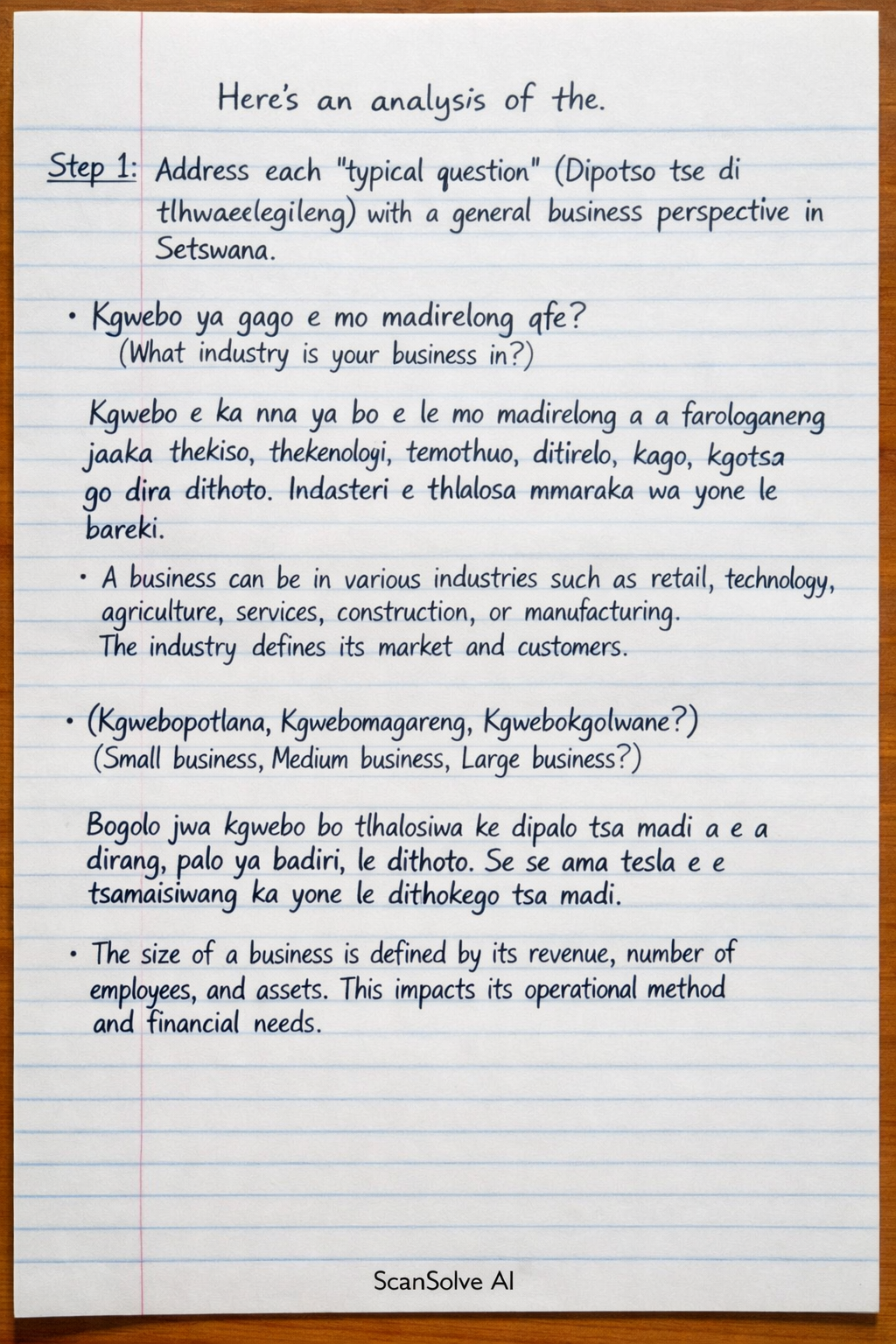
Step 1: Address each "typical question" (Dipotso tse di tlhwaelegileng) with a general business perspective in Setswana.
-
Kgwebo ya gago e mo madirelong afe? (What industry is your business in?) Kgwebo e ka nna ya bo e le mo madirelong a a farologaneng jaaka thekiso, thekenoloji, temothuo, ditirelo, kago, kgotsa go dira dithoto. Indasteri e tlhalosa mmaraka wa yone le bareki. A business can be in various industries such as retail, technology, agriculture, services, construction, or manufacturing. The industry defines its market and customers.
-
(Kgwebopotlana, Kgwebomagareng, Kgwebokgolwane)? (Small business, Medium business, Large business?) Bogolo jwa kgwebo bo tlhalosiwa ke dipalo tsa madi a e a dirang, palo ya badiri, le dithoto. Se se ama tsela e e tsamaisiwang ka yone le ditlhokego tsa madi. The size of a business is defined by its revenue, number of employees, and assets. This impacts its operational method and financial needs.
-
A o tlhoka madia le mantsi go simolola kgwebo e? (Do you need money and resources to start this business?) Ee, go simolola kgwebo go tlhoka madi (capital) a go simolola, ditshenyegelo tsa letsatsi le letsatsi, le didirisiwa jaaka didirisiwa, didirisiwa tse di tala, le batho. Yes, starting a business requires capital for initial investments, daily expenses, and resources such as equipment, raw materials, and human resources.
-
A o na le bagwebimmogo? (Do you have competitors?) Bontsi jwa dikgwebo bo na le bagwebimmogo. Go ba lemoga le go ba tlhaloganya go botlhokwa go aga leano la go gaisana le go bona pharologanyo. Most businesses have competitors. Identifying and understanding them is crucial for building a competitive strategy and finding differentiation.
-
Ke bokgoni bofe bo o bo tlhokang go tsamaisa kgwebo e? (What skills do you need to run this business?) Go tsamaisa kgwebo go tlhoka bokgoni jo bo farologaneng, jaaka go laola madi, go bapatsa, boeteledipele, go rarabolola mathata, tirelo ya bareki, le kitso e e kgethegileng ya indasteri. Running a business requires diverse skills, such as financial management, marketing, leadership, problem-solving, customer service, and industry-specific knowledge.
-
A o dira madia le mantsi mo kgwebong kgotsa mo tirong? (Do you make money and resources in the business or in the work?) Kgwebo e e atlegileng e dira madi le didirisiwa ka ditiro tsa yone (go rekisa dithoto kgotsa ditirelo) go fedisa ditshenyegelo le go dira poelo. A successful business generates money and resources through its operations (selling goods or services) to cover expenses and make a profit.
-
Ke kgwebo ya mofuta mang e? (What type of business is it?) Dikgwebo di ka kgaoganngwa ka popego ya tsona ya semolao (jaaka mongwefela, kopano, khampani) le ka tiro ya tsona e kgolo (jaaka thekiso, tirelo, kago, kgotsa go dira dithoto). Businesses can be classified by their legal structure (e.g., sole proprietorship, partnership, company) and their main activity (e.g., retail, service, construction, or manufacturing).
-
A melao ya tlhaolele e dirile go go nne le bothata go dira kgwebo e mo nakong e e fetileng? (Did discriminatory laws make it difficult for you to do business in the past?) Go ya ka hisitori, dikgwebo di le dintsi, segolobogolo tse di nang le batho ba ba kgetholotsweng, di ne di lebana le dikgwetlho tse dikgolo ka ntlha ya melao le maano a kgethololo. Historically, many businesses, especially those owned by marginalized groups, faced significant challenges due to discriminatory laws and policies.
-
Melao eo, e na le tlhotlheletso e e kae mo dikgwebong tsa gompieno? (How much influence do those laws have on businesses today?) Le fa melao e mentsi ya kgethololo e fedisitswe, ditlamorago tsa yone di sa ntse di ka ama tikologo ya kgwebo ya gompieno ka go sa lekalekane ga tsamaiso, go bona madi, ditšhono tsa mmaraka, le mekgwa ya go nna le dithoto. While many discriminatory laws have been repealed, their legacy can still influence contemporary business environments through systemic inequalities, access to capital, market opportunities, and ownership patterns.
Still stuck on this one?
Ask a follow-up, and the answer starts from this question.
More Languages Questions
Handwritten Step-by-Step Solution
Get this as a handwritten image on WhatsApp — like a tutor wrote it for you.
Try on WhatsApp