

This languages problem is solved step by step below, with detailed explanations to help you understand the method and arrive at the correct answer.
ScanSolve AI Answer
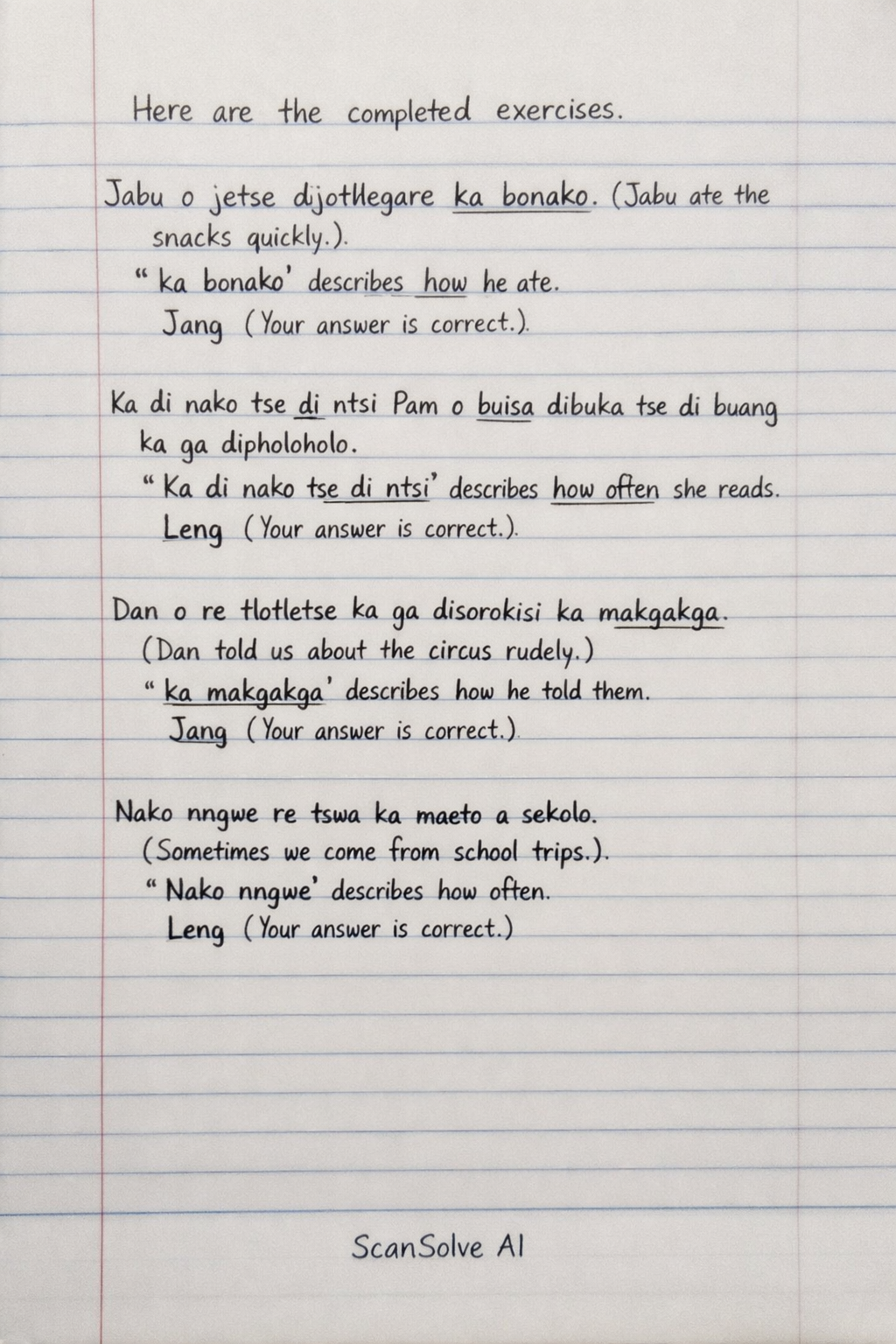
Here are the completed exercises. Step 1: Complete the table by identifying if the underlined word describes how often/long (leng), where (kao), or how (jang). Jabu o jetse dijotlhegare ka bonako. (Jabu ate the snacks quickly.) "ka bonako" describes how* he ate. Jang (Your answer is correct.) Ka di nako tse di ntsi Pam o buisa dibuka tse di buang ka ga dipholoholo. (Often Pam reads books about animals.) "Ka di nako tse di ntsi" describes how often* she reads. Leng (Your answer is correct.) Dan o re tlotletse ka ga disorokisi ka makgakga. (Dan told us about the circus rudely.) "ka makgakga" describes how* he told them. Jang (Your answer is correct.) Nako nngwe re tswa ka maeto a sekolo. (Sometimes we come from school trips.) "Nako nngwe" describes how often*. Leng (Your answer is correct.) Rametlae o ne a bina ka boitumelo kwa disorokising. (The clown danced happily at the circus.) "ka boitumelo" describes how* he danced. Jang (Your answer is correct.) Morago ga disorokisi, bana ba ne ba boela kwa sekolong ka iketlo. (After the circus, the children returned to school slowly.) "ka iketlo" describes how* they returned. Jang (Your answer is correct.) Step 2: Select the correct word for each sentence. Ke rata go itshwara mo nokeng/nôkeng. The correct word is nôkeng (meaning "at the waist/hip"). "Nokeng" means "at the river". Ke rata go itshwara mo nôkeng. Mmaagwe o mo lemile/lêmile ka go mo fa madi a mantsi. The correct word is lêmile (meaning "spoiled/pampered"). "Lemile" means "plowed". Mmaagwe o mo lêmile ka go mo fa madi a mantsi. (Your answer is correct.) Maši a gagwe a tlaa rêmarema. The correct word is rema (meaning "to curdle/spoil"). "Rêma" means "to chop". Maši a gagwe a tlaa rema. (Your answer is correct.) Rre Sebate o boka/bôka kgosi. The correct word is boka (meaning "to praise"). "Bôka" means "to be rotten". Rre Sebate o boka kgosi. (Your answer is correct.) Diaparo tsa bona di tlaa oma/ôma ka moso. The correct word is oma (meaning "to dry"). "Ôma" means "to be numb". Diaparo tsa bona di tlaa oma ka moso. (Your answer is correct.) Boka/bôka ntsi ke eo e wela mo dijong. The correct word is Bôka (meaning "maggot"). "Boka" is the imperative "Praise!". Bôka ntsi ke eo e wela mo dijong. Mosadimogolo o itshwere noka/nôka. The correct word is nôka (meaning "waist/hip"). "Noka" means "river". Mosadimogolo o itshwere nôka.