
We read your photo as:
Complete the following sentences correctly/specifically: Bana ba kena sekolo se phahameng. Bana ba tsamaile ka bongata ho ya serapeng sa diphoofolo. Ba phehisana le bona. O ape
ScanSolve AI Answer
Step-by-step solution
5 stepsUnderstand the instruction.
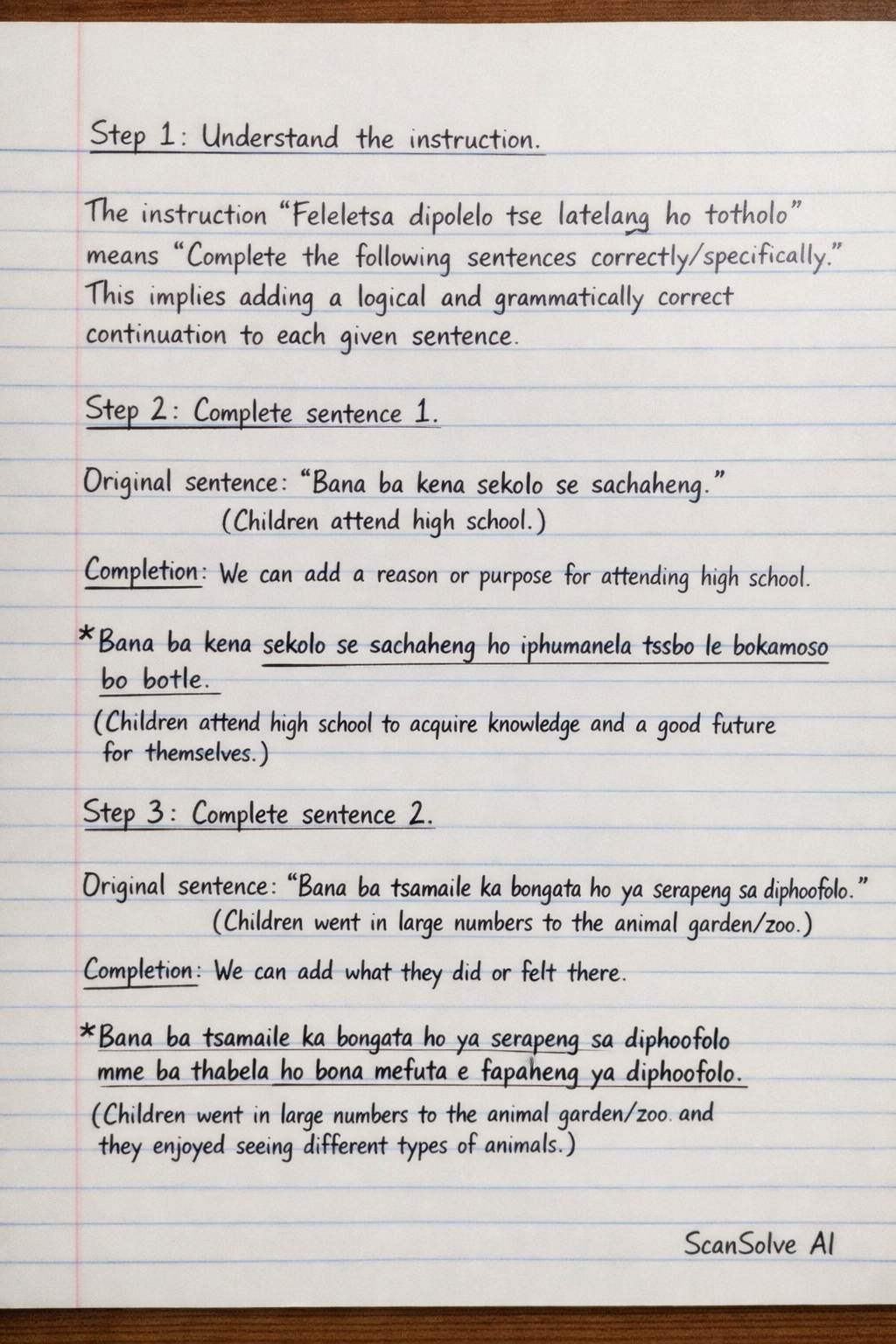
The instruction "Feleletsa dipolelo tse latelang ho totholo" means "Complete the following sentences correctly/specifically." This implies adding a logical and grammatically correct continuation to each given sentence.
Complete sentence 1.
Original sentence: "Bana ba kena sekolo se phahameng." (Children attend high school.)
Completion: We can add a reason or purpose for attending high school.
Bana ba kena sekolo se phahameng ho iphumanela tsebo le bokamoso bo botle.
(Children attend high school to acquire knowledge and a good future for themselves.)Complete sentence 2.
Original sentence: "Bana ba tsamaile ka bongata ho ya serapeng sa diphoofolo." (Children went in large numbers to the animal garden/zoo.)
Completion: We can add what they did or felt there.
Bana ba tsamaile ka bongata ho ya serapeng sa diphoofolo mme ba thabela ho bona mefuta e fapaneng ya diphoofolo.
(Children went in large numbers to the animal garden/zoo and they enjoyed seeing different types of animals.)Complete sentence 3.
Original sentence: "Ba phehisana le bona." (They are arguing with them.)
Completion: We can add the reason for the argument.
Ba phehisana le bona ka lebaka la ho se utlwane ka taba e itseng.
(They are arguing with them because of disagreement on a certain matter.)Complete sentence 4.
Original sentence: "O apere diapano tse futhumetseng tsa mme." (She is wearing warm clothes of mother.)
Completion: We can add the reason for wearing warm clothes.
O apere diapano tse futhumetseng tsa mme hobane maemo a lehodimo a bata haholo.
(She is wearing warm clothes of mother because the weather conditions are very cold.)Here are the completed sentences:
- Bana ba kena sekolo se phahameng ho iphumanela tsebo le bokamoso bo botle.
- Bana ba tsamaile ka bongata ho ya serapeng sa diphoofolo mme ba thabela ho bona mefuta e fapaneng ya diphoofolo.
- Ba phehisana le bona ka lebaka la ho se utlwane ka taba e itseng.
- O apere diapano tse futhumetseng tsa mme hobane maemo a lehodimo a bata haholo.
Still stuck on this one?
Ask a follow-up, and the answer starts from this question.
More Languages Questions
Handwritten Step-by-Step Solution
Get this as a handwritten image on WhatsApp — like a tutor wrote it for you.
Try on WhatsApp