
CONTINUOUS ASSESSMENT QUESTIONS (CA) Question 1 A Nigerian company purchased machinery worth 8,000 from a foreign supplier on credit on 1st April 2025 when the exchange rate was ₦1,250/. At 31st December 2025, the exchange rate was ₦1,320/. The company finally settled the debt on 31st January 2026 when the exchange rate was ₦1,350/. Required: a. Explain the concept of foreign currency transactions under IAS 21. b. Prepare the necessary journal entries to record: The initial transaction The year-end adjustment The final settlement of the debt --- Question 2 XYZ Plc, a Nigerian parent company, has a foreign subsidiary in the United Kingdom. The subsidiary provided the following balances as at 31st December 2025: Assets: £25,000 Liabilities: £10,000 Share Capital: £8,000 (issued when exchange rate was ₦950/£) Revenue: £15,000 Expenses: £6,000 The following exchange rates are available: Closing rate: ₦1,300/£ Average rate: ₦1,200/£ Required: a. Translate the financial statements of the subsidiary into naira. b. Calculate the foreign currency translation reserve. c. State the accounting treatment of the translation difference in accordance with IAS 21.
ScanSolve AI Answer
Step-by-step solution
6 stepsQuestion 1
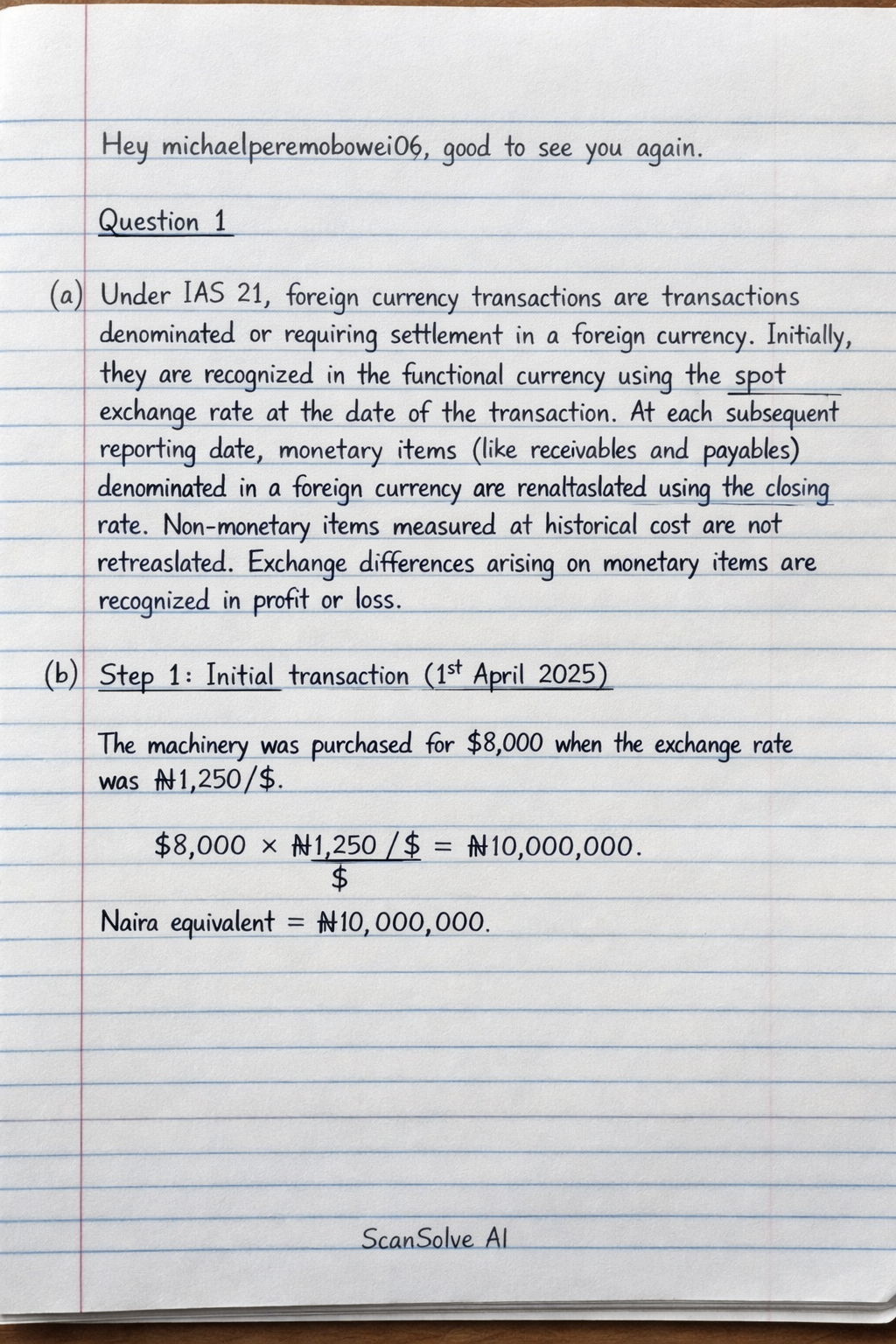
a) Under IAS 21, foreign currency transactions are transactions denominated or requiring settlement in a foreign currency. Initially, they are recognized in the functional currency using the spot exchange rate at the date of the transaction. At each subsequent reporting date, monetary items (like receivables and payables) denominated in a foreign currency are retranslated using the closing rate. Non-monetary items measured at historical cost are not retranslated. Exchange differences arising on monetary items are recognized in profit or loss.
b)
Initial transaction (1st April 2025)
The machinery was purchased for .
The Naira equivalent is = ₦10,000,000.Year-end adjustment (31st December 2025)
The debt of 8,000 is revalued at the closing rate of ₦1,320/8,000 \times ₦1,320/$ = ₦10,560,000.
Exchange loss = ₦10,560,000 - ₦10,000,000 = ₦560,000.Final settlement of the debt (31st January 2026)
The debt of 8,000 is settled at the rate of ₦1,350/8,000 \times ₦1,350/$ = ₦10,800,000.
Carrying amount of debt before settlement = ₦10,000,000 (initial) + ₦560,000 (loss) = ₦10,560,000.
Additional exchange loss = ₦10,800,000 - ₦10,560,000 = ₦240,000.Question 2
a)
Translate the financial statements of the subsidiary into Naira.
- Assets: Translated at the closing rate (₦1,300/£).
- Liabilities: Translated at the closing rate (₦1,300/£).
- Share Capital: Translated at the historical rate (₦950/£).
- Revenue: Translated at the average rate (₦1,200/£).
- Expenses: Translated at the average rate (₦1,200/£).
- Net Profit:
b)
Calculate the foreign currency translation reserve (FCTR).
The FCTR is the balancing figure in the translated balance sheet.
Assets = Liabilities + Share Capital + Retained Earnings (Net Profit) + FCTRc)
State the accounting treatment of the translation difference.
In accordance with IAS 21, translation differences arising from the translation of the financial statements of a foreign operation (like a subsidiary) are recognized in other comprehensive income (OCI). These differences are accumulated in a separate component of equity called the foreign currency translation reserve (FCTR). They are subsequently reclassified to profit or loss only upon the disposal or partial disposal of the foreign operation.
Still stuck on this one?
Ask a follow-up, and the answer starts from this question.
More Languages Questions
Handwritten Step-by-Step Solution
Get this as a handwritten image on WhatsApp — like a tutor wrote it for you.
Try on WhatsApp