

This mathematics problem involves applying core mathematical principles and formulas. Below you will find a complete step-by-step solution with detailed explanations for each step, helping you understand not just the answer but the method behind it.
ScanSolve AI Answer
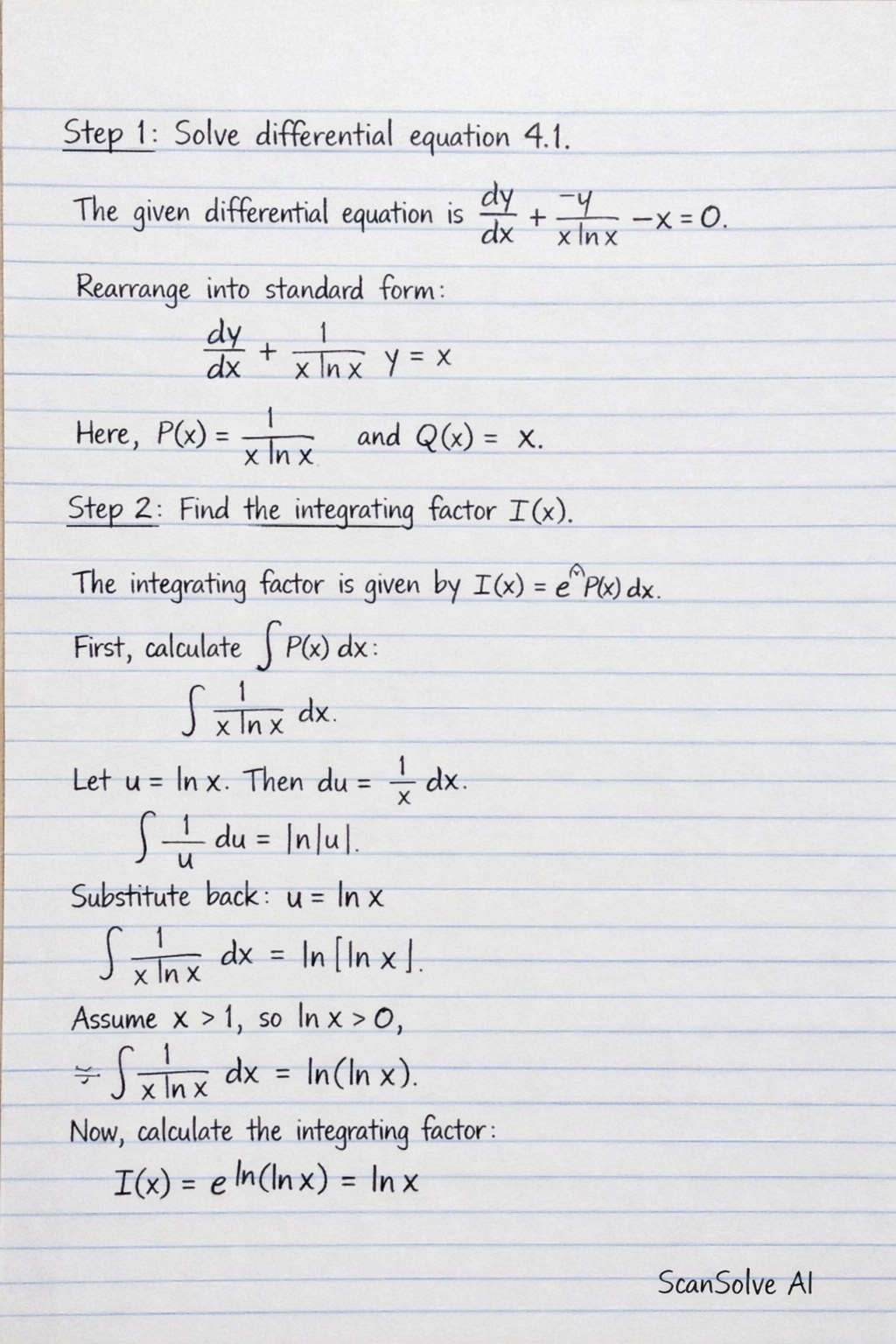
Step 1: Solve differential equation 4.1. The given differential equation is (dy)/(dx) + (y)/(x x) - x = 0. Rearrange it into the standard form of a first-order linear differential equation, (dy)/(dx) + P(x)y = Q(x): (dy)/(dx) + ((1)/(x x))y = x Here, P(x) = (1)/(x x) and Q(x) = x. Step 2: Find the integrating factor I(x). The integrating factor is given by I(x) = e^ P(x) dx. First, calculate P(x) dx: (1)/(x x) dx Let u = x. Then du = (1)/(x) dx. (1)/(u) du = |u| Substitute back u = x: (1)/(x x) dx = | x| Assuming x > 1 (so x > 0), we have ( x). Now, calculate the integrating factor: I(x) = e^( x) = x Step 3: Multiply the differential equation by the integrating factor and integrate. Multiply the standard form of the differential equation by I(x): ( x) (dy)/(dx) + ( x) ((1)/(x x))y = x ( x) ( x) (dy)/(dx) + (1)/(x)y = x x The left side is the derivative of the product y · I(x): (d)/(dx)(y x) = x x Integrate both sides with respect to x: y x = x x dx Use integration by parts for x x dx. Let u = x and dv = x dx. Then du = (1)/(x) dx and v = (x^2)/(2). x x dx = u v - v du = ( x)((x^2)/(2)) - (x^2)/(2) · (1)/(x) dx = (x^2)/(2) x - (x)/(2) dx = (x^2)/(2) x - (x^2)/(4) + C Substitute this back into the equation for y x: y x = (x^2)/(2) x - (x^2)/(4) + C Solve for y: y = (x^2)/(2) - (x^2)/(4 x) + (C)/( x) The general solution for 4.1 is: y = (x^2)/(2) - (x^2)/(4 x) + (C)/( x) Step 4: Solve differential equation 4.2. The given differential equation is (d^2y)/(dx^2) + 2(dy)/(dx) + 5y = 6x^2. This is a second-order linear non-homogeneous differential equation. The general solution is y = y_c + y_p, where y_c is the complementary solution and y_p is the particular solution. Step 5: Find the complementary solution (y_c). Consider the homogeneous equation: (d^2y)/(dx^2) + 2(dy)/(dx) + 5y = 0. The characteristic equation is r^2 + 2r + 5 = 0. Use the quadratic formula r = -b ± sqrt(b^2 - 4ac)2a: r = -2 ± sqrt(2^2 - 4(1)(5))2(1) = -2 ± sqrt(4 - 20)2 = -2 ± sqrt(-16)2 = (-2 ± 4i)/(2) r = -1 ± 2i The roots are complex conjugates of the form ± i, where = -1 and = 2. The complementary solution is: y_c = e^ x(C_1 ( x) + C_2 ( x)) = e^-x(C_1 (2x) + C_2 (2x)) Step 6: Find the particular solution (y_p). The non-homogeneous term is Q(x) = 6x^2. Since Q(x) is a polynomial of degree 2, we assume a particular solution of the form: y_p = Ax^2 + Bx + C Find the first and second derivatives of y_p: y_p' = 2Ax + B y_p'' = 2A Substitute y_p, $