
We read your photo as:
Discuss the two language teaching approaches as set out in the CAPS document.
Languages
ScanSolve AI Answer
Step-by-step solution
3 stepsQUESTION 1: LANGUAGE TEACHING APPROACHES
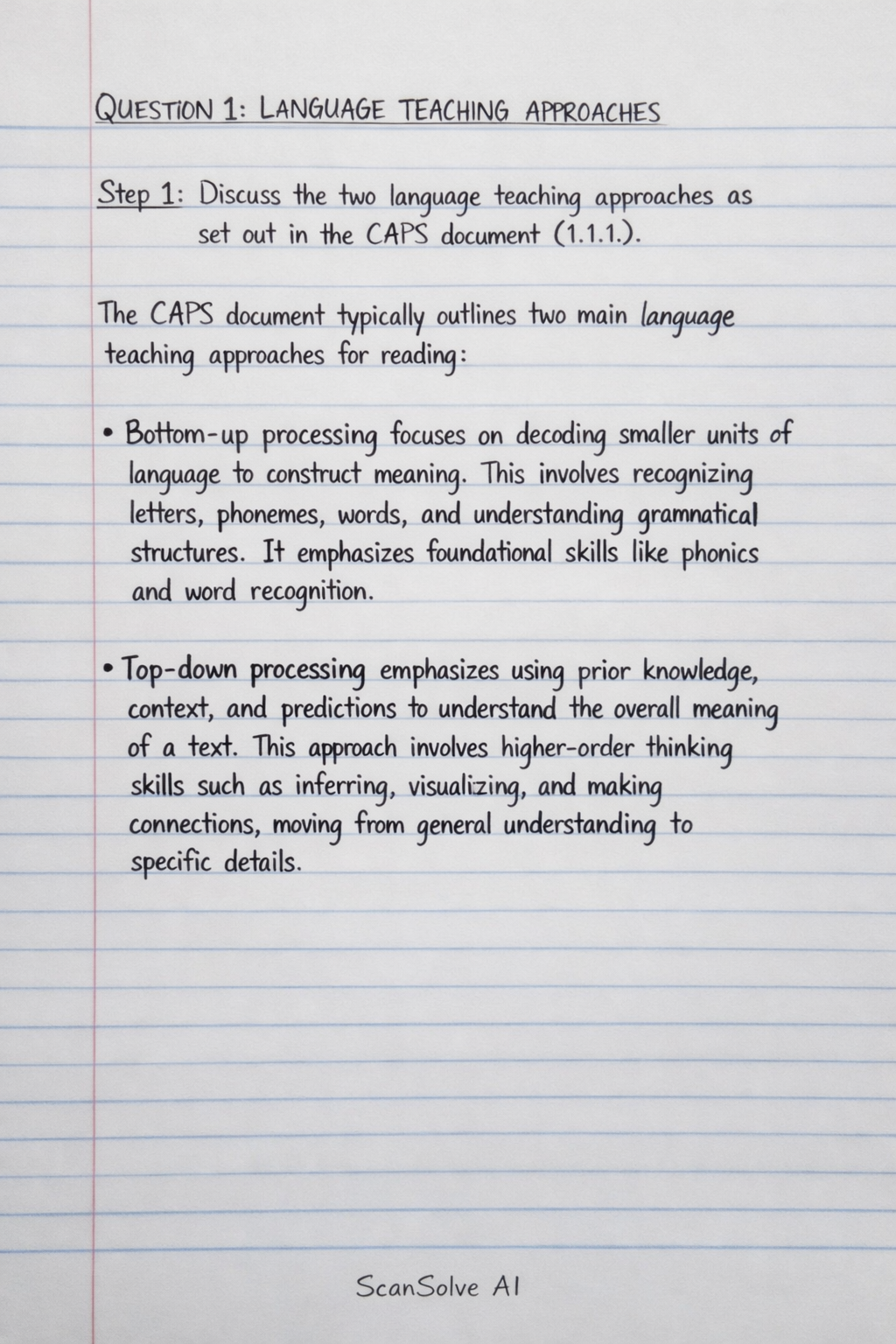
Discuss the two language teaching approaches as set out in the CAPS document (1.1.1).
The CAPS document typically outlines two main language teaching approaches for reading: bottom-up processing and top-down processing.
- Bottom-up processing focuses on decoding smaller units of language to construct meaning. This involves recognizing letters, phonemes, words, and understanding grammatical structures. It emphasizes foundational skills like phonics and word recognition.
- Top-down processing emphasizes using prior knowledge, context, and predictions to understand the overall meaning of a text. This approach involves higher-order thinking skills such as inferring, visualizing, and making connections, moving from general understanding to specific details.
Discuss which teaching approach/es would be suitable for the content stipulated in the Grade 4 Term 2 2023/24 ATP and justify the response (1.1.2).
A balanced approach that integrates both bottom-up and top-down processing would be most suitable. The ATP content includes elements requiring both:
- Bottom-up elements: "Breaks up words into syllables to understand rhythm," "Identifies rhythm and rhyme."
- Top-down elements: "Discusses main idea/s," "Skimming for main ideas," "Scanning for supporting details," "Making predictions," "Inferring the meaning of unfamiliar words and images," "Visualisation," "Making connections," "Inferences." A balanced approach ensures learners develop both the foundational skills to decode text and the comprehension strategies to understand its meaning deeply.
Explain how you would use the selected approach/es when teaching the content as stipulated in the ATP above (1.1.3).
To implement a balanced approach:
- For bottom-up skills, when teaching "breaking words into syllables" or "identifying rhythm and rhyme," I would use explicit phonics instruction, word segmentation activities, and rhyming exercises. During "read aloud" or "shared reading," I would model how to sound out words and recognize word patterns.
- For top-down skills, when teaching "discusses main idea/s," "making predictions," or "inferring," I would activate prior knowledge before reading, encourage learners to predict content from titles and illustrations, and guide them to identify main ideas and supporting details. During "group guided reading," I would prompt learners to visualize, make connections to their experiences, and infer meanings using context clues.
- The "reading methodologies" like "group guided/shared/paired/independent reading" would be used to integrate both. For example, in guided reading, I would support learners in decoding challenging words (bottom-up) while simultaneously facilitating discussions about the text's meaning and themes (top-down).
Was this helpful?
Still stuck on this one?
Ask a follow-up, and the answer starts from this question.
Got a different question?Ask your own question
More Languages Questions
QWhat is the CAPS document and what is its purpose in South African education?QIdentify the correct option for each of the following multiple-choice questions regarding English…QContrast learner-centred and constructivist approaches to education.QAre the examples and tasks in this lesson appropriate for the developmental level of grade 3…QDiscuss details on the types of computer assisted instructions in teaching methods
Handwritten Step-by-Step Solution
Get this as a handwritten image on WhatsApp — like a tutor wrote it for you.
Try on WhatsApp