
English please not french
ScanSolve AI Answer
Answer
4
Step-by-step solution
24 stepsHere are the solutions to the questions:
23. The value of x in the equation is
Add 3 to both sides of the equation.
Divide both sides by 2.
The correct option is C. 4.
24. The value of x in the equation is
Take the square root of both sides of the equation.
The correct option is D. .
25. The value of x in the equation is
Subtract $2x$ from both sides of the equation.
Add 5 to both sides of the equation.
The correct option is A. 8.
26. The value of x in the inequality is
Add 1 to both sides of the inequality.
Divide both sides by 2.
The correct option is B. .
27. The solution to the simultaneous equations: and is
Add the two equations together to eliminate .
Solve for .
Substitute the value of into the first equation ().
Solve for .
The solution is .
The correct option is A. .28. The value of x in the sequence is
Determine the common difference between consecutive terms.
This is an arithmetic sequence with a common difference .
Find the value of by adding the common difference to the preceding term.
The correct option is B. 7.
29. The 10th term of the sequence is
Identify the first term () and the common difference ().
The first term .
The common difference .Use the formula for the -th term of an arithmetic sequence, , with .
The correct option is C. 20.
30. The sum of the first 10 terms of the sequence is
Identify the first term (), the common difference (), and the number of terms ().
From question 29, , , and .
Use the formula for the sum of the first terms of an arithmetic sequence, .
The correct option is D. 110.
31. The common ratio of the sequence is
Calculate the ratio of any term to its preceding term.
The common ratio .
The correct option is A. 2.32. The 5th term of the sequence is
Identify the first term () and the common ratio ().
The first term .
From question 31, the common ratio .Use the formula for the -th term of a geometric sequence, , with .
The correct option is B. 32.
33. The sum to infinity of the sequence is
Identify the first term () and the common ratio ().
The first term .
The common ratio .Use the formula for the sum to infinity of a geometric sequence, , since .
The correct option is A. 2.
34. The value of x in the equation is
Convert the logarithmic equation to its equivalent exponential form.
The definition of logarithm states that is equivalent to .
Here, , , and .Calculate the value of .
The correct option is D. 8.
Try one yourself
A new problem that tests the same skill.
Still stuck on this one?
Ask a follow-up, and the answer starts from this question.
More Languages Questions
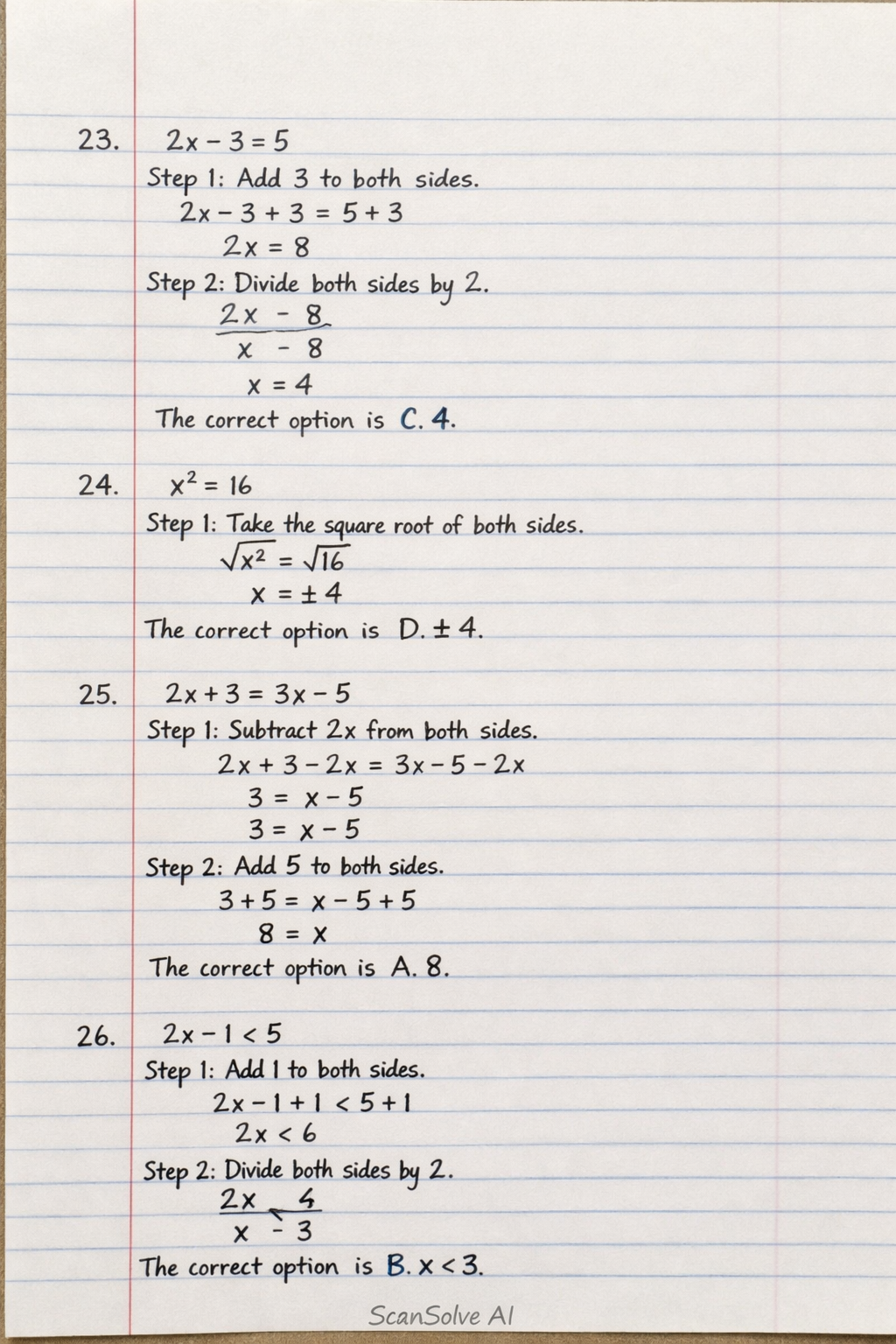
Handwritten Step-by-Step Solution
Get this as a handwritten image on WhatsApp — like a tutor wrote it for you.
Try on WhatsApp