
We read your photo as:
What are examples of Yoruba titles, expressions, religions, and proverbs?
ScanSolve AI Answer
Answer
Ìwé ìtàn
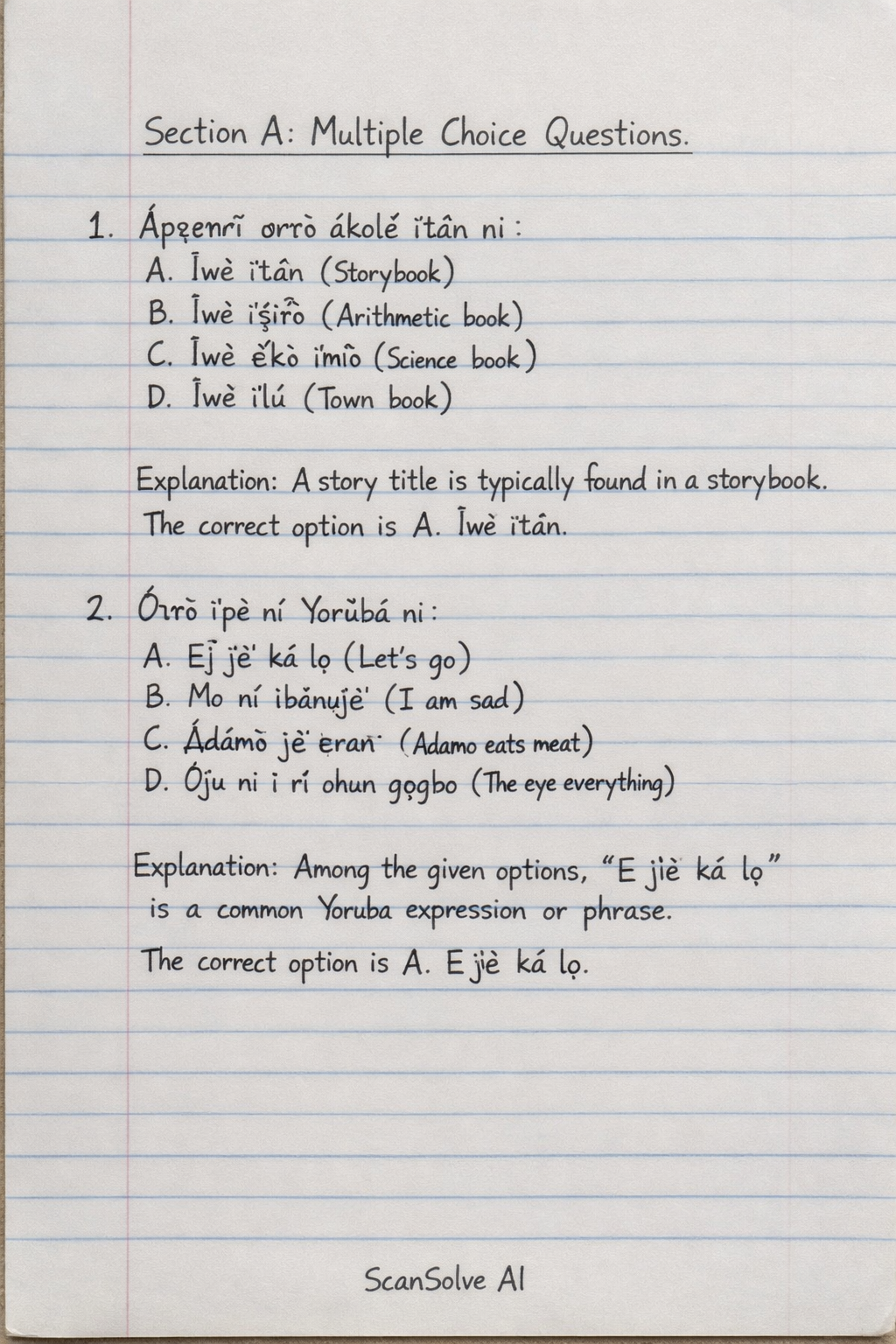
Section A: Multiple Choice Questions
-
Àpẹẹrẹ ọrọ àkọlé ìtàn ni (An example of a story title is)
- A. Ìwé ìtàn (Storybook)
- B. Ìwé ìṣírò (Arithmetic book)
- C. Ìwé ẹ̀kọ́ ìmọ̀ (Science book)
- D. Ìwé ìlú (Town book)
- Explanation: A story title is typically found in a storybook.
- The correct option is A. Ìwé ìtàn.
-
Ọrọ̀ ìpè ní Yorùbá ni (A word of expression/call in Yoruba is)
- A. Ẹ jẹ́ ká lọ (Let's go)
- B. Mo ní ìbànújẹ́ (I am sad)
- C. Àdàmọ̀ jẹ ẹran (Adamo eats meat)
- D. Ojú ni í rí ohun gbogbo (The eye sees everything)
- Explanation: Among the given options, "Ẹ jẹ́ ká lọ" is a common Yoruba expression or phrase.
- The correct option is A. Ẹ jẹ́ ká lọ.
-
Ẹ̀sìn tí ó pọ̀ jùlọ ní Yorùbá ni (The most common religion in Yorubaland is)
- A. Islam àti Kristiẹni (Islam and Christianity)
- B. Hindu
- C. Búddha (Buddhism)
- D. Judaism
- Explanation: Islam and Christianity are the two dominant religions practiced in Yorubaland.
- The correct option is A. Islam àti Kristiẹni.
-
Àpẹẹrẹ owe Yorùbá ni (An example of a Yoruba proverb is)
- A. Ọmọ tí a kò kọ́ ní ilé àkọ́kọ́ rẹ̀ (A child not taught in his first home)
- B. Table
- C. Chair
- D. Book
- Explanation: Option A is the beginning of a well-known Yoruba proverb: "Ọmọ tí a kò kọ́ ní ilé, yóò kọ́ ní oko" (A child not taught at home will be taught on the farm/in the world). The other options are English words for objects.
- The correct option is A. Ọmọ tí a kò kọ́ ní ilé àkọ́kọ́ rẹ̀.
-
Ìbáṣepọ̀ pẹ̀lú olùkọ́ ni (A greeting to a teacher is)
- A. Ẹ káàrọ̀ (Good morning)
- B. Ìwé l'ọ́mọ ọ̀yà (Book is a child of debt)
- C. Àdàmọ̀ jẹ ẹran (Adamo eats meat)
- D. Mo ní ìbànújẹ́ (I am sad)
- Explanation: "Ẹ káàrọ̀" is a standard Yoruba greeting for "Good morning".
- The correct option is A. Ẹ káàrọ̀.
-
Ìbáṣepọ̀ pẹ̀lú ọ̀rẹ́ ni (A greeting to a friend is)
- A. Ẹ kú ọjọ́ (Good day)
- B. Mo ní ìbànújẹ́ (I am sad)
- C. Àdàmọ̀ jẹ ẹran (Adamo eats meat)
- D. Ojú ni í rí ohun gbogbo (The eye sees everything)
- Explanation: "Ẹ kú ọjọ́" is a common and appropriate greeting for a friend, meaning "Good day".
- The correct option is A. Ẹ kú ọjọ́.
-
Ọrọ̀ ìbáṣepọ̀ tó yẹ ní òṣán ni (A suitable greeting word in the afternoon is)
- A. Ẹ káàsán (Good afternoon)
- B. Ẹ kú àlé (Good evening)
- C. Ẹ káàrọ̀ (Good morning)
- D. Mo ní ìbànújẹ́ (I am sad)
- Explanation: "Ẹ káàsán" is the Yoruba greeting for "Good afternoon".
- The correct option is A. Ẹ káàsán.
-
Ọrọ̀ ìbáṣepọ̀ tó yẹ ní alẹ́ ni (A suitable greeting word in the evening is)
- A. Ẹ kú alẹ́ (Good evening)
- B. Ẹ káàsán (Good afternoon)
- C. Ẹ káàrọ̀ (Good morning)
- D. Mo ní ìbànújẹ́ (I am sad)
- Explanation: "Ẹ kú alẹ́" is the Yoruba greeting for "Good evening".
- The correct option is A. Ẹ kú alẹ́.
-
Ọrọ̀ ìpinnu rere ni (A word of good decision is)
- A. Kó ẹ̀kọ́ rẹ (Learn your lesson)
- B. Mo ní ìbànújẹ́ (I am sad)
- C. Àdàmọ̀ jẹ ẹran (Adamo eats meat)
- D. Ojú ni í rí ohun gbogbo (The eye sees everything)
- Explanation: "Kó ẹ̀kọ́ rẹ" (Learn your lesson) is an advice that implies a good decision or outcome.
- The correct option is A. Kó ẹ̀kọ́ rẹ.
Try one yourself
A new problem that tests the same skill.
Still stuck on this one?
Ask a follow-up, and the answer starts from this question.
More Languages Questions
Handwritten Step-by-Step Solution
Get this as a handwritten image on WhatsApp — like a tutor wrote it for you.
Try on WhatsApp